
Use the operators from V–25, but perturb the rectangular comparison map:
The generator defect is \(\Delta=C_\eta A-BC_\eta\), with only one nonzero entry, \(\Delta_{13}=7\eta\) (matrix indices begin at one).
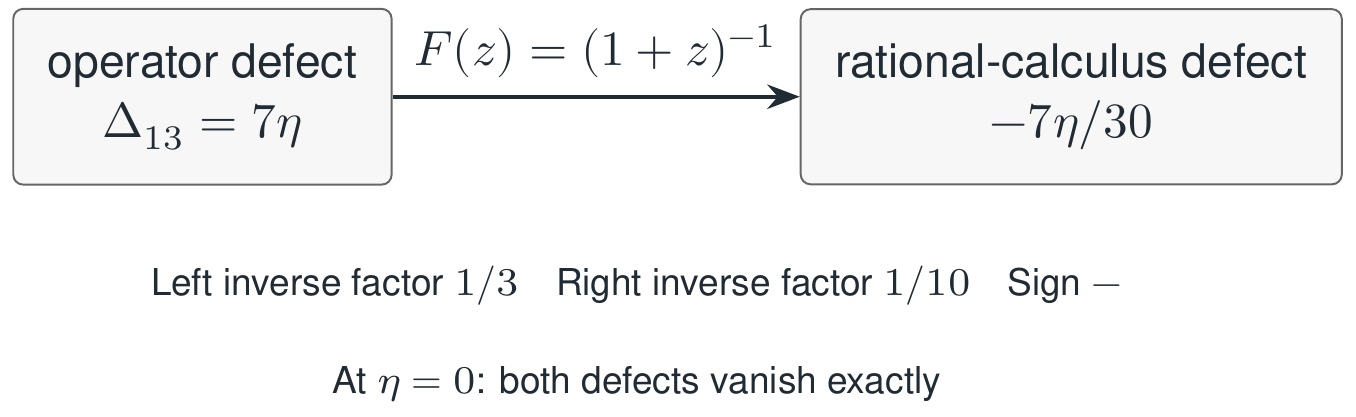
Reading the drawing
The arrow maps the displayed original defect to the rational-calculus defect. The notes below give the two inverse factors, the sign, and the zero-defect control. The plate compares this rectangular substitution with its core naturality result.
Drawing labels and data 5 labels
Read the original labels as selectable text. Tables preserve grid relationships; other short labels are grouped compactly.
operator defect
\(\Delta_{13}=7\eta\)
rational-calculus defect
\(-7\eta/30\)
- \(F(z)=(1+z)^{-1}\)
Left inverse factor \(1/3\) Right inverse factor \(1/10\) Sign \(-\)
- At \(\eta=0\): both defects vanish exactly
Evidence note from the source edition
The perturbation lets the discarded eigenvalue enter the comparison. Exact naturality holds at \(\eta=0\); a nonzero defect is transformed, not erased, by the rational calculus.
A resolvent identity supplies the sign and both inverse factors
For \(F(z)=1/(1+z)\), all required inverses exist, and
This follows by multiplying the difference by \(I+B\) on the left and \(I+A\) on the right. The middle numerator is \((I+B)C_\eta-C_\eta(I+A)=-\Delta\).
The retained Jordan block still contributes \(F'(2)=-1/9\), as on V–25. The new third-column discrepancy compares \(F(9)=1/10\) with \(F(2)=1/3\), multiplied by \(\eta\).
The general holomorphic defect formula integrates the corresponding resolvent defect under its contour and spectral assumptions. This rational example verifies an actual matrix inverse identity. It does not remove those analytic hypotheses or establish a calculus for arbitrary unbounded operators.
Read this as
Exact intertwining gives exact naturality. When intertwining fails, the functional calculus has a structured defect whose factors can be computed.