
Let three scalar packets form the directed chain \(0\to1\to2\), with transfer coefficients \(2\) and \(3\). The generator and its powers are
Therefore the exponential is the exact polynomial
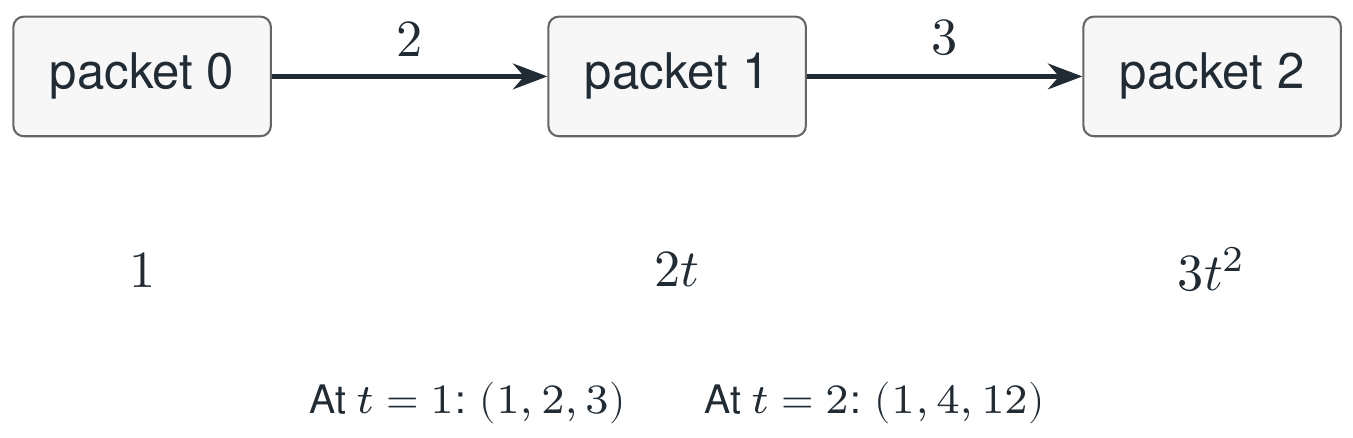
Reading the drawing
Two arrows lead from packet zero to packet one and then packet two, with their transfer weights written above. The time-dependent components are written below the packets, followed by two exact-time examples.
Drawing labels and data 9 labels
Read the original labels as selectable text. Tables preserve grid relationships; other short labels are grouped compactly.
- packet 0
- packet 1
- packet 2
- \(2\)
- \(3\)
- \(1\)
- \(2t\)
- \(3t^2\)
At \(t=1\): \((1,2,3)\) At \(t=2\): \((1,4,12)\)
Evidence note from the source edition
Only the empty path, one-edge paths, and the two-edge path exist. The coefficient \(3t^2\) includes both the edge product \(2\cdot3\) and the ordered-time simplex area \(t^2/2\).
Path length counts transfers, not elapsed time
Starting at \(e_0\), the complete state is \((1,2t,3t^2)^{\mathsf T}\). No fourth packet or repeated cycle can contribute. Direct differentiation gives \(x'(t)=Ax(t)\), including the relation \(x_2'(t)=3x_1(t)\).
If nonzero diagonal generators are added, a path acquires an integral of the within-packet evolutions between its transfer times. Acyclicity still bounds the number of transfers. It does not make the diagonal exponential factors polynomial in time.
This is a linear transfer example. The columns of \(A\) do not sum to zero; the total of the displayed state is \(1+2t+3t^2\). It is consequently not a Markov probability model. Positivity of off-diagonal coefficients alone does not imply conservation of probability.
Read this as
An acyclic packet graph terminates the transfer expansion. Nilpotence makes this particular full exponential polynomial; the two statements have different hypotheses.