
The kernel \(K(t)=te^{-2t}\) from V–23 has transform \(1/(z+2)^2\). It is realized by two auxiliary states:
With \(D={\begin{pmatrix}-2&1\\0&-2\end{pmatrix}}\), \(B=(1,0)\), and \(C=(0,1)^{\mathsf T}\), the feedback kernel is \(Be^{tD}C=te^{-2t}\).
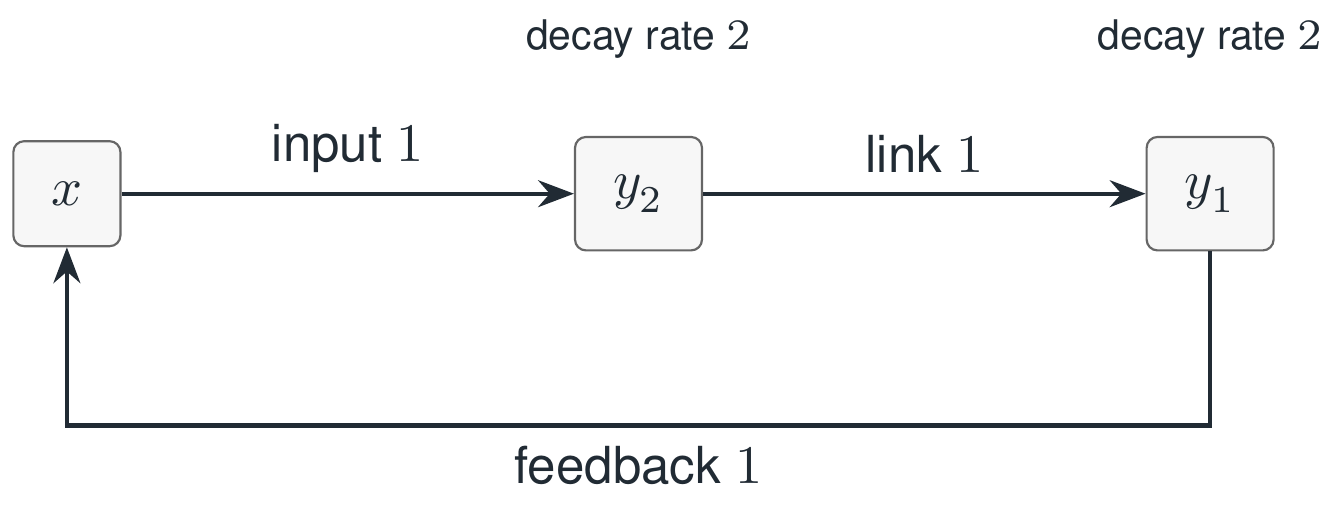
Reading the drawing
The top arrows pass the retained input through the two auxiliary states. The lower arrow feeds the second auxiliary output back to the retained state. The input, link, feedback, and decay-rate labels are all retained.
Drawing labels and data 8 labels
Read the original labels as selectable text. Tables preserve grid relationships; other short labels are grouped compactly.
- \(x\)
- \(y_2\)
- \(y_1\)
- input \(1\)
- link \(1\)
- feedback \(1\)
- decay rate \(2\)
- decay rate \(2\)
Evidence note from the source edition
An input first enters \(y_2\), transfers to \(y_1\), and then returns to \(x\). The two equal decay rates produce a repeated pole through the intervening link.
Elimination recovers the convolution, including its preparation
Variation of constants gives
so the retained equation is
The convolution-only version is exact for \(y(0)=0\). For a nonzero preparation, \(Be^{tD}y(0)=e^{-2t}(y_1(0)+t y_2(0))\) is an additional forcing.
The highest pole coefficient is nonzero in this example. A hidden Jordan block can become invisible to a transfer function if its entrance or exit coupling annihilates that coefficient. Pole order is therefore bounded by hidden Jordan depth, with equality requiring a visible highest term.
Read this as
A polynomial-exponential kernel has a concrete finite state realization when the matrices are supplied. This does not realize every possible memory law with finitely many states.