
Take \(X_n={\mathbb R}\), \(C_n=R_n=1\), and
Each semigroup is contractive for \(t\ge0\). The exact adjacent generator-defect magnitude is
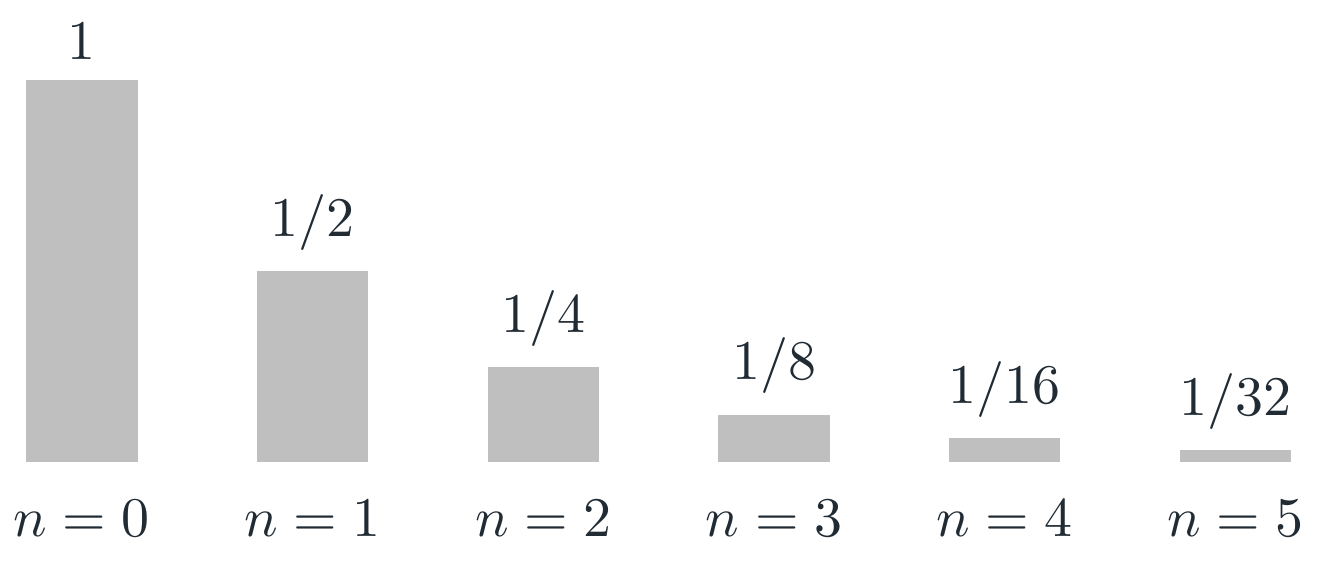
Reading the drawing
The horizontal labels give successive refinement levels. Each bar is half the preceding one, and its exact value is written above it. The plate explains the stated scalar completion and connecting maps.
Drawing labels and data 12 labels
Read the original labels as selectable text. Tables preserve grid relationships; other short labels are grouped compactly.
- \(n=0\)
- \(1\)
- \(n=1\)
- \(1/2\)
- \(n=2\)
- \(1/4\)
- \(n=3\)
- \(1/8\)
- \(n=4\)
- \(1/16\)
- \(n=5\)
- \(1/32\)
Evidence note from the source edition
The bars show the certified tail \(2^{-n}\) at horizon \(T=1\). They are bounds on a whole time interval, not errors sampled at the right endpoint.
The estimate follows before any graph is drawn
For \(0\le t\le T\), the derivative of \(a\mapsto e^{-at}\) has absolute value at most \(T\) when \(a\ge0\). Thus
The limit is \(e^{-t}\), which does have the semigroup law. Here every reconstruction is the identity, so the hidden-range excursion is identically zero. That closure fact is additional to the tail estimate.
In a general tower, the weighted estimate includes norms of composed connecting and reconstruction maps. Dropping those weights without contraction or another uniform bound can change a convergent error budget into an invalid one. Even a small defect at each individual level does not control the sum over all levels.
Read this as
A summable tail gives an explicit stopping rule for a fixed horizon. It does not remove weights, supply uniformity on all time, or prove closure without its own hypotheses.