
Modify only column zero of \(K\): move \(1/16\) of its mass from target state zero to target state two. The perturbed matrix \(K_\varepsilon\) remains stochastic, but its aggregate column now differs from column one. Relative to the unchanged coarse kernel,
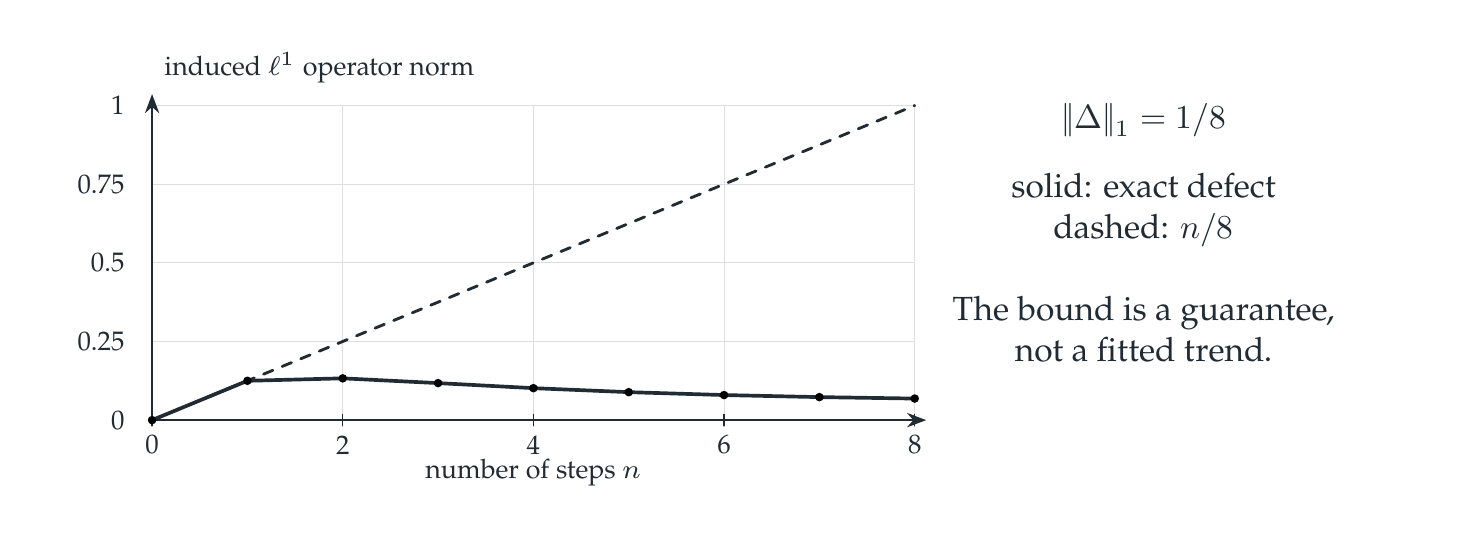
Reading the drawing
The horizontal axis counts steps and the vertical axis uses the induced one-norm. The solid values come from the exact finite model. The dashed line is the bound based on the one-step defect; it is a guarantee and need not be sharp. The axis ticks and all original legend labels follow.
Drawing labels and data 15 labels
Read the original labels as selectable text. Tables preserve grid relationships; other short labels are grouped compactly.
Horizontal axis and ticks
number of steps \(n\), 0, 2, 4, 6, 8
Vertical axis and ticks
induced \(\ell^1\) operator norm, 0, 0.25, 0.5, 0.75, 1
One-step defect and legend
- \(\|\Delta\|_1=1/8\)
solid: exact defect
dashed: \(n/8\)
The bound is a guarantee,
not a fitted trend.
Evidence note from the source edition
The solid values are computed with rational matrix powers. The dashed certificate uses only stochasticity and the exact one-step defect. It need not be sharp.
Telescoping tells us where every error originates
For \(n\ge0\),
Each summand propagates one defect between an earlier fine evolution and a later coarse evolution. Column-stochastic matrices have induced \(\ell^1\) norm one, so the norm is at most \(n/8\). The empty sum at \(n=0\) is zero.
The continuous counterpart is equally explicit. With fine generator \(-1\), coarse generator \(-2\), and \(C=1\), the generator defect is \(1\) and
Its resolvent version is \(1/(z+1)-1/(z+2)=1/((z+1)(z+2))\) for \(z>0\).
Read this as
A small defect does not disappear. The identity specifies how it accumulates, and the norm assumptions turn that identity into a finite-horizon certificate.