
Let \(K_2=\frac14{\begin{pmatrix}3&1\\1&3\end{pmatrix}}\), start at state \(0\), use weights \(w=(1,1/2)\), and terminal observable \(f=(2,1)\). For three transitions, there are eight possible state sequences after the fixed initial state. We evaluate
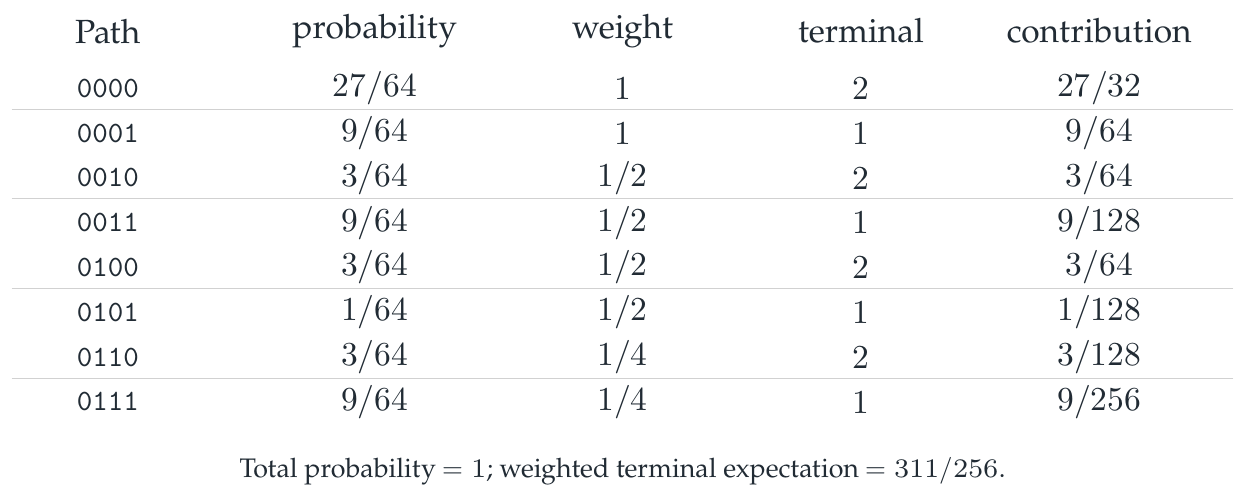
Each path contributes its transition probability times its three departure weights times its terminal value.
Reading the drawing
Read each row across from the path address to its probability, departure-state weight, terminal value, and weighted contribution. The bottom note gives the total path probability and weighted terminal expectation. The selectable transcript retains every original table label.
Drawing labels and data 46 labels
Read the original labels as selectable text. Tables preserve grid relationships; other short labels are grouped compactly.
- Path
- probability
- weight
- terminal
- contribution
0000- \(27/64\)
- \(1\)
- \(2\)
- \(27/32\)
0001- \(9/64\)
- \(1\)
- \(1\)
- \(9/64\)
0010- \(3/64\)
- \(1/2\)
- \(2\)
- \(3/64\)
0011- \(9/64\)
- \(1/2\)
- \(1\)
- \(9/128\)
0100- \(3/64\)
- \(1/2\)
- \(2\)
- \(3/64\)
0101- \(1/64\)
- \(1/2\)
- \(1\)
- \(1/128\)
0110- \(3/64\)
- \(1/4\)
- \(2\)
- \(3/128\)
0111- \(9/64\)
- \(1/4\)
- \(1\)
- \(9/256\)
Total probability \(=1\); weighted terminal expectation \(=311/256\).
Evidence note from the source edition
Every possible path is included. The probability column sums to one. The contribution column sums to \(311/256\), agreeing exactly with the transfer calculation.
Check which side of the transition gets weighted
The backward operator on observables is \(D_w K_2^{\mathsf T}\). Therefore the expectation is the zeroth coordinate of
Its forward dual is \(K_2D_w\): weight the mass at the departing state, then move it. Weighting arrival states instead gives \(D_wK_2\), a different expression. The exact tests deliberately check that the two conventions do not agree in this example.
The answer \(311/256\) exceeds one, but it is not a probability. The terminal observable can equal two. With \(0\le w_i\le1\), the weighted expectation is bounded by the maximum terminal value, not necessarily by one.
This calculation certifies a finite three-step identity for a stated model. The continuous-time theorem uses the corresponding infinitesimal generator and potential, with the direction of action kept consistent.
Read this as
A Feynman–Kac weight changes the value assigned to each path. Its location relative to a transition is part of the model, not a typographical choice.