
On four states, consider two likelihoods
Two states may share a packet in the coarsest partition on which every listed likelihood is constant exactly when their entire likelihood profiles agree. The profiles are
so the partition is \(\{0,1\},\{2\},\{3\}\).
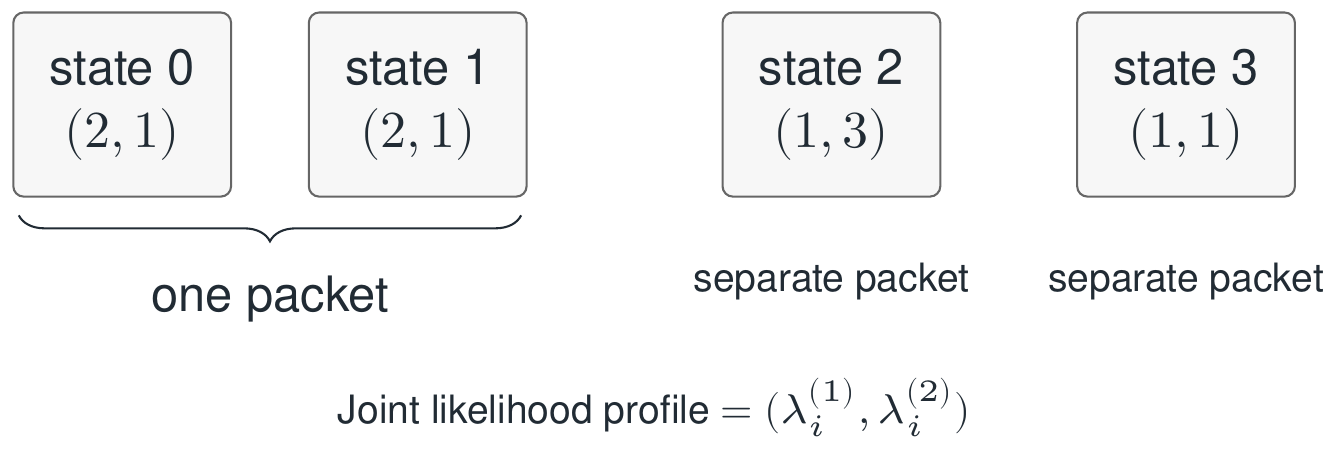
Reading the drawing
The first two states share their displayed profile and are joined by a brace. The remaining states have separate profiles and are labelled as separate packets. The bottom formula identifies the joint profile being compared.
Drawing labels and data 8 labels
Read the original labels as selectable text. Tables preserve grid relationships; other short labels are grouped compactly.
state 0
\((2,1)\)
state 1
\((2,1)\)
state 2
\((1,3)\)
state 3
\((1,1)\)
- one packet
- separate packet
- separate packet
Joint likelihood profile \(=(\lambda^{(1)}_i,\lambda^{(2)}_i)\)
Evidence note from the source edition
The first observation alone allows the last two states to be merged. The second observation distinguishes them. The shared partition must respect both likelihoods.
A complete two-stage calculation
Start from the uniform prior. The coarse prior is \((1/2,1/4,1/4)\). After the first likelihood, it becomes \((2/3,1/6,1/6)\); after the second, it is
The direct fine update multiplies the likelihoods componentwise, giving weights \((2,2,3,1)\) and posterior \((2,2,3,1)/8\). Its packet masses are precisely the displayed coarse posterior.
The individual evidences are \(Z_1=3/2\) and \(Z_2=4/3\), and their product is \(2\), the direct evidence of the product likelihood. These are relative likelihood weights, so evidence larger than one is allowed.
This partition supplies fixed coarse likelihoods that work for every prior. A single-packet aggregation always gives posterior \((1)\); that mass-only commutation does not identify likelihood profiles. A prior-dependent conditional average can summarize one update on a coarser partition, but requires the within-packet information that a fixed sufficient rule avoids.
Read this as
Equal full likelihood profiles determine the coarsest partition on which every listed likelihood is constant. This partition admits fixed sufficient update rules.