E3 Generator defects and functional calculus
On this page · Permalink · Source line 2276
Let \(X_f\) and \(X_c\) be complex Banach spaces. Let \(A_f\in\mathcal B(X_f)\), \(A_c\in\mathcal B(X_c)\), and \(C\in\mathcal B(X_f,X_c)\). Define
and
Theorem E3.1: Duhamel defect identity
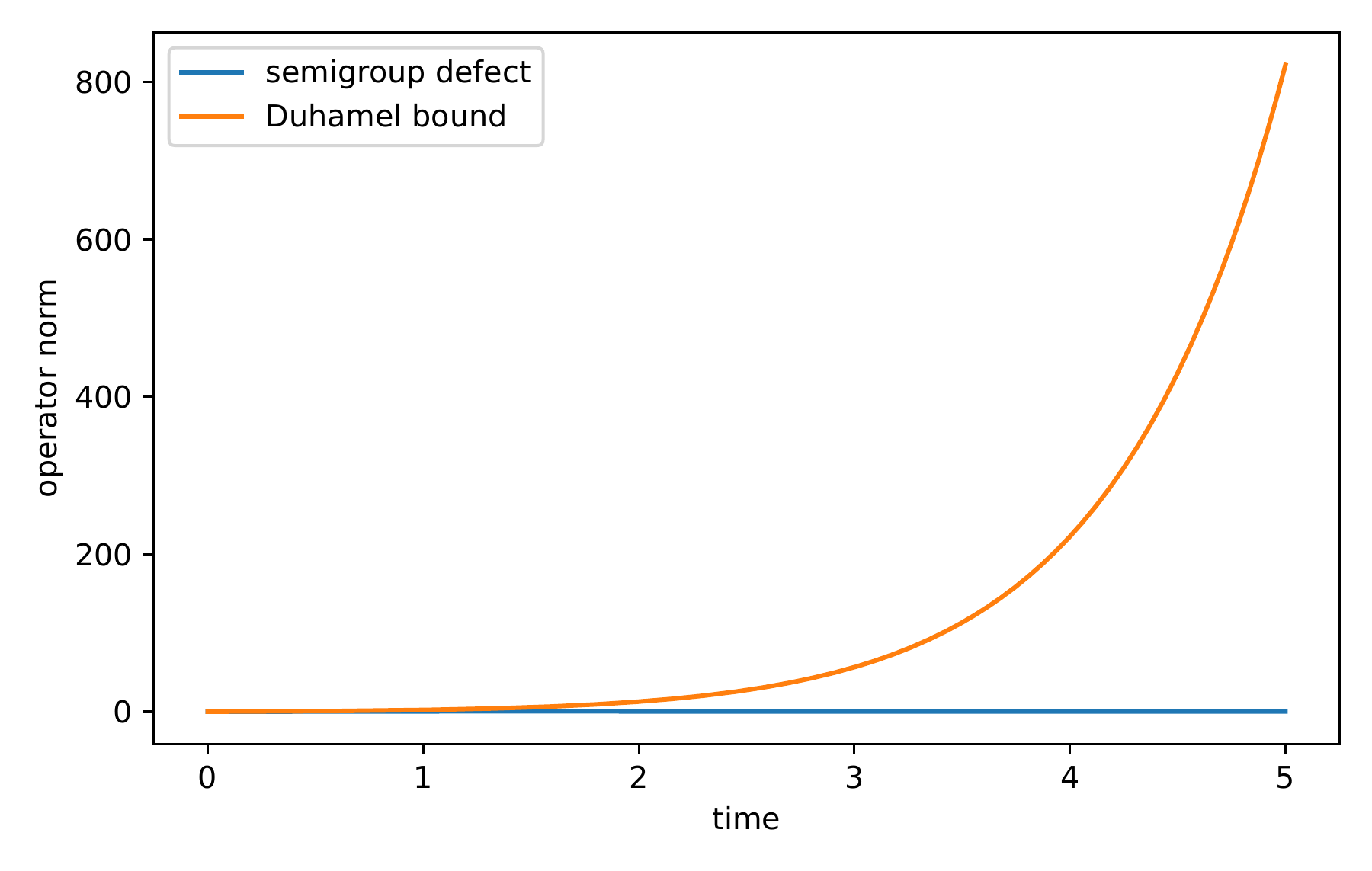
For every \(t\geq0\),
If
then
For contraction semigroups,
Read proof · Read statement and proof side by side · Permalink · Source line 2287 · Claim record · Lean coverage · Code · Worked examples
Proof of Theorem E3.1
For fixed \(t\), set
Then
Integrating from zero to \(t\) gives the identity. The estimates follow by taking norms under the integral.
Back to statement · Read statement and proof side by side · Permalink · Source line 2317 · Claim record · Lean coverage · Code · Worked examples
Proposition E3.2: Infinitesimal recovery of the defect
The generator defect is the first order semigroup defect:
in operator norm. Consequently,
if and only if \(CA_f=A_cC\).
Read proof · Read statement and proof side by side · Permalink · Source line 2329 · Claim record · Lean coverage · Code · Worked examples
Proof of Proposition E3.2
The operator norm expansions
give the limit. The equivalence follows from this limit and Theorem E3.1.
Back to statement · Read statement and proof side by side · Permalink · Source line 2345 · Claim record · Lean coverage · Code · Worked examples
Theorem E3.3: Resolvent defect identity
Let \(z\) belong to the resolvent sets of \(A_f\) and \(A_c\). With
one has
Read proof · Read statement and proof side by side · Permalink · Source line 2355 · Claim record · Lean coverage · Code · Worked examples
Proof of Theorem E3.3
Multiply the proposed identity on the left by \(zI-A_c\) and on the right by \(zI-A_f\). Both sides reduce to
Back to statement · Read statement and proof side by side · Permalink · Source line 2370 · Claim record · Lean coverage · Code · Worked examples
Theorem E3.4: Holomorphic defect formula
Let \(\Gamma\) be the positively oriented rectifiable boundary of a finite union of pairwise disjoint bounded Jordan domains. Assume that both spectra lie inside this union and that \(\Gamma\) lies in the common resolvent set. Thus its winding number is one about every spectral point. If \(g\) is holomorphic on a neighborhood of the closure of the union, then
In particular,
Read proof · Visual guide: An operator substitution transports the defect too · Read statement and proof side by side · Permalink · Source line 2377 · Claim record · Lean coverage · Code · Worked examples
Proof of Theorem E3.4
Apply the Dunford integral formula to both operators and use Theorem E3.3 under the contour integral. The norm estimate is immediate.
Back to statement · Read statement and proof side by side · Permalink · Source line 2401 · Claim record · Lean coverage · Code · Worked examples
Corollary E3.5: Exact naturality
If \(CA_f=A_cC\), then
for every holomorphic function covered by Theorem E3.4. The conclusion includes exponentials, resolvents, and polynomials.
Read proof · Read statement and proof side by side · Permalink · Source line 2405 · Claim record · Lean coverage · Code · Worked examples
Proof of Corollary E3.5
Set \(\Delta=0\) in Theorem E3.4.
Back to statement · Read statement and proof side by side · Permalink · Source line 2413 · Claim record · Lean coverage · Code · Worked examples