
Let \(N={\begin{pmatrix}0&1\\0&0\end{pmatrix}}\), so \(N^2=0\) and \(\|N\|_2=1\). On \([0,T]\), compare the memory kernels \(K(t)=N\) and \(\widetilde K(t)=0\), with identity free semigroup, no forcing, and initial state \(x_0=e_1=(0,1)^{\mathsf T}\). The equations are
Their exact solutions are \(x(t)=(t^2/2,1)^{\mathsf T}\) and \(\widetilde x(t)=(0,1)^{\mathsf T}\).
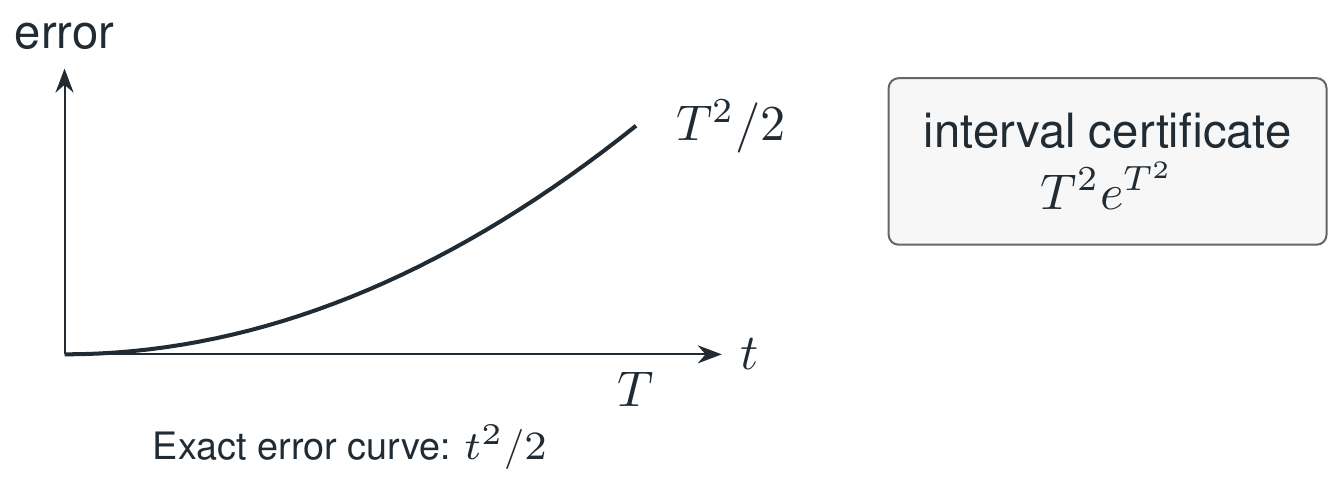
Reading the drawing
The curve rises from the origin to the marked time horizon. Its exact expression is written beside and below the plot. A separate box contains the interval certificate, which the source derives under common initial data and forcing.
Drawing labels and data 6 labels
Read the original labels as selectable text. Tables preserve grid relationships; other short labels are grouped compactly.
- \(t\)
- error
- \(T\)
- \(T^2/2\)
interval certificate
\(T^2e^{T^2}\)
- Exact error curve: \(t^2/2\)
Evidence note from the source edition
The first-coordinate error is exactly \(t^2/2\). The certificate bounds its maximum on the entire interval. The bound is deliberately shown separately from the trajectory.
Track every constant before applying the estimate
Here \(M_T=1\), \(B=\sup\|\widetilde x\|=1\), and
The theorem yields
At \(T=1/2\), the exact error is \(1/8\) and the certificate is \(e^{1/4}/4\). Nilpotence makes this example polynomial; it does not remove the time horizon from the general theorem.
The two solutions share initial state, free semigroup, and forcing. If those are changed as well, their errors need additional terms. An integrated kernel error alone does not automatically control a trajectory on an infinite horizon.
Read this as
The compression estimate transports an \(L^1\) kernel budget into a finite-horizon state bound, using an explicit bound on the comparison trajectory.