
Square-root evolution can be written as an average of ordinary diffusion over a positive clock variable \(s\):
Here \(t\) is the external time; \(s\) is the ordinary diffusion time being mixed. They are not interchangeable variables.
Reading the drawing
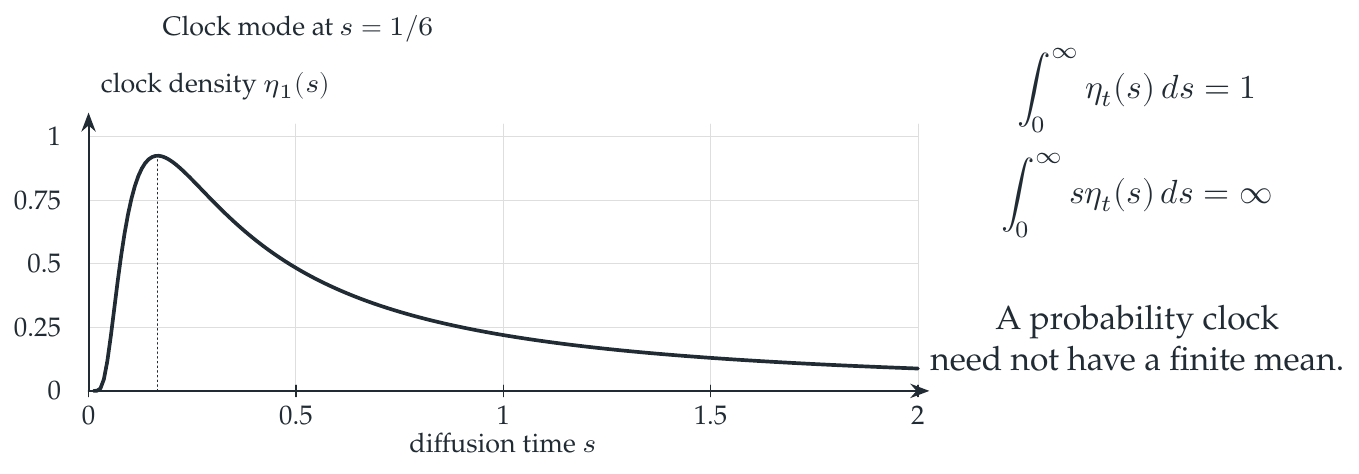
The curve rises to a marked mode and then has a long tail. The integrals at right distinguish its total mass from its first moment. The plate specifies the fixed clock parameter used for the drawing.
Drawing labels and data 16 labels
Read the original labels as selectable text. Tables preserve grid relationships; other short labels are grouped compactly.
- 0
- 0.5
- 1
- 1.5
- 2
- 0
- 0.25
- 0.5
- 0.75
- 1
- diffusion time \(s\)
- clock density \(\eta_1(s)\)
- Clock mode at \(s=1/6\)
- \(\displaystyle\int_0^\infty\eta_t(s)\,ds=1\)
A probability clock
need not have a finite mean.
Evidence note from the source edition
The density \(\eta_1\) peaks at \(s=1/6\) but has a long right tail. The drawing ends at \(s=2\); it does not claim that the missing tail has zero mass.
Check the normalizer before interpreting a density
Under \(s=t^2/(4u^2)\), reversing the integration limits gives
Its integral over \(u>0\) is one, so \(\eta_t\) is a probability density. On each eigenmode of \(L\), the operator formula reduces to the scalar Laplace identity
The manuscript supplies that scalar identity and its spectral assembly. The appendix separately checks the change of variables and normalization; sampled curves are not used to certify an improper integral.
A normalized density need not have a finite mean. For large \(s\), the exponential factor tends to one and \(\eta_t(s)\) is proportional to \(s^{-3/2}\). Consequently \(s\eta_t(s)\) has a nonintegrable \(s^{-1/2}\) tail. The clock has infinite mean even though its total mass is one.
Read this as
Subordination is a weighted mixture of diffusion times. Replacing the clock distribution by a single average time is not justified, and here that average is infinite.