
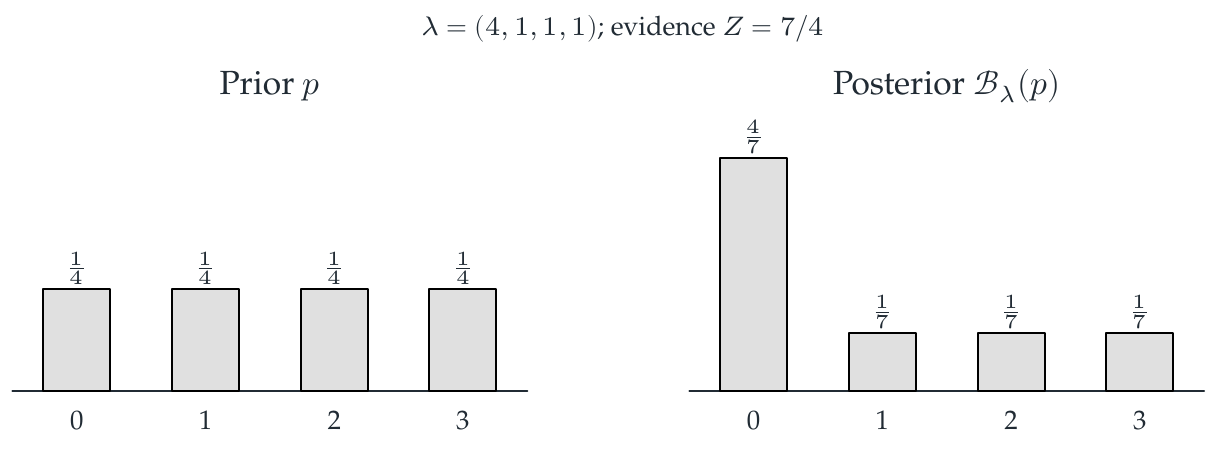
Start with \(p=(1,1,1,1)^{\mathsf T}/4\) and likelihood weights \(\lambda=(4,1,1,1)^{\mathsf T}\). The unnormalized vector is \((1,1/4,1/4,1/4)^{\mathsf T}\), its evidence is \(Z=7/4\), and
Likelihood weights may be rescaled, so an evidence larger than one is not a probability claim. Multiplying all likelihoods by one common positive factor leaves this posterior unchanged.
Reading the drawing
The left panel gives equal prior masses at four addresses. The right panel shows the posterior after the displayed likelihood is applied and normalized. The likelihood vector and total evidence are annotated above.
Drawing labels and data 19 labels
Read the original labels as selectable text. Tables preserve grid relationships; other short labels are grouped compactly.
- Prior \(p\)
- 0
\(\frac{1}{4}\)
- 1
\(\frac{1}{4}\)
- 2
\(\frac{1}{4}\)
- 3
\(\frac{1}{4}\)
Posterior \(\mathcal B_\lambda(p)\)
- 0
\(\frac{4}{7}\)
- 1
\(\frac{1}{7}\)
- 2
\(\frac{1}{7}\)
- 3
\(\frac{1}{7}\)
- \(\lambda=(4,1,1,1)\); evidence \(Z=7/4\)
Evidence note from the source edition
The A packet becomes heavier and its internal shape changes. The B packet retains an equal internal split but loses total mass. These are different effects of the same likelihood.
Reconstruct from packet mass times packet shape
The unnormalized packet evidences are \(Z_{\mathrm A}=5/4\) and \(Z_{\mathrm B}=1/2\). The resulting masses and conditional shapes are
Thus \(m_{\mathrm A}q_{\mathrm A}+m_{\mathrm B}q_{\mathrm B}\) is exactly the displayed posterior. Keeping only the masses would not reconstruct the fine state.
There is no need to divide by a zero packet evidence. For likelihood \((0,0,1,1)\), packet A has mass zero and contributes the zero vector. Only the occupied B packet has a conditional probability vector. If the total evidence is zero, however, the Bayesian update is not defined and the implementation rejects the input.
Read this as
Bayesian reconstruction uses two kinds of data: how much posterior mass a packet carries and how that mass is distributed inside the packet.