
Consider a fine operator, a coarse operator, and a rectangular map
Direct multiplication gives \(C_rA_f=A_cC_r\). For \(F(z)=1/(1+z)\), which is defined at both spectra, compute the matrices by inversion:
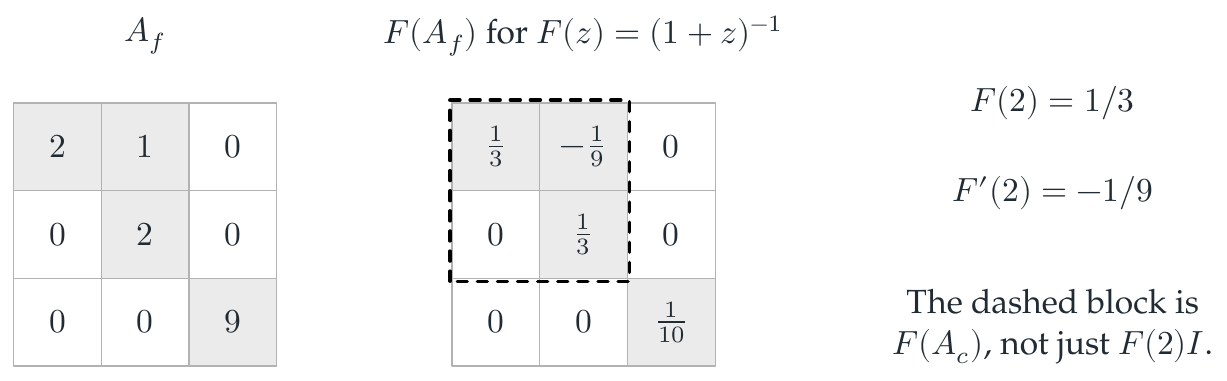
Reading the drawing
The dashed block in the function matrix corresponds to the non-diagonal repeated-eigenvalue block. The right-hand annotations give the scalar function and its derivative at that eigenvalue. The note distinguishes the whole block function from scalar substitution alone.
Drawing labels and data 23 labels
Read the original labels as selectable text. Tables preserve grid relationships; other short labels are grouped compactly.
- \(A_f\)
| Row / column | Column 1 | Column 2 | Column 3 |
|---|---|---|---|
| Row 1 | \(2\) | \(1\) | \(0\) |
| Row 2 | \(0\) | \(2\) | \(0\) |
| Row 3 | \(0\) | \(0\) | \(9\) |
- \(F(A_f)\) for \(F(z)=(1+z)^{-1}\)
| Row / column | Column 1 | Column 2 | Column 3 |
|---|---|---|---|
| Row 1 | \(\frac{1}{3}\) | \(- \frac{1}{9}\) | \(0\) |
| Row 2 | \(0\) | \(\frac{1}{3}\) | \(0\) |
| Row 3 | \(0\) | \(0\) | \(\frac{1}{10}\) |
- \(F(2)=1/3\)
- \(F'(2)=-1/9\)
The dashed block is
\(F(A_c)\), not just \(F(2)I\).
Evidence note from the source edition
The discarded eigenvalue \(9\) contributes \(1/10\) only on the fine side. On the retained Jordan block, the off-diagonal entry is \(F'(2)=-1/9\), not zero. The rectangular comparison preserves that entry.
Why spectral values are not enough
On the retained block \(A_c=2I+N\), with \(N^2=0\), one has
Hence \(C_rF(A_f)=F(A_c)C_r\). Replacing the block by \(F(2)I\) would lose the nonzero derivative term and no longer give the actual inverse of \(I+A_c\).
For polynomials, naturality follows by transporting every operator power. The manuscript's finite holomorphic statement uses finite Taylor data at each primary block and the corresponding nilpotent orders. This example verifies a rational instance with an actual inverse rather than asserting that arbitrary scalar substitutions are meaningful.
The same mechanism explains why the Jordan memory kernel on Visual 23 contains \(t e^{-2t}\). Exponentiation also has nonzero derivatives at repeated spectral values.
Read this as
A functional calculus acts on operators, including their nilpotent parts. Exact intertwining transports that full action, not merely a list of scalar eigenvalue images.