
Return to the four-state model of V–4 and the perturbed stochastic matrix \(K_\varepsilon\) of V–6. Let
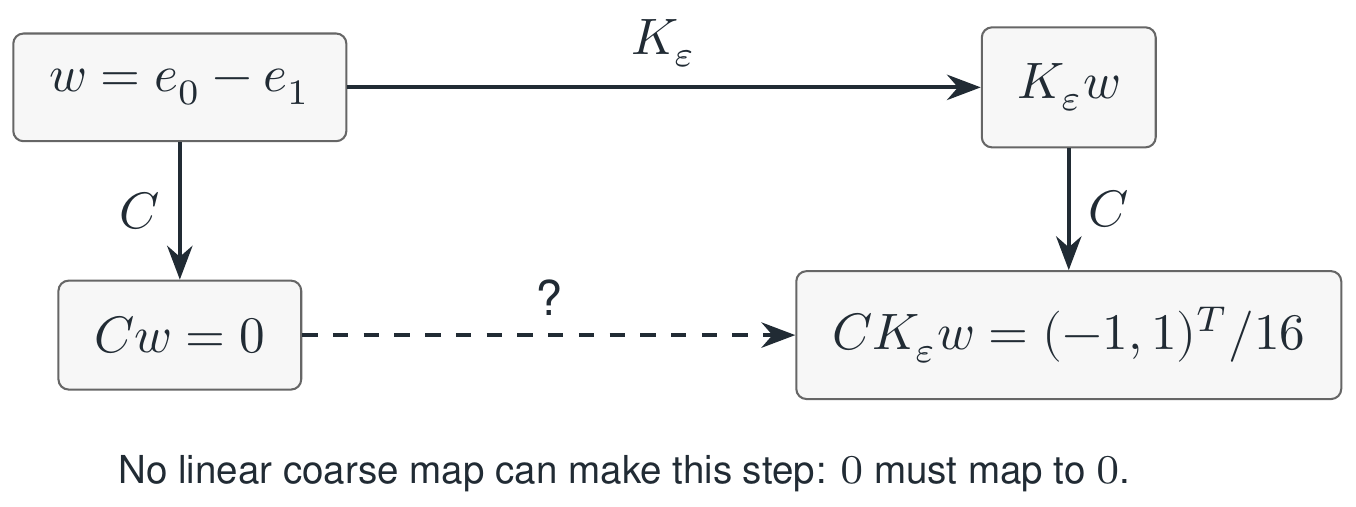
The vector \(w\) changes the fine distribution inside the first packet without changing its mass: \(Cw=0\). Yet
Reading the drawing
The upper row applies the fine transition to a vector in the aggregation kernel. The vertical arrows aggregate before and after that transition. The dashed lower arrow and its question mark show the attempted coarse step, with the obstruction written beneath.
Drawing labels and data 9 labels
Read the original labels as selectable text. Tables preserve grid relationships; other short labels are grouped compactly.
- \(w=e_0-e_1\)
- \(K_\varepsilon w\)
- \(Cw=0\)
- \(CK_\varepsilon w=(-1,1)^T/16\)
- \(K_\varepsilon\)
- \(C\)
- \(C\)
- ?
No linear coarse map can make this step: \(0\) must map to \(0\).
Evidence note from the source edition
The coarse input cannot see \(w\). The next coarse output can. Therefore no linear coarse operator can reproduce this fine step for every input.
Why one witness rules out every coarse matrix
If some \(\bar K\) satisfied \(CK_\varepsilon=\bar KC\), then \(CK_\varepsilon w=\bar KCw=0\), contradicting the displayed vector. The failure is not repaired by fitting a different coarse transition matrix to selected priors.
More generally, for a surjective aggregation map \(C\), a linear map \(M\) descends exactly if \(CM\) vanishes on \(\ker C\). The descended map is defined by \(\bar M(Cx)=CMx\); the kernel condition makes this independent of the representative \(x\).
For a deterministic partition of a finite stochastic system, differences \(e_i-e_j\) within the same source block span the forgotten directions. Testing them gives the familiar equality of aggregate columns. Nonnegativity and column sums of the descended stochastic matrix then follow from the fine stochastic matrix and the partition structure.
Read this as
The canonical obstruction is the action on information that aggregation discards. A nonzero witness in that kernel rules out exact descent at once.