
Take the generator
The total-mass direction \((1,1)\) has eigenvalue zero. The contrast \((1,-1)\) has eigenvalue \(-2\). Resolving those two directions gives the full transfer, not only its first-order approximation:
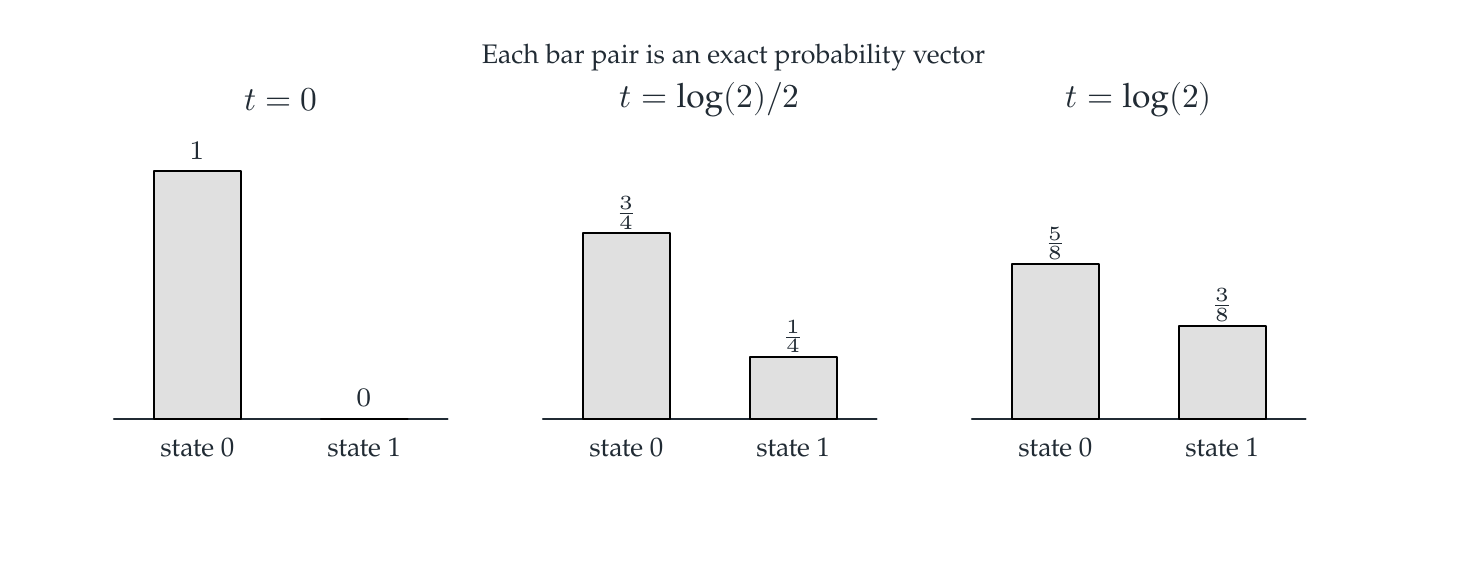
Reading the drawing
Each panel uses the same two states and probability scale. Mass moves from state zero toward the uniform distribution. The time labels and every displayed bar value are transcribed in the three tables below.
Drawing labels and data 16 labels
Read the original labels as selectable text. Tables preserve grid relationships; other short labels are grouped compactly.
| State | Probability |
|---|---|
| state 0 | \(1\) |
| state 1 | \(0\) |
| State | Probability |
|---|---|
| state 0 | \(\frac{3}{4}\) |
| state 1 | \(\frac{1}{4}\) |
| State | Probability |
|---|---|
| state 0 | \(\frac{5}{8}\) |
| state 1 | \(\frac{3}{8}\) |
- Each bar pair is an exact probability vector
Evidence note from the source edition
A point seed at state zero approaches the uniform distribution. The displayed times were selected so that every bar label is rational. This is continuous-time evolution, not a simulated trajectory.
Two checks explain the mechanism
The constant mode is unchanged, while each elapsed interval multiplies the contrast by \(e^{-2t}\). Consequently two intervals multiply their contrast factors:
For \(t\ge0\), the entries are nonnegative and every column sums to one. Differentiation gives \(T'(t)=GT(t)\). These three facts separately check the initial condition, the evolution equation, and preservation of probability.
At \(t=\log 2\), the retained first coordinate is \(5/8\). It would instead be \(1/2\) under the isolated scalar equation \(\dot x=-x\). The discrepancy is the mass that can leave state zero and return. On Visual 22, we remove the second coordinate correctly and recover exactly the same \(5/8\) using a memory integral.
Read this as
The semigroup lives on the complete state. One diagonal entry of a semigroup need not itself satisfy a scalar semigroup law.