
Now use a two-dimensional hidden block
Choose the entrance column \(V=(0,1)^{\mathsf T}\) and exit row \(U=(1,0)\). The hidden exponential is not \(e^{-2t}I\):
The nilpotent link carries an input from the second hidden coordinate to the first.
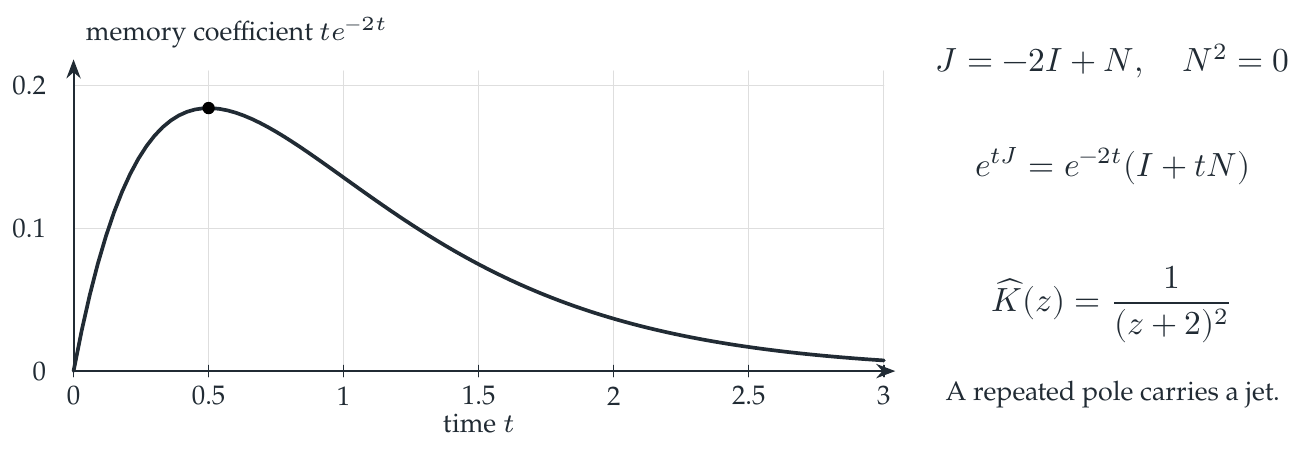
Reading the drawing
The curve rises from zero, reaches a marked maximum, and decays. The annotations retain the nilpotent Jordan part, its exponential, and the transform with a repeated pole. The note identifies the derivative information carried by that pole.
Drawing labels and data 16 labels
Read the original labels as selectable text. Tables preserve grid relationships; other short labels are grouped compactly.
- 0
- 0.5
- 1
- 1.5
- 2
- 2.5
- 3
- 0
- 0.1
- 0.2
- time \(t\)
- memory coefficient \(t e^{-2t}\)
- \(J=-2I+N,\quad N^2=0\)
- \(e^{tJ}=e^{-2t}(I+tN)\)
- \(\widehat K(z)=\dfrac1{(z+2)^2}\)
- A repeated pole carries a jet.
Evidence note from the source edition
The memory kernel starts at zero, becomes positive, and peaks at \(t=1/2\). A rule that retained the eigenvalue \(-2\) but discarded the Jordan chain would predict the zero kernel for these entrance and exit maps.
The transfer function sees pole order
The exact transform is
The repeated pole and the polynomial factor \(t\) are the same information in two domains. For a longer nilpotent chain, higher powers of \(t\) occur with factorial denominators.
A zero value \(K_{\rm mem}(0)\) does not make the entire kernel zero. Nor do stable eigenvalues alone specify every transient contribution: entrance maps, exit maps, and nilpotent structure matter. Here the full kernel is nevertheless elementary, so its peak and transform can be checked without numerical fitting.
This page is an explicit finite realization. It does not show that an arbitrary continuum memory kernel admits a finite-dimensional representation of this form.
Read this as
Repeated eigenvalues may carry directional information through Jordan chains. Keep the finite jet of the functional calculus, not just its values on the spectrum.