
For each \(n\ge1\), compare the two scalar operators \(A_n=0\) and \(B_n=1/n^2\) through the identity. Their ordinary defects have sizes \(1/n^2\), while their square-root defects have sizes \(1/n\):
These are independent scalar comparisons, not a constructed inverse system. They isolate an error-scale obstruction without claiming a coherent refinement tower.
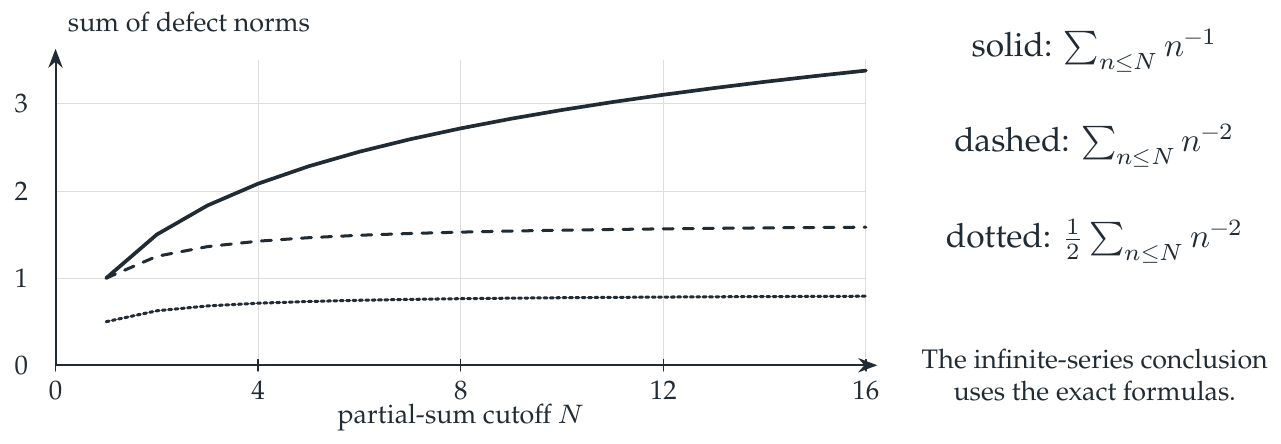
Reading the drawing
The solid, dashed, and dotted curves are the three sums listed at right. The source note reserves the infinite-series conclusion for the exact formulas. The horizontal axis is the refinement cutoff.
Drawing labels and data 15 labels
Read the original labels as selectable text. Tables preserve grid relationships; other short labels are grouped compactly.
- 0
- 4
- 8
- 12
- 16
- 0
- 1
- 2
- 3
- partial-sum cutoff \(N\)
- sum of defect norms
- solid: \(\sum_{n\le N}n^{-1}\)
- dashed: \(\sum_{n\le N}n^{-2}\)
dotted: \(\frac12\sum_{n\le N}n^{-2}\)
The infinite-series conclusion
uses the exact formulas.
Evidence note from the source edition
Partial sums through \(n=16\) illustrate the contrast. The convergence and divergence statements follow from the displayed series, not from the finite plot. A common positive gap gives the third, summable upper bound.
A uniform hypothesis can change the conclusion
Replace the pair by \(A_n=1\) and \(B_n=1+1/n^2\). Then
This is the elementary form of the uniform-gap mechanism on Visual 16. Without such information, transferring a summable generator-defect budget through a fractional function can fail.
The formal release keeps three original research questions separate: realization of broader transfer semigroups, uniform stochastic-refinement control, and latent packet closure. The exact finite examples here do not settle their existence, domain, topology, or uniformity requirements.
Likewise, exact hidden-state elimination only yields the finite memory models that were supplied. It does not establish a finite latent realization for every memory law. A complete list of matrix identities can still leave an infinite-dimensional approximation problem untouched.
Read this as
A finite example can expose a missing hypothesis. It cannot supply a projective-limit construction, a uniform constant, or a continuum realization merely by passing at several levels.