
In \(L^2(\gamma)\) for the standard Gaussian law on \({\mathbb R}\), use the probabilists' Hermite polynomials
The Ornstein–Uhlenbeck generator is \(\mathcal Lf=f''-xf'\). Direct polynomial differentiation gives \(\mathcal LH_n=-nH_n\) for these three polynomials. Their squared norms are \(n!\) and different Hermite degrees are orthogonal.
Reading the drawing
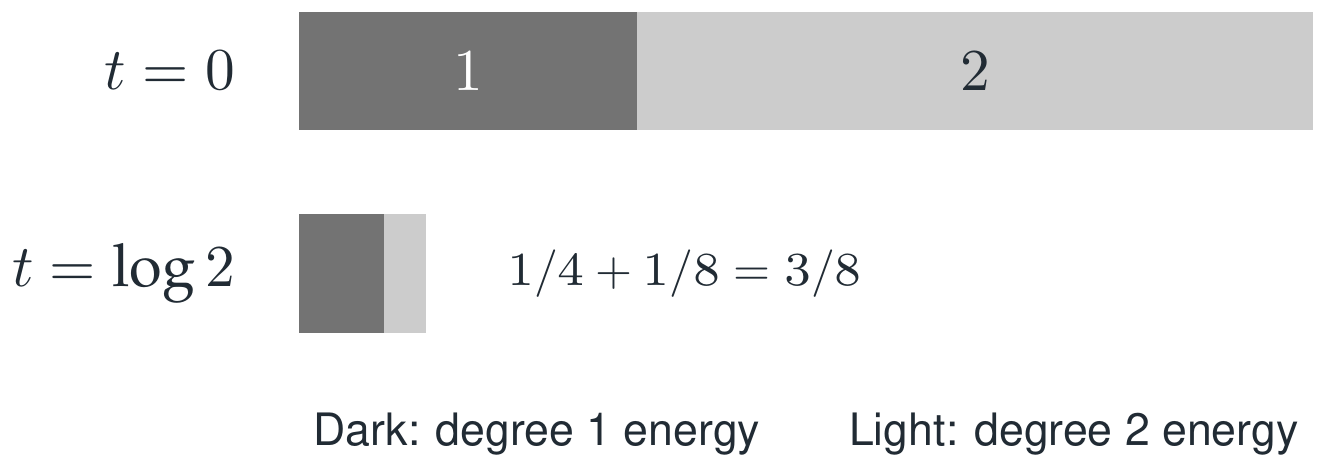
The upper stacked bar gives the initial degree-one and degree-two energies. The smaller lower bar gives them at the displayed later time. The legend distinguishes the two degrees and the note gives their total remaining energy.
Drawing labels and data 6 labels
Read the original labels as selectable text. Tables preserve grid relationships; other short labels are grouped compactly.
- \(t=0\)
- \(t=\log2\)
- \(1\)
- \(2\)
- \(1/4+1/8=3/8\)
Dark: degree 1 energy Light: degree 2 energy
Evidence note from the source edition
For \(f=H_1+H_2\), the two bars are its separate squared-energy contributions. At \(t=\log2\), their sum is \(3/8\), below the spectral-gap bound \(3/4\).
Reconstruction preserves the modes; time changes their weights
The semigroup sends \(f=H_1+H_2\) to
Its mean is zero. The Gaussian gap bounds this by \(e^{-2t}\|f\|_2^2=3e^{-2t}\). It need not be an equality when multiple degrees are present.
For the nonnegative operator \(-\mathcal L\), a square-root evolution replaces rate \(n\) by \(\sqrt n\). On \(g=H_1+H_4\), the coefficients at \(t=\log2\) are \(1/2\) and \(1/4\), whereas ordinary OU evolution gives \(1/2\) and \(1/16\). The eigenfunctions agree; the rates differ.
These calculations concern polynomial elements of Gaussian \(L^2\). The general expansion and generator-domain statements belong to the traditional proof; a finite list of Hermite checks does not establish completeness of the basis.
Read this as
Orthogonal packets make the energy accounting exact. A fractional generator alters the spectral clock while keeping the same Gaussian modes.