
Our main finite model has generator
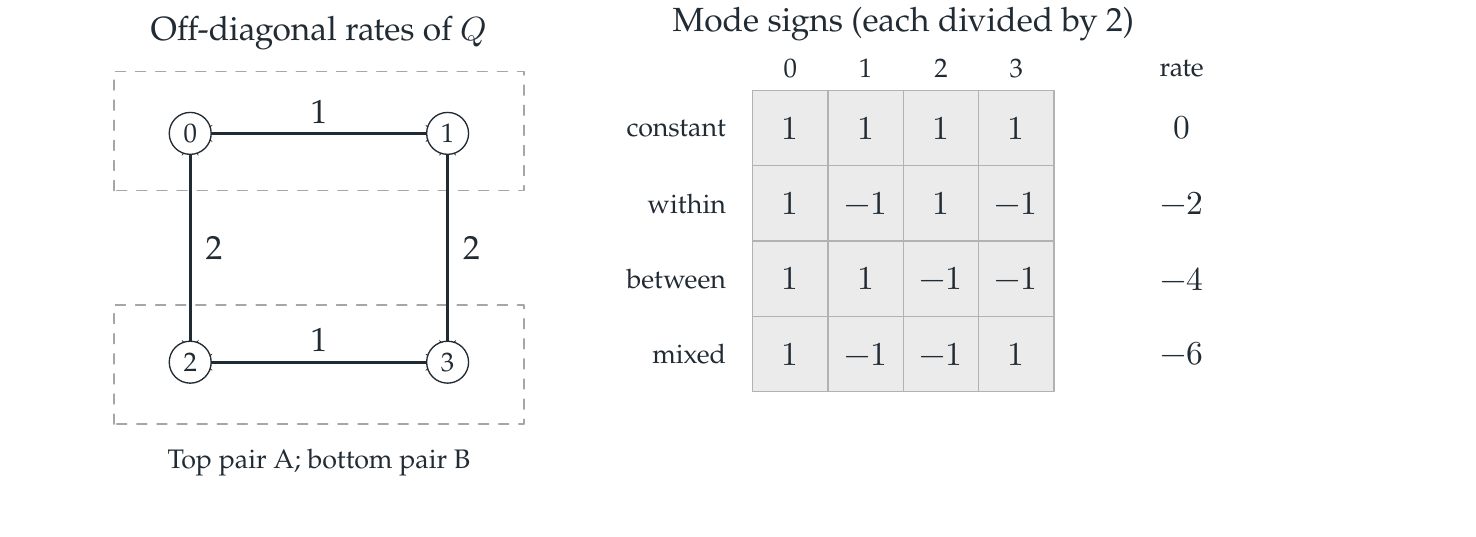
The graph shows rates between actual states. The four normalized sign vectors on the right form an orthonormal basis \(u_j\). Their projectors \(P_j=u_ju_j^{\mathsf T}\) sum to the identity and satisfy \(P_iP_j=0\) for \(i\ne j\).
Reading the drawing
The left panel places states zero and one in the upper packet and states two and three in the lower packet. Horizontal and vertical bidirectional links have the rates listed below. The right panel gives each mode in state order, followed by its generator eigenvalue. Divide every sign entry by two, as the original caption specifies.
Drawing labels and data 40 labels
Read the original labels as selectable text. Tables preserve grid relationships; other short labels are grouped compactly.
| Position | State |
|---|---|
| Top left | 0 |
| Top right | 1 |
| Bottom left | 2 |
| Bottom right | 3 |
| States joined | Rate |
|---|---|
| 0 and 1 | 1 |
| 2 and 3 | 1 |
| 0 and 2 | 2 |
| 1 and 3 | 2 |
- Top pair A; bottom pair B
| Mode | 0 | 1 | 2 | 3 | rate |
|---|---|---|---|---|---|
| constant | \(1\) | \(1\) | \(1\) | \(1\) | \(0\) |
| within | \(1\) | \(-1\) | \(1\) | \(-1\) | \(-2\) |
| between | \(1\) | \(1\) | \(-1\) | \(-1\) | \(-4\) |
| mixed | \(1\) | \(-1\) | \(-1\) | \(1\) | \(-6\) |
Evidence note from the source edition
State coordinates have off-diagonal transfers. Spectral packets reduce the generator and evolve independently. The two dashed state groups are the coarse partition used next.
The same evolution has a closed formula
Writing \(q=e^{-2t}\) gives
At \(q=1/2\), the point seed \(e_0\) becomes \((15,5,9,3)^{\mathsf T}/32\). The polynomial identity \(T(q)T(r)=T(qr)\) checks composition exactly, without numerical matrix exponentiation.
Any other complete packet family still has exact block convolution. For the coordinate groups A and B,
The intermediate packet cannot generally be omitted. Only a reducing family eliminates all cross terms.
For later discrete calculations define \(K=I+Q/8\). This matrix is stochastic, but it is not \(e^{Q/8}\). It is the step kernel in the uniformization identity \(e^{tQ}=e^{-8t}\sum_{n\ge0}(8t)^nK^n/n!\).
Read this as
Changing packet coordinates does not change the evolution. Replacing continuous time by one discrete step does.