
Use \(u(x)=x-x^4\), which vanishes at both endpoints and solves \(-u''=12x^2\). Its centered second difference is not exact:
Since the stencil differentiates the quadratic \(x(1-x)\) exactly, the solution \(u_h\) to the sampled forcing \(12x_i^2\) satisfies
This gives both the sign and size of the error, rather than merely a log–log slope.
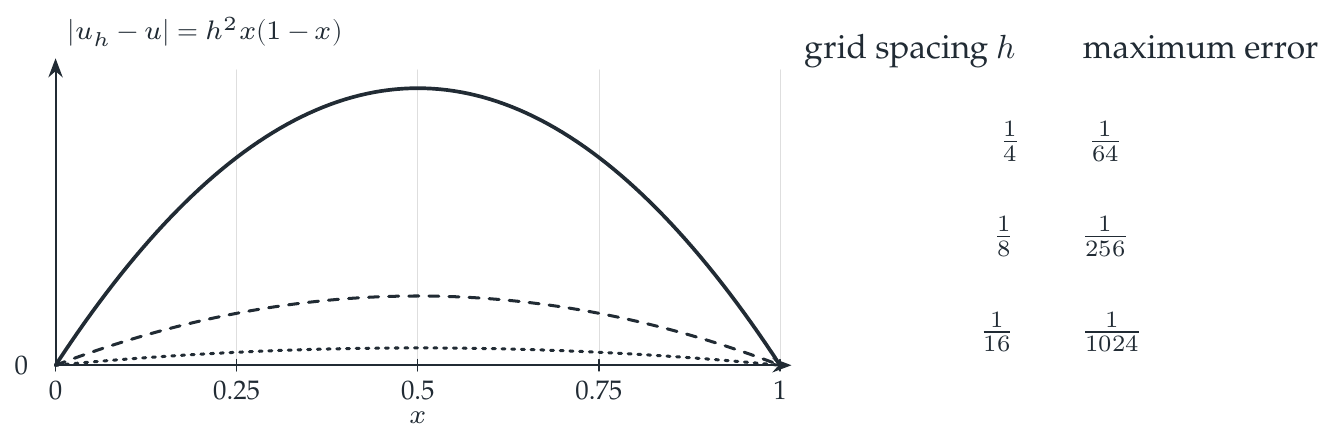
Reading the drawing
The curves give the stated quartic test problem at three grid spacings. The table on the right pairs each spacing with its maximum error. The formula above the plot states the exact error profile for this example.
Drawing labels and data 12 labels
Read the original labels as selectable text. Tables preserve grid relationships; other short labels are grouped compactly.
- 0
- 0.25
- 0.5
- 0.75
- 1
- 0
- \(x\)
- \(|u_h-u|=h^2x(1-x)\)
- grid spacing \(h\) maximum error
\(\frac{1}{4}\) \(\frac{1}{64}\)
\(\frac{1}{8}\) \(\frac{1}{256}\)
\(\frac{1}{16}\) \(\frac{1}{1024}\)
Evidence note from the source edition
The three curves show magnitudes of the exact nodal errors for \(h=1/4,1/8,1/16\). Lines between grid points are visual guides, not an additional continuous numerical solution. The error is negative on every interior node.
One refinement divides this error by four
All three grids include \(x=1/2\), where the maximum absolute nodal error is \(h^2/4\). It equals \(1/64\), \(1/256\), and \(1/1024\), respectively. Exact rational matrix inversion verifies these values independently of the closed error formula.
The manuscript also compares the discrete eigenvalues
with \((k\pi)^2\), with error at most \((k\pi)^4h^2/12\). For a fixed mode \(k\), the bound tends to zero quadratically. It does not claim a uniform small error for modes whose index grows like \(1/h\).
The nodal Green identity is exact, while the discretization of the differential equation still has a truncation error. These statements concern different comparisons and do not contradict one another.
Read this as
An exact inverse of the discrete operator does not make that operator equal to the differential operator. Keep algebraic inversion and continuum approximation separate.