
Let the coarse space be \({\mathbb R}\) and every finer space be \({\mathbb R}^2\). The first connecting maps are \(C(x,y)=x\) and \(Rx=(x,0)\); all later maps are identities. Let the coarse evolution be the identity and all fine evolutions be rotations:
The reconstructed sequence is already constant above its first level. Only one adjacent defect is nonzero, so its defect sum is finite on every bounded time interval.
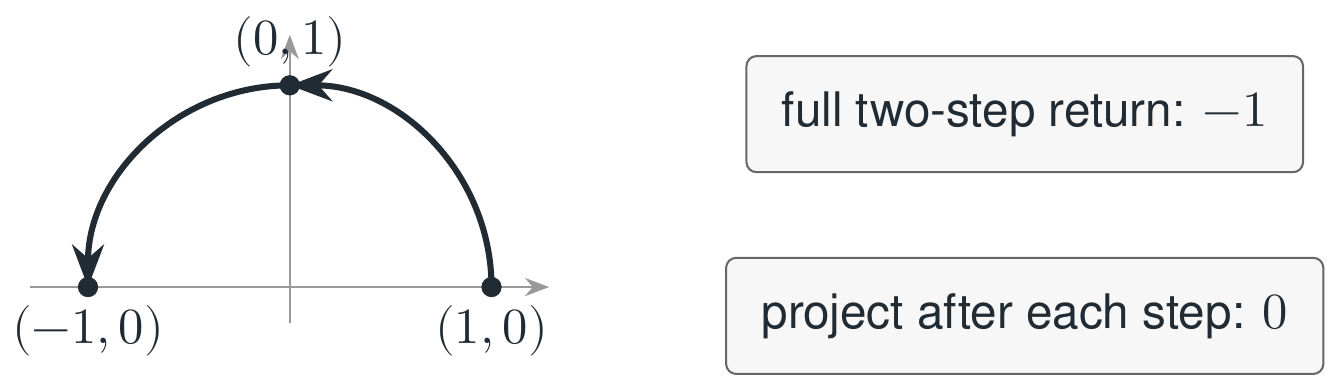
Reading the drawing
The semicircle follows the two-step excursion from the horizontal axis through the vertical direction to the opposite horizontal point. The boxes compare the full two-step return with inserting the retained projector after each step.
Drawing labels and data 5 labels
Read the original labels as selectable text. Tables preserve grid relationships; other short labels are grouped compactly.
- \((1,0)\)
- \((0,1)\)
- \((-1,0)\)
- full two-step return: \(-1\)
- project after each step: \(0\)
Evidence note from the source edition
The full state returns to the coarse line with negative sign after two quarter turns. Resetting the hidden coordinate after the first quarter turn loses the returning contribution.
A limit can fail the semigroup identity
At \(s=t=\pi/2\),
Write \(P=RC={\operatorname{diag}}(1,0)\). The exact algebraic difference is
Its value is \(1\) at these times, matching the missing hidden excursion. This is a failure of closure, not a failure of convergence.
The strengthened closure theorem asks for the corresponding excursion norm to tend to zero with refinement, uniformly on bounded time intervals. Generator control of range leakage supplies a sufficient condition in its stated contractive setting. The present rotation example never meets that vanishing condition.
Read this as
A convergent sequence of reconstructed evolutions need not converge to a semigroup. The limit must also forget no excursion that can later return.