
Special Functions
Komorebi P.
Explore five families built from contraction, arithmetic, prime-sieve measures and rotation orbits. Start with a worked calculation, open the current books in the site reader, or follow a result into its written proof and formal companion.
Read the monograph online · Run the coupled-function lab · Work and evidence · Read by topic · Choose a book
A pair of functions with a shared beginning
For real contractions \(0<q,r,a,b<1\), the coupled family satisfies
\[U'(z)=1+U(qz)V(rz),\qquad
V'(z)=1+U(az)V(bz),\qquad U(0)=V(0)=0.
\]
Both functions start with slope one. Their later coefficients distinguish the four scale addresses. The coupled chapter develops existence, growth and parameter recovery; its extended arguments are collected in the monograph's proof appendices.
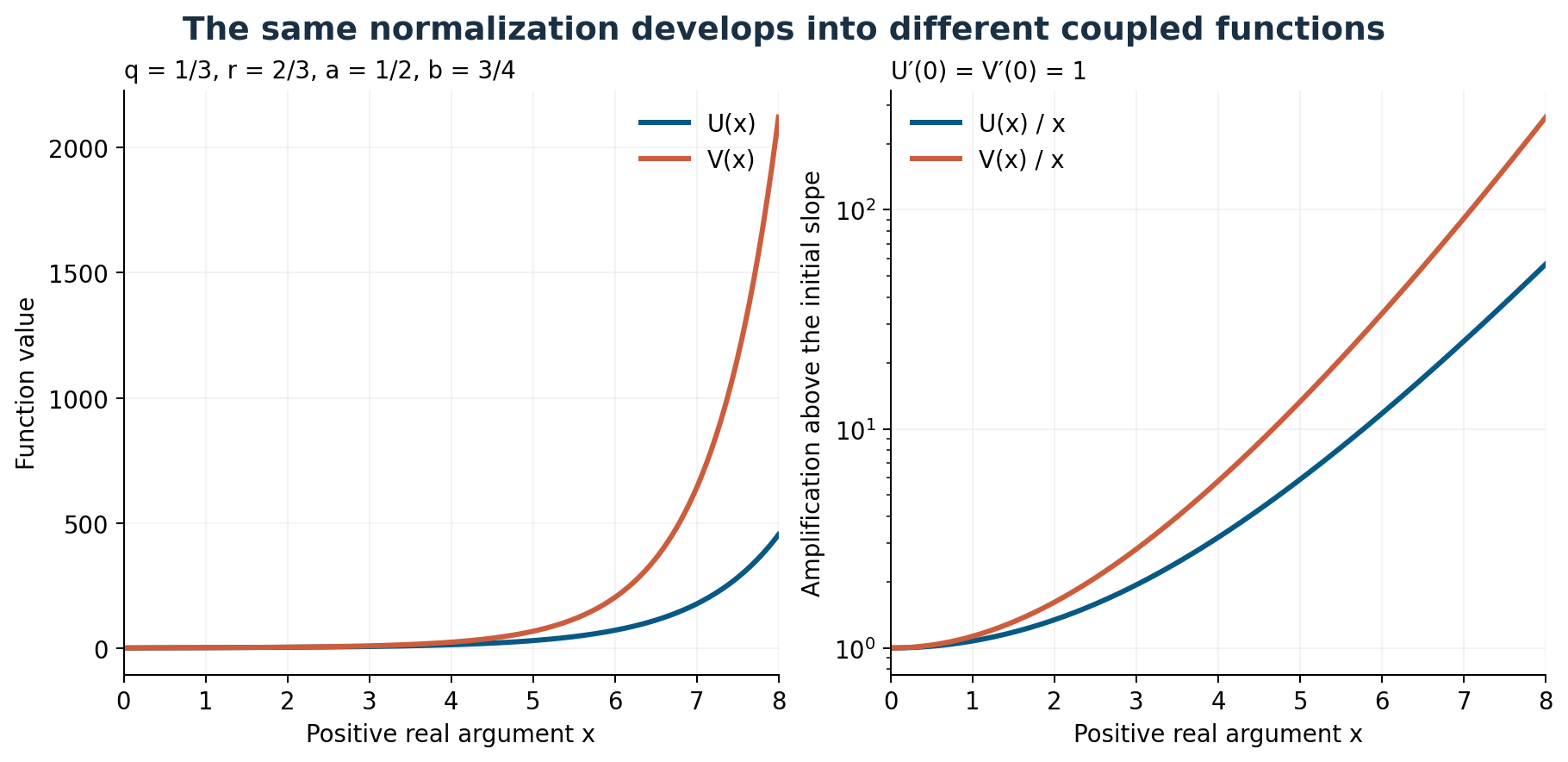
Run the coupled-function lab
Open the interactive lab. It computes twelve exact rational coefficients for each component, plots the Taylor polynomials through degree 23 on \([-1,1]\), and exports both coefficient lists as CSV. Change the four rational contractions or the coefficient count in the editor and run again.
Writing \(U(z)=\sum_{n\ge0}u_nz^{2n+1}\) and \(V(z)=\sum_{n\ge0}v_nz^{2n+1}\), the first coefficients in this example are \(u_0=v_0=1\), \(u_1=2/27\) and \(v_1=1/8\).
The formal companion records the majorant \(0<u_n,v_n\le2^{-n}\) when the four positive scales are at most one. If \(N\) coefficients are retained and \(0<R<\sqrt2\), put \(\rho=R^2/2\). For either component, the omitted series on \(|z|\le R\) is bounded by
\[\left|\sum_{n\ge N}c_nz^{2n+1}\right|
\le \frac{R\rho^N}{1-\rho}.
\]
For the supplied \(R=1\), \(N=12\), the envelope is exactly \(1/2048\). It bounds truncation of the series; plotted decimal evaluation also has floating-point roundoff. The formal companion states precisely what is checked for the recurrence and local series and which analytic identifications remain open.
For a shorter first calculation, work through the scalar contracted-feedback recurrence, which computes coefficients by hand before introducing the coupled pair.
Choose a reading volume
| Volume | What it offers | Read here |
|---|---|---|
| Special Functions | The current 134-page monograph: five families, seven chapters and ten proof appendices | Read online · Open PDF |
| Expanded Visual Guide | The current 180-page visual volume, with 171 worked lessons and associated plates across the eight-paper series | Open visual guide |
| Resolution and Coupled Atlas | Nineteen pages and fourteen computed plates on coupled functions, growth, recovery and finite resolution | Open coupled atlas |
| Packet Realization Core | The preserved 38-page consolidated core and correction register for the original series | Open core and corrections |
| Original Series Collected Reader | The core followed by all eight original papers, assembled into 469 pages | Open collected reader |
The last two entries are reference editions. The collected reader already includes the 38-page core. Read the original papers together with that correction register; the first three volumes provide the current reading route.
Follow one of the five families
| Family | Central question | Begin with |
|---|---|---|
| Contracted nonlinear feedback | How do two contracted arguments determine coefficients and entire growth? | Defining equation and recurrence, then Chapter 1 |
| Arithmetic at complex depth | How do arithmetic weights produce an entire depth parameter, shift formulas and positive kernels? | Chapter 2, with its arithmetic and spectral constructions |
| Prime sieves and signed measures | When do arithmetic moments give positive orthogonal-polynomial systems, and when does positivity fail at finer resolution? | Chapter 3, with its positivity and transport arguments |
| Spectral functions of zero orbits | How does a rotation-invariant zero address lead to spectral zeta values and exact coefficients? | Chapter 4, Chapter 5, and the sequence plotting guide |
| Coupled contraction functions | What do interacting scales preserve about growth, local series and recovery of parameters? | Chapter 6, the coupled atlas, and the browser lab |
The related reciprocal sequence plots compare exact coefficients with factorial normalization. Their guide explains the relation to Paper IV and the sequence chapter; they are distinct from the coupled-function experiment.
Follow a result into its evidence
Use the written proof map to locate the relevant argument and appendices. The current formalization guide records the latest Lean scope, replay command and remaining work. The source edition Lean status preserves its earlier finite-core and first-block assessment.
Use the maintained continuation checkpoint for current restart instructions. The parent continuation and release files preserve the imported edition; dated evidence retains its original source links.
The coupled formalization covers the canonical entire solution, uniqueness, exact growth order, type bounds/proportions, rescaling, guarded recovery, scalar identities, local remainders, H.1 operator classification and J's mathematical evaluation and factorial-normalization contracts. The latest block proves the exact guarded-majorant algorithm specification: first-small contraction ladders, reverse-fold/fuel equality, explicit step/size failures and abstract validation order. Successful results certify actual complex bounds and rational endpoints. The Block17 report, claim map, Lean source and I/O inventory bind the extension. Full Python runtime and dictionary refinement remain open. Other J/F/H, I and A-E analytic coverage remain; ordinary type convergence is conditional. The full monograph has not been formalized.
The edition guide supplies build and replay commands. The exact coupled-function checker is a separate computational entry point. The work page keeps these routes beside the recorded completion and confidence labels.
Download and continue
Download the reading selection, or use Build your own ZIP to choose individual books and supporting files. The source edition's rights and reuse notice states the available terms.
Physics collection · All reading routes · Browse the books · Glossary