
Use the four-state kernel \(K\) and aggregation \(C\) from Visual 5, starting at \(p_0=e_0\). Observe two likelihood vectors constant inside both packets:
Predict, then update at each observation. The fine calculation gives
Reading the drawing
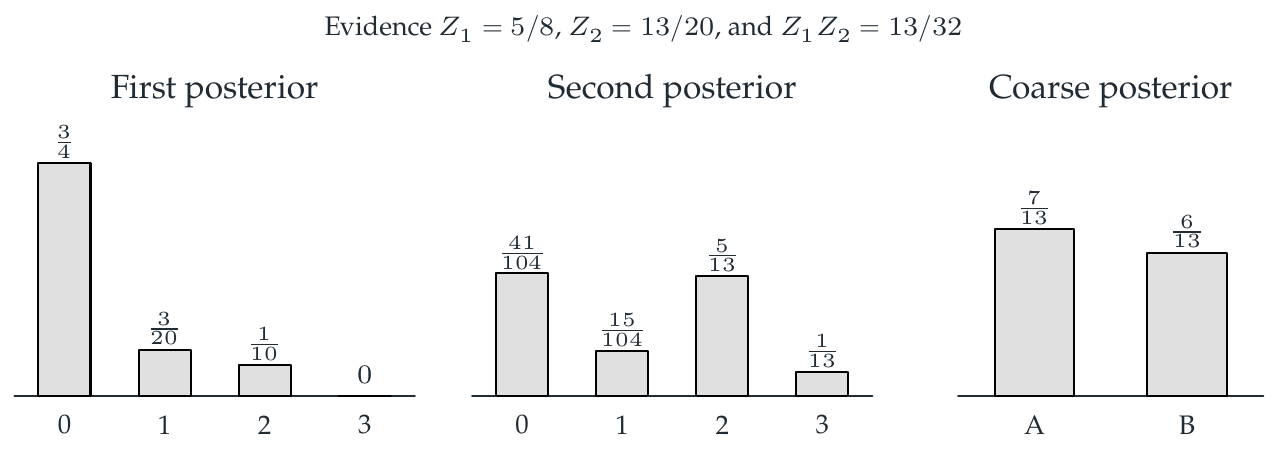
Read the three bar panels from left to right. The first two use the four fine states; the third aggregates into the two declared packets. The two evidence values and their product are written above.
Drawing labels and data 24 labels
Read the original labels as selectable text. Tables preserve grid relationships; other short labels are grouped compactly.
- First posterior
- 0
\(\frac{3}{4}\)
- 1
\(\frac{3}{20}\)
- 2
\(\frac{1}{10}\)
- 3
- \(0\)
- Second posterior
- 0
\(\frac{41}{104}\)
- 1
\(\frac{15}{104}\)
- 2
\(\frac{5}{13}\)
- 3
\(\frac{1}{13}\)
- Coarse posterior
- A
\(\frac{7}{13}\)
- B
\(\frac{6}{13}\)
Evidence \(Z_1=5/8\), \(Z_2=13/20\), and \(Z_1Z_2=13/32\)
Evidence note from the source edition
Within-packet probabilities change during the two observations, but the packet totals agree exactly with an independent two-state filter. The second coarse posterior is \((7/13,6/13)\).
Check the normalizers, not only the final vector
The first and second predictive evidences are
The unnormalized product \(D_2KD_1Kp_0\) has mass \(13/32\) and normalizes to \(p_2\). Because the likelihood entries here lie in \([0,1]\), they can serve as probabilities of the specified observations. This makes the product their joint evidence in the stated model.
Two distinct equalities justify the coarse computation. First, \(CK=K_cC\) transports prediction. Second, the likelihood is constant on each packet, so \(CD_r=\overline D_rC\) transports observation weighting. Their composition preserves both the posterior packet totals and the evidence factors.
The coarse filter does not recover the within-packet shape. If a later observation distinguishes states inside a packet, those missing probabilities can become necessary, as the counterexample on Visual 10 shows.
Read this as
Exact filtering at a coarse level needs both dynamical lumpability and observation sufficiency. Agreement under one step does not excuse testing the other.