
Let a transient process move through two successive rate-one stages, then leave the system. With column probabilities, the transient generator and starting vector are
Thus \(p(t)=e^{-t}(1,t)^{\mathsf T}\). Its total remaining mass, exit density, and hazard are
The initial hazard is zero because an exit needs two stages, not one.
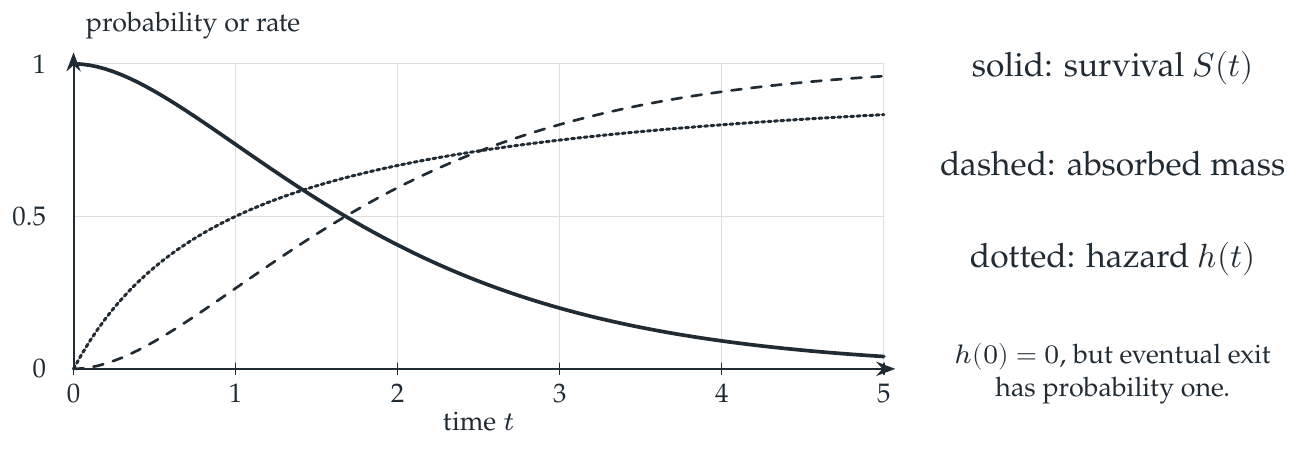
Reading the drawing
The solid survival curve decreases, the dashed absorbed mass increases, and the dotted hazard starts at zero. Their meanings and the eventual-exit statement are written beside the plot. The plate keeps probability and rate distinct.
Drawing labels and data 15 labels
Read the original labels as selectable text. Tables preserve grid relationships; other short labels are grouped compactly.
- 0
- 1
- 2
- 3
- 4
- 5
- 0
- 0.5
- 1
- time \(t\)
- probability or rate
- solid: survival \(S(t)\)
- dashed: absorbed mass
- dotted: hazard \(h(t)\)
\(h(0)=0\), but eventual exit
has probability one.
Evidence note from the source edition
Survival falls from one to zero, while absorbed mass \(1-S\) rises to one. The dotted hazard is an instantaneous rate, not a probability, even though it shares the displayed numerical scale. Time is measured in inverse stage-rate units.
Missing transient mass is absorbed mass
The column sums of \(T\) are \(0\) and \(-1\). The exit-rate row is therefore \((0,1)\), and \(f(t)=(0,1)p(t)\). Adding an absorbing state restores a three-state probability vector with total mass one.
Exact integration gives
Equivalently, the mean is \({\mathbf{1}}^{\mathsf T}(-T)^{-1}e_0\). A single exponential waiting time with mean two would have constant hazard \(1/2\) and variance four, so matching the mean alone would not reproduce this distribution.
The hazard formula is used where \(S(t)>0\). The model has that property for every finite \(t\ge0\). No division by an already vanished survival mass is required.
Read this as
Survival tracks mass, density tracks exits per unit time, and hazard conditions on survival. Equal means or equal initial rates do not identify a waiting-time law.