
Start with equal prior masses on scores \(u=(0,1,2)\) and likelihood \(e^{tu}\). Put \(q=e^t\). The evidence and tilted distribution are
At \(t=\log2\), they are \(Z=7/3\) and \(p=(1,2,4)/7\).
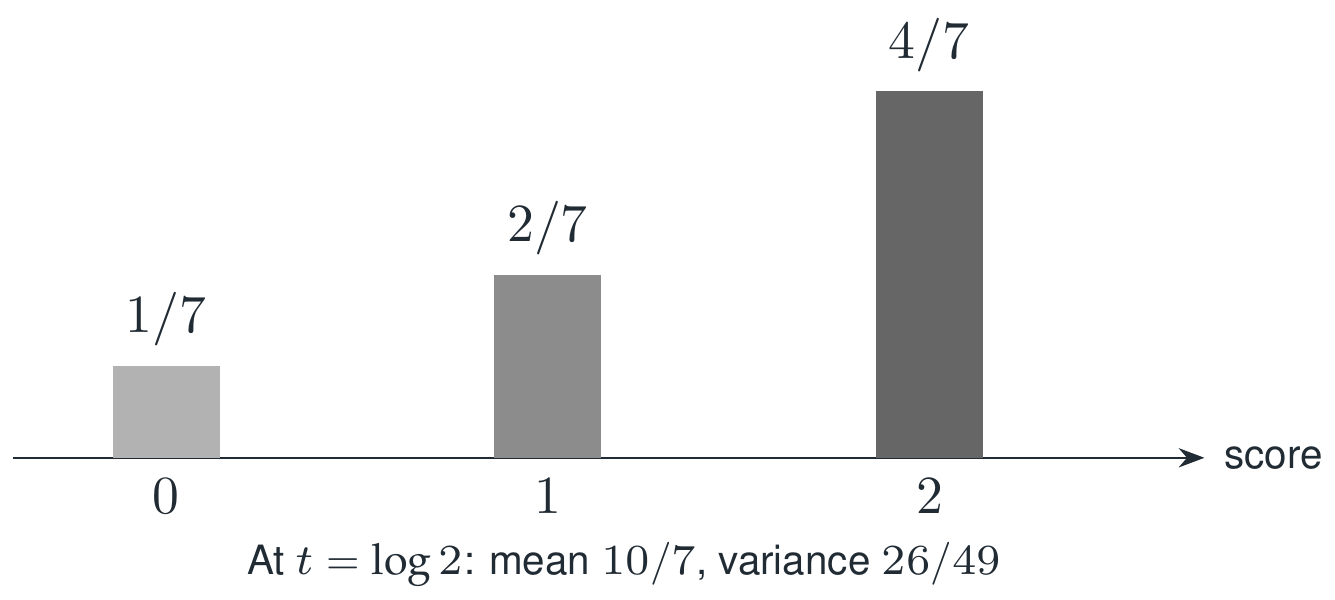
Reading the drawing
The horizontal addresses are the three score values, and each bar is labelled by its posterior probability. The annotation below gives the time, mean, and variance used by the worked example.
Drawing labels and data 8 labels
Read the original labels as selectable text. Tables preserve grid relationships; other short labels are grouped compactly.
- score
- \(0\)
- \(1\)
- \(2\)
- \(1/7\)
- \(2/7\)
- \(4/7\)
- At \(t=\log2\): mean \(10/7\), variance \(26/49\)
Evidence note from the source edition
The score values stay fixed. Their probabilities change. The rising mean score is a property of this tilted family, not an increase in the individual scores.
Two derivatives have different statistical meanings
The first derivative of log evidence is the current mean score, and the second is its variance:
At \(q=2\) the exact values are
Thus the derivative of the mean is \(26/49\) at this time. The flow equation \(p_i'=(u_i-{\mathbb E} u)p_i\) gives derivatives \((-10,-6,16)/49\), which sum to zero.
As \(t\to\infty\), mass concentrates on the largest score present in the initial support. A score with zero initial prior mass is never created by multiplication. If several occupied states tie for the maximum, their relative prior proportions remain unchanged within that maximal packet.
Read this as
Log evidence is a cumulant generator for the tilted law. Its curvature is variance, so the mean score is monotone even though the flow is nonlinear.