
The two-state evolution from Visual 3 has generator
Retain the first coordinate and eliminate the second. For \(z\) away from the relevant poles, the retained entry of \((zI-A)^{-1}\) is
The term \(\Sigma(z)=1/(z+1)\) is the hidden coordinate's self-energy.
Reading the drawing
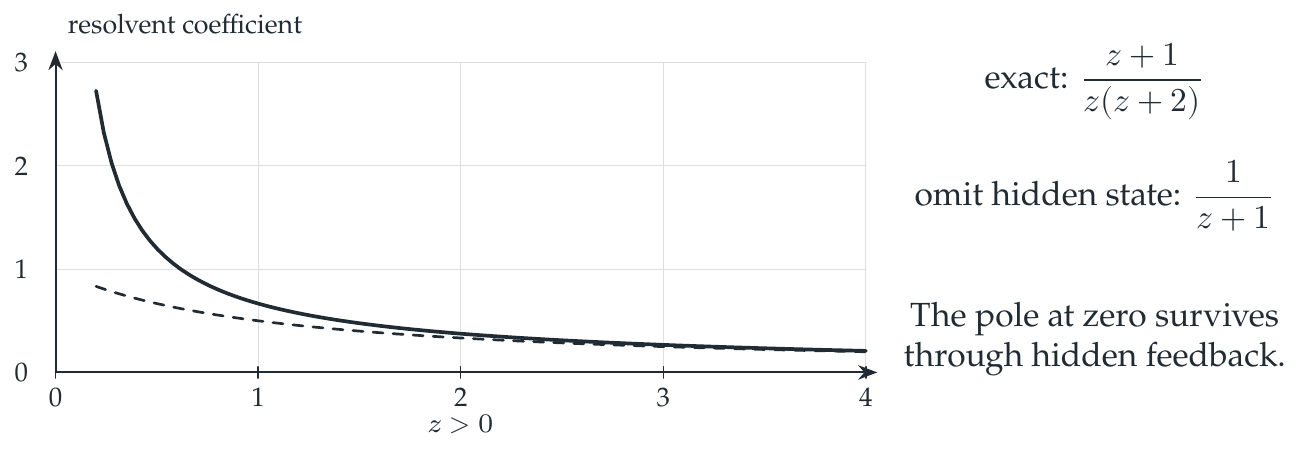
The solid and dashed curves show the two expressions written at right for positive spectral parameter. The source note identifies the pole retained through hidden feedback. The full system and the deleted model use different resolvent coefficients.
Drawing labels and data 14 labels
Read the original labels as selectable text. Tables preserve grid relationships; other short labels are grouped compactly.
- 0
- 1
- 2
- 3
- 4
- 0
- 1
- 2
- 3
- \(z>0\)
- resolvent coefficient
- exact: \(\dfrac{z+1}{z(z+2)}\)
- omit hidden state: \(\dfrac1{z+1}\)
The pole at zero survives
through hidden feedback.
Evidence note from the source edition
The full inverse gives a rational response with two poles, at \(0\) and \(-2\). Its partial fractions are \(R_x(z)=\frac12z^{-1}+\frac12(z+2)^{-1}\). The hidden intermediate inverse has its own excluded point \(z=-1\).
An eliminated variable has not disappeared
If the coupling to the second coordinate were simply deleted, the retained resolvent would be \((z+1)^{-1}\). That has a different pole and a different long-time limit. The correction is frequency dependent, so it cannot be represented by one constant scalar generator on the retained coordinate.
The Schur expression first requires \(z+1\ne0\), as well as invertibility of the full matrix. Its simplified rational form has a removable intermediate singularity at \(z=-1\), where the retained entry of the full inverse is well-defined and equals zero. Simplification does not retroactively make the eliminated block invertible there.
For \(z>0\), the Laplace transform of \((1+e^{-2t})/2\) is exactly \(R_x(z)\). The next page derives the time-domain equation producing that response.
Read this as
The Schur complement is exact elimination, not independent dynamics on a smaller state space. Hidden evolution returns as a \(z\)-dependent self-energy.