
Consider the scalar memory kernel
It has three primary blocks. The middle block carries a Jordan term and must be retained or omitted as a whole for this selection rule. Their certified integrated weights are
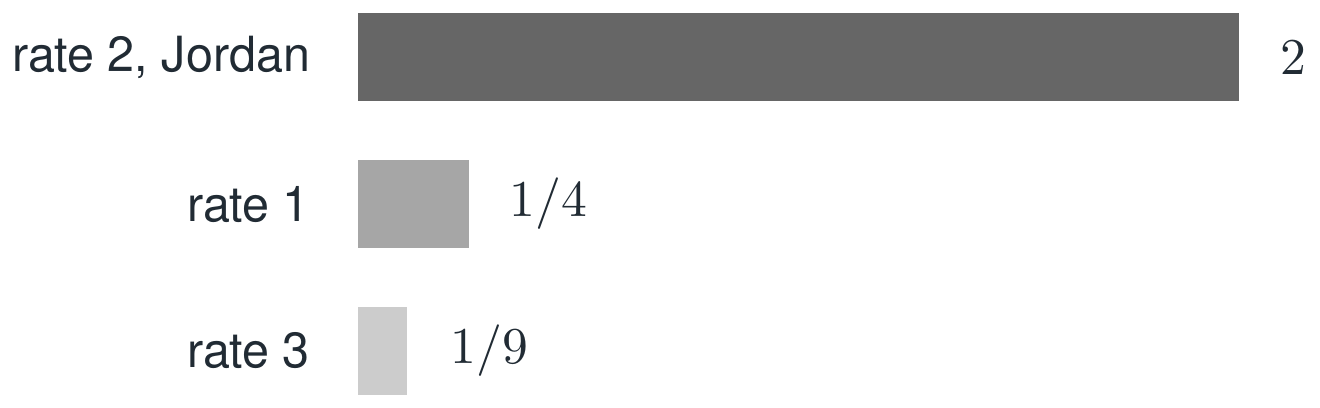
Reading the drawing
Each horizontal bar is labelled by its decay rate and contribution. The longest bar is the Jordan block; the smaller bars represent the two other rates. The plate states the cost and block-count budget for this selection problem.
Drawing labels and data 6 labels
Read the original labels as selectable text. Tables preserve grid relationships; other short labels are grouped compactly.
- rate 2, Jordan
- \(2\)
- rate 1
- \(1/4\)
- rate 3
- \(1/9\)
Evidence note from the source edition
With one primary block retained, choose the middle block and certify omitted weight \(13/36\). With two retained, add the rate-one block and the remaining certificate is \(1/9\).
The slowest eigenvalue is not necessarily the largest effect
The rate-two block has the greatest weight because its couplings and nilpotent contribution dominate. Retaining the slowest rate alone would omit weight \(2+1/9\), a much larger certificate.
The descending order is \(2,1/4,1/9\). A target tolerance \(1/8\) needs two blocks according to this bound: one block leaves \(13/36>1/8\), while two leave \(1/9\le1/8\). Every term in this particular scalar kernel is nonnegative, so its omitted integral equals the certificate.
In general matrix kernels, cancellations can make the true error smaller. The theorem optimizes the sum of omitted block weights, not every possible approximation error. Moreover, a Jordan block may cost several state dimensions. A fixed budget in total hidden dimension is a different optimization problem from a fixed number of primary blocks.
Read this as
The largest-weight rule is exact for its stated certificate and block-count budget. It is not a claim of globally optimal model reduction.