
For this observable example, choose the fixed probability weights \(\pi=(1,2,3,4)/10\). They are not being identified with the stationary law of the earlier symmetric chain. On the same two-block partition, conditional expectation is
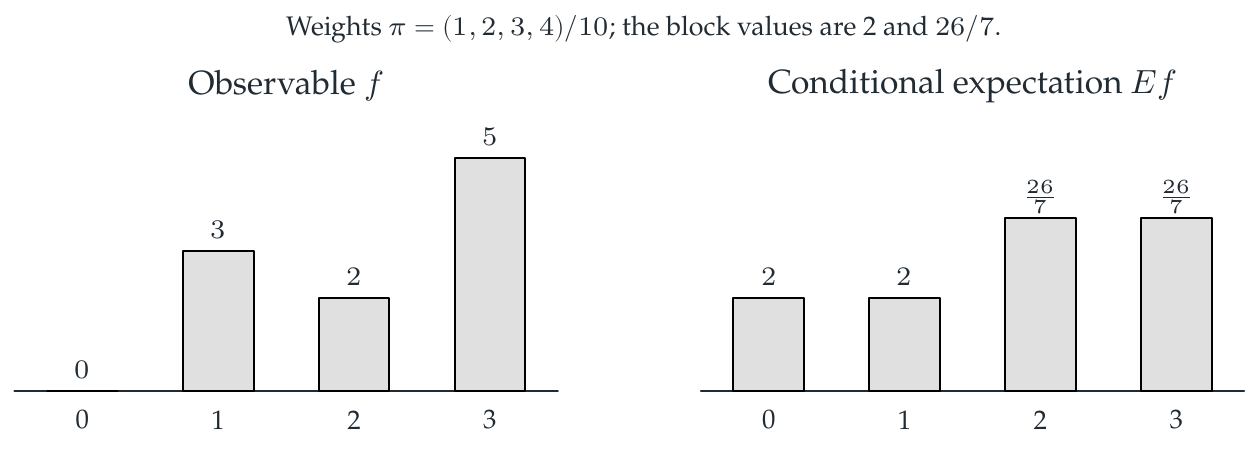
It replaces function values by their weighted block average. In particular, \(f=(0,3,2,5)^{\mathsf T}\) becomes \(Ef=(2,2,26/7,26/7)^{\mathsf T}\).
Reading the drawing
The left panel gives the four observable values. The right panel replaces values inside each block by its weighted average. The weights and the two resulting block values are written above the panels.
Drawing labels and data 19 labels
Read the original labels as selectable text. Tables preserve grid relationships; other short labels are grouped compactly.
- Observable \(f\)
- 0
- \(0\)
- 1
- \(3\)
- 2
- \(2\)
- 3
- \(5\)
- Conditional expectation \(Ef\)
- 0
- \(2\)
- 1
- \(2\)
- 2
\(\frac{26}{7}\)
- 3
\(\frac{26}{7}\)
Weights \(\pi=(1,2,3,4)/10\); the block values are 2 and \(26/7\).
Evidence note from the source edition
The bars are function values, not state probabilities. Their total need not be one. The block masses \(3/10\) and \(7/10\) determine the denominators in the averaging formula.
Which inner product makes this an orthogonal projection?
Put \(W=\operatorname{diag}(\pi)\). Direct multiplication checks
The middle equation is weighted self-adjointness. Ordinary symmetry fails: \(E_{01}=2/3\) whereas \(E_{10}=1/3\). Testing \(E=E^{\mathsf T}\) would therefore reject a correct conditional-expectation projector.
The range consists exactly of functions constant on each block. The error \(f-Ef\) has weighted mean zero inside every block, so it is weighted-orthogonal to every block-constant function. This is the finite projection interpretation of conditional expectation.
In contrast, \(C\) acts on probability columns by summing masses. The shapes of \(C\) and \(E\) differ, and their domains have different interpretations. The notation “coarsening” alone does not specify which operation is intended.
Read this as
An exact weighted projector can be oblique in the unweighted Euclidean picture. Keep the measure and the inner product in the model.