
Write the same system as
Solving the second equation first gives
Substitution is exact:
The hidden initial state produces a separate forcing term. It must be retained even when the memory kernel is known.
Reading the drawing
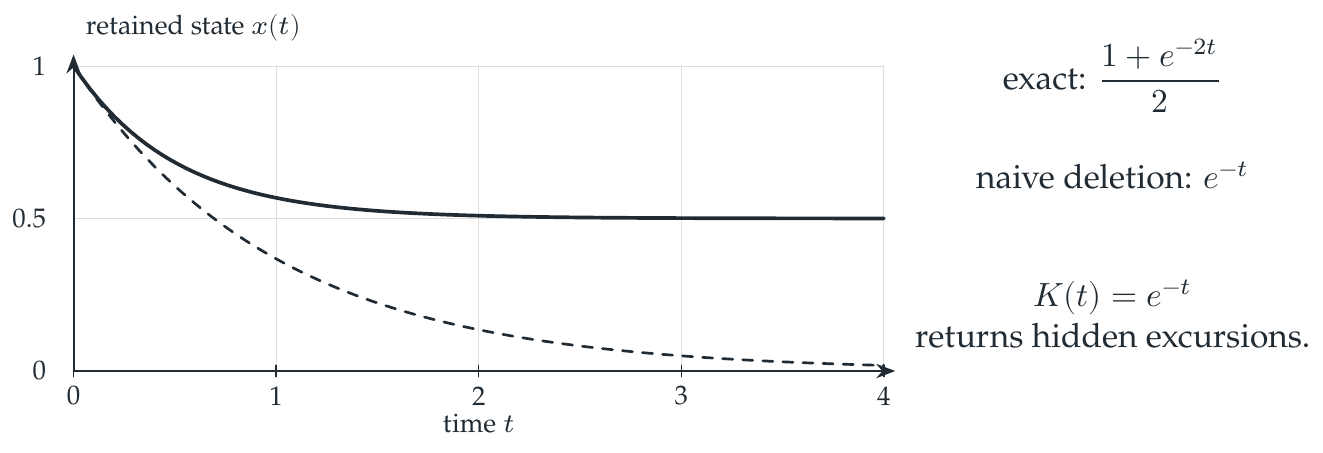
The two curves start together and then separate: the exact retained state approaches a nonzero limit, while the deletion curve decays toward zero. The formulas and memory kernel are written to the right.
Drawing labels and data 13 labels
Read the original labels as selectable text. Tables preserve grid relationships; other short labels are grouped compactly.
- 0
- 1
- 2
- 3
- 4
- 0
- 0.5
- 1
- time \(t\)
- retained state \(x(t)\)
- exact: \(\dfrac{1+e^{-2t}}2\)
- naive deletion: \(e^{-t}\)
\(\displaystyle K(t)=e^{-t}\)
returns hidden excursions.
Evidence note from the source edition
For \((x(0),y(0))=(1,0)\), the exact retained coordinate is \((1+e^{-2t})/2\). The dashed curve \(e^{-t}\) solves the equation obtained by deleting the hidden coordinate rather than eliminating it.
Projection can destroy the semigroup law
Let \(R(t)=(1+e^{-2t})/2\), the response to this fixed initial preparation. At \(t=\log2\),
The full two-state propagator is a semigroup, but this retained scalar response is not. Restarting it as a scalar model silently resets the hidden coordinate, which generally carries information from the first interval.
The appendix verifies the full differential equation, initial condition, integral memory equation, and Laplace resolvent in this model. Its kernel is \(e^{-t}\), whose transform is the self-energy on Visual 21.
Read this as
Exact reduction retains a record of the eliminated state through convolution and initial forcing. A memoryless approximation must justify the information it removes.