
E15 Memory modes and controlled compression
On this page · Permalink · Source line 4629
How to read the result
Stable hidden modes may carry polynomial factors when a Jordan block is present. A spectral gap controls eventual decay, while nonnormal coupling can produce substantial intermediate memory. The compression certificate below is optimal for its declared primary-block selection problem.
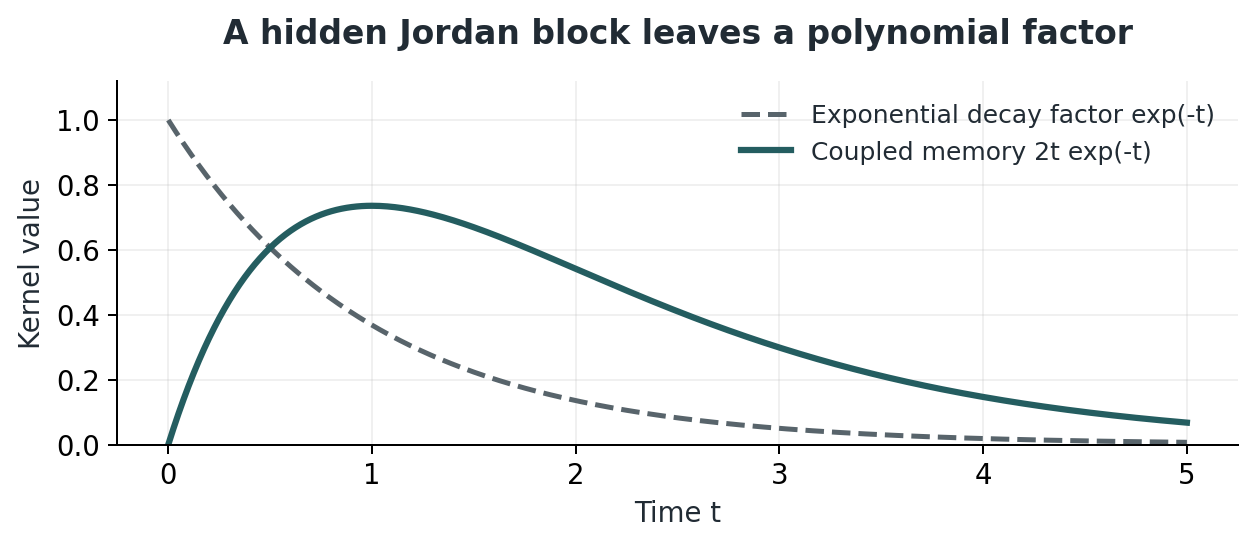
Finite hidden systems produce rational self energies and finite modal memory. This is the state space viewpoint familiar from linear systems theory [Kailath1980]. The same formulas also underlie the Mori Zwanzig representation of reduced dynamics [Zwanzig1961], [ChorinHaldKupferman2000].
Theorem E15.1: Polynomial exponential memory of a finite hidden system
Let \(X_Q\) be a finite dimensional complex space. Let \(\mu_1,\ldots,\mu_r\) be the distinct eigenvalues of \(A_{QQ}\), let \(Q_j\) be the corresponding primary spectral projections, and set
Let \(\nu_j\) be the least positive integer for which \(N_j^{\nu_j}=0\), and define
Then
and
Suppose \(\operatorname{Re}\mu_j<0\) for every \(j\). If \(J\subseteq\{1,\ldots,r\}\) and \({\mathcal K}_J\) retains the complete primary blocks indexed by \(J\), then
Read proof · Visual guide: Keep blocks by their certified contribution · Read statement and proof side by side · Permalink · Source line 4643 · Claim record · Lean coverage · Code · Worked examples
Proof of Theorem E15.1
The primary decomposition gives
with commuting scalar and nilpotent parts on \(Q_jX_Q\). Therefore
Multiplication by \(A_{PQ}\) and \(A_{QP}\) gives the memory formula. On the \(j\)th primary space, the nilpotent resolvent expansion is
Multiplication by the coupling blocks gives the self energy formula for every \(z\) outside the hidden spectrum. Equivalently, on a right half plane it is the Laplace transform identity
Under stability,
Sum the omitted terms.
Back to statement · Read statement and proof side by side · Permalink · Source line 4684 · Claim record · Lean coverage · Code · Worked examples
Corollary E15.2: Optimal selection for the certified primary block bound
Under the stable assumptions of Theorem E15.1, define the primary block weights
Among all sets \(J\) containing \(k\) primary blocks, the certified upper bound
is minimized by retaining the \(k\) largest weights. If
then the least number of retained primary blocks certified to give \(L^1\) error at most \(\varepsilon\) is the least \(k\) for which
Read proof · Visual guide: Keep blocks by their certified contribution · Read statement and proof side by side · Permalink · Source line 4725 · Claim record · Lean coverage · Code · Worked examples
Proof of Corollary E15.2
If a retained set contains a block with smaller weight than an omitted block, exchanging them reduces the omitted weight sum. Repeating the exchange gives the set of the \(k\) largest weights. The tolerance statement is the corresponding sorted tail condition.
Back to statement · Read statement and proof side by side · Permalink · Source line 4748 · Claim record · Lean coverage · Code · Worked examples
Corollary E15.3: Normal hidden dynamics
Suppose \(X_Q\) is a finite dimensional Hilbert space. If \(A_{QQ}\) is normal with spectral resolution
then
where
If \(\operatorname{Re}\mu_j<0\), then
Read proof · Read statement and proof side by side · Permalink · Source line 4752 · Claim record · Lean coverage · Code · Worked examples
Proof of Corollary E15.3
Normality removes every nilpotent part, so \(\nu_j=1\). Apply Theorem E15.1.
Back to statement · Read statement and proof side by side · Permalink · Source line 4776 · Claim record · Lean coverage · Code · Worked examples
Corollary E15.4: Pole order and hidden Jordan depth
Every finite hidden block produces a strictly proper rational self energy. At an eigenvalue \(\mu_j\), its pole order is at most the size of the largest Jordan block of \(A_{QQ}\) at \(\mu_j\). Equality holds when the corresponding highest coefficient \(B_{j,\nu_j-1}\) is nonzero.
Read proof · Visual guide: Two auxiliary states realize a repeated pole · Read statement and proof side by side · Permalink · Source line 4780 · Claim record · Lean coverage · Code · Worked examples
Proof of Corollary E15.4
Read the pole order from the partial fraction expansion in Theorem E15.1.
Back to statement · Read statement and proof side by side · Permalink · Source line 4784 · Claim record · Lean coverage · Code · Worked examples
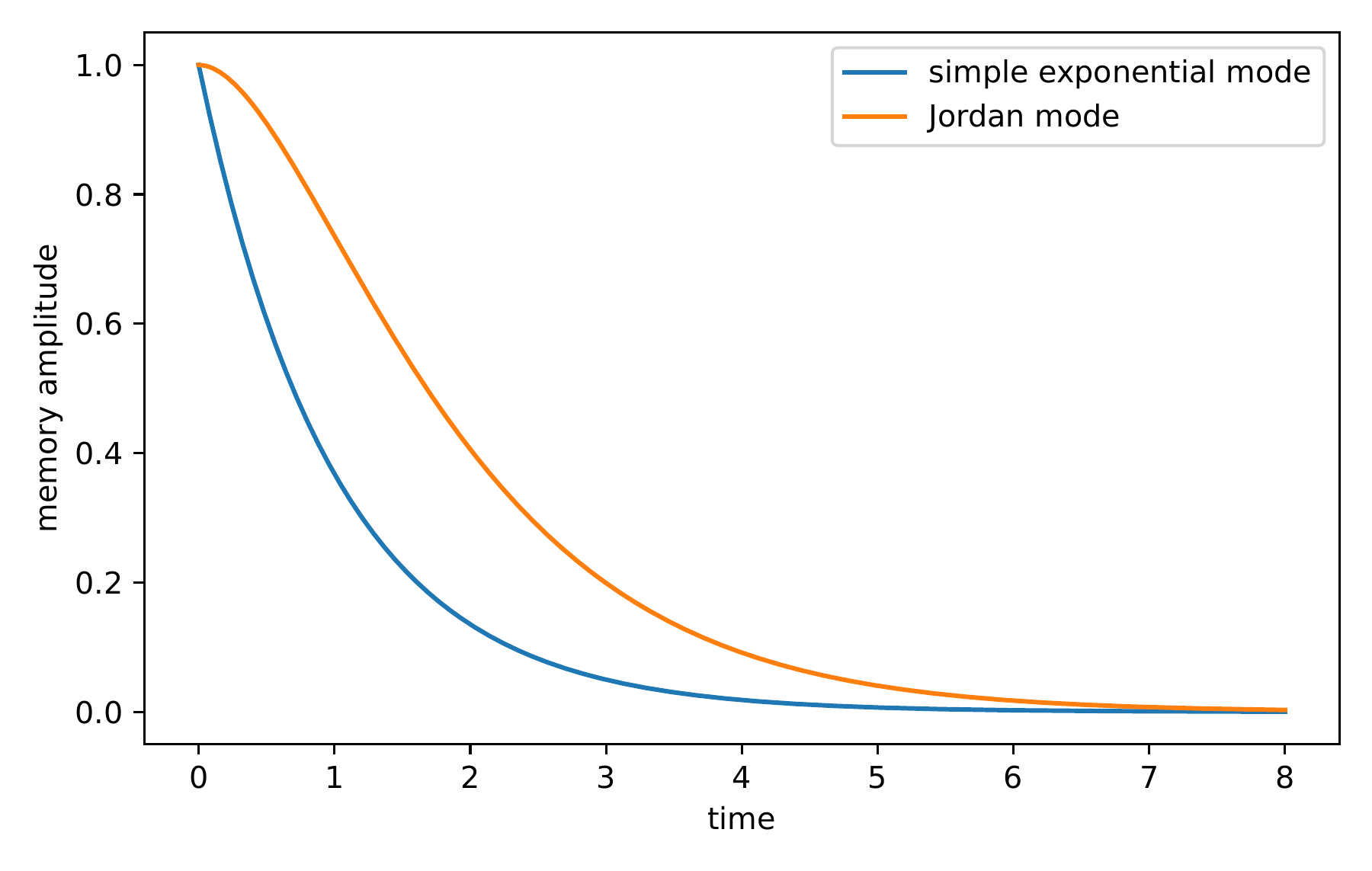
Corollary E15.5: Finite auxiliary state realization
Every kernel of the form
can be represented exactly by adjoining the finite auxiliary state
A nonzero auxiliary initial state adds the explicit forcing \(B{\mathrm e}^{tD}y(0)\). The self energy of the augmented system is
Read proof · Visual guide: Two auxiliary states realize a repeated pole · Read statement and proof side by side · Permalink · Source line 4795 · Claim record · Lean coverage · Code · Worked examples
Proof of Corollary E15.5
Eliminate \(y\) by variation of constants or apply Theorem E14.1 to the augmented block matrix.
Back to statement · Read statement and proof side by side · Permalink · Source line 4814 · Claim record · Lean coverage · Code · Worked examples
Theorem E15.6: Volterra stability under kernel compression
Let \(S(t)\) be a strongly continuous semigroup on a Banach space \(X\), fix \(T>0\), and assume
Let \(K,\widetilde K\in L^1((0,T),\mathcal B(X))\), let \(g\in L^1((0,T),X)\), and let \(x,\widetilde x\in C([0,T],X)\). Suppose these are mild solutions with the same initial state and forcing, except that \(K\) is replaced by \(\widetilde K\):
Assume
Set
Then
Read proof · Visual guide: A kernel certificate becomes a trajectory certificate · Read statement and proof side by side · Permalink · Source line 4818 · Claim record · Lean coverage · Code · Worked examples
Proof of Theorem E15.6
Let
Subtract the two mild equations. Fubini's theorem and the triangle inequality give
For \(t\leq T\), replace the last factor \(t\) by \(T\) and apply Gronwall's inequality.
Back to statement · Read statement and proof side by side · Permalink · Source line 4855 · Claim record · Lean coverage · Code · Worked examples
Corollary E15.7: Trajectory bound for modal truncation
Under the assumptions of Theorem E15.1 and Theorem E15.6, replacing \({\mathcal K}\) by \({\mathcal K}_J\) changes the retained trajectory by at most
Read proof · Read statement and proof side by side · Permalink · Source line 4871 · Claim record · Lean coverage · Code · Worked examples
Proof of Corollary E15.7
Insert the \(L^1\) error from Theorem E15.1 into Theorem E15.6.
Back to statement · Read statement and proof side by side · Permalink · Source line 4883 · Claim record · Lean coverage · Code · Worked examples
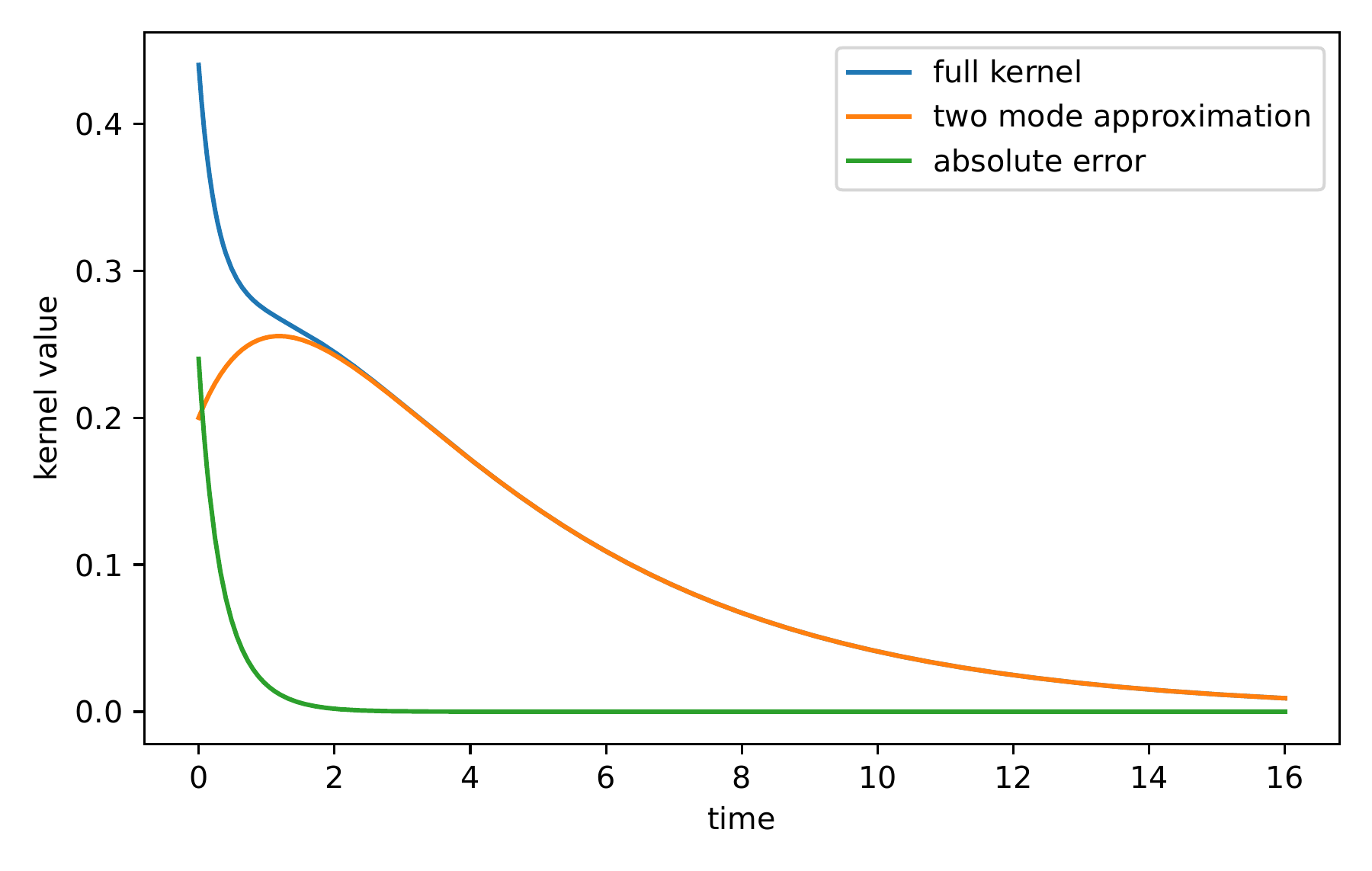
Remark E15.8
A finite hidden realization is exact for rational self energy. A general memory kernel may require infinitely many modes or a continuum of modes. The compression theorem gives a stability estimate once an \(L^1\) approximation has been supplied. The largest weight rule is optimal for the certified blockwise bound. It need not minimize the true kernel error when different modal terms cancel.