E7 Gaussian transfer and Hermite packets
On this page · Permalink · Source line 3117
Let \(\gamma\) be the standard Gaussian probability measure on \({\mathbb R}\). For \(t\geq0\), define the Ornstein Uhlenbeck transfer
Let \(H_n\) be the probabilists' Hermite polynomial defined by
and set \(h_n=H_n/\sqrt{n!}\).
Theorem E7.1: Ornstein Uhlenbeck semigroup
The operators \(({\mathcal O}_t)_{t\geq0}\) form a positive Markov contraction semigroup on \(L^p(\gamma)\) for every \(1\leq p\leq\infty\). On \(L^2(\gamma)\), the semigroup is self adjoint and
The family \((h_n)_{n\geq0}\) is an orthonormal basis of \(L^2(\gamma)\).
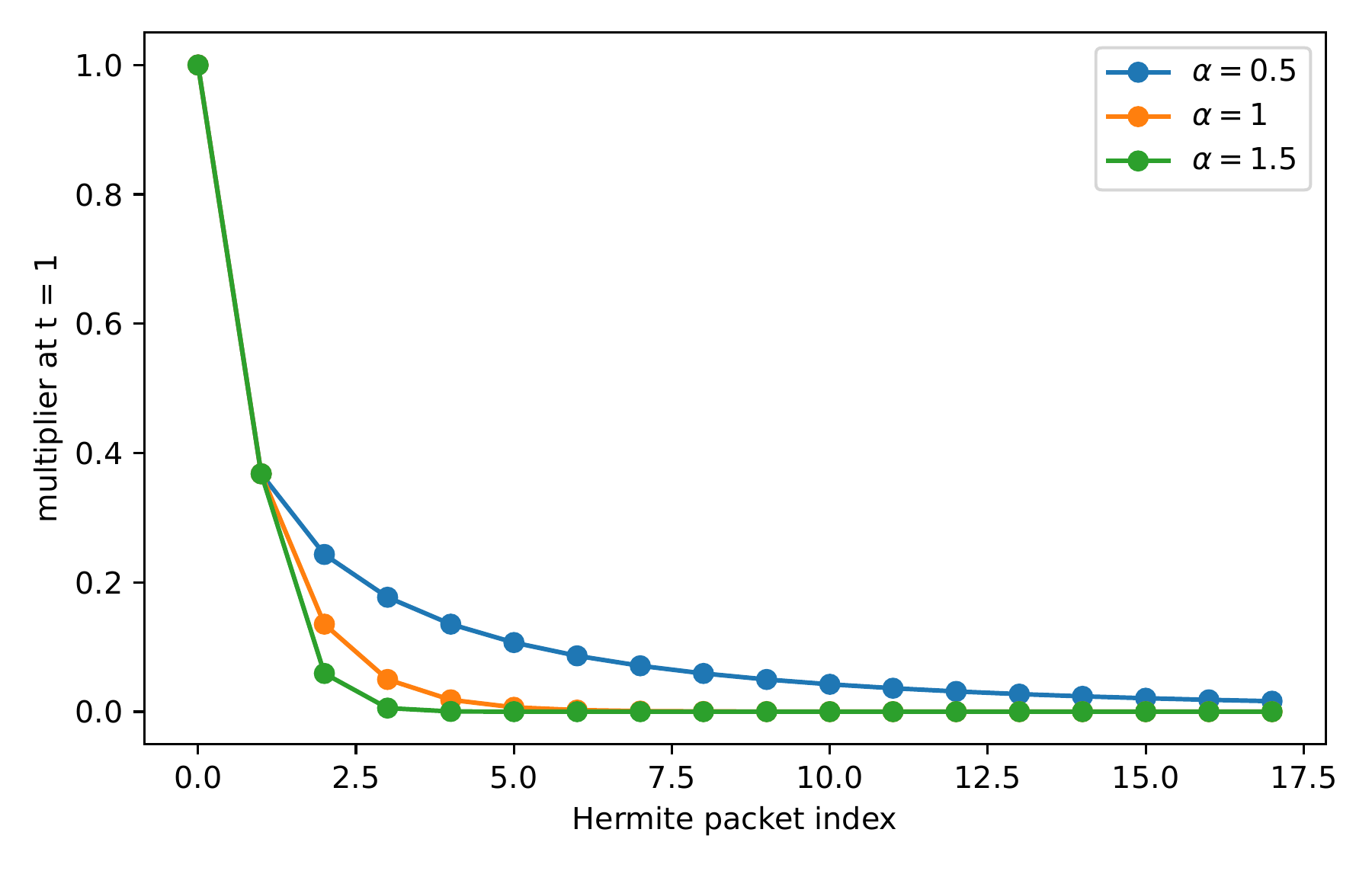
Read proof · Visual guide: Gaussian packets have separate clocks · Read statement and proof side by side · Permalink · Source line 3137 · Claim record · Lean coverage · Code · Worked examples
Proof of Theorem E7.1
Positivity and preservation of constants follow from the integral formula. If \(X\) and \(Y\) are independent standard Gaussian variables, then
has the same distribution as
with \(Z\) standard Gaussian. This proves the semigroup law. Jensen's inequality and invariance of \(\gamma\) give the \(L^p\) contraction. The joint Gaussian pair
is symmetric under interchange, which proves self adjointness.
Apply \({\mathcal O}_t\) to the Hermite generating function. Gaussian integration gives
Comparison of coefficients proves the eigenvalue formula. The same generating function shows
The Hermite polynomials span all polynomials, and polynomials are dense in \(L^2(\gamma)\). Hence the normalized family is an orthonormal basis. See [Janson1997] for the general Gaussian Hilbert space setting.
Back to statement · Read statement and proof side by side · Permalink · Source line 3145 · Claim record · Lean coverage · Code · Worked examples
Corollary E7.2: Hermite packet reconstruction
Let \(P_n\) be the orthogonal projection onto \({\mathbb C} h_n\). Then
in the strong operator topology and
For \(f\in L^2(\gamma)\),
Read proof · Visual guide: Gaussian packets have separate clocks · Read statement and proof side by side · Permalink · Source line 3192 · Claim record · Lean coverage · Code · Worked examples
Proof of Corollary E7.2
Apply Parseval's identity and the eigenvalue formula in Theorem E7.1.
Back to statement · Read statement and proof side by side · Permalink · Source line 3212 · Claim record · Lean coverage · Code · Worked examples
Proposition E7.3: Generator and Dirichlet form
On the polynomial subspace, the infinitesimal generator of \(({\mathcal O}_t)\) is the differential operator
It satisfies
For every polynomial \(f\),
Read proof · Read statement and proof side by side · Permalink · Source line 3216 · Claim record · Lean coverage · Code · Worked examples
Proof of Proposition E7.3
Write
For a polynomial \(f\), Taylor expansion at \(x\) and Gaussian integration give
Every omitted term is a polynomial in the Gaussian variable multiplied by a quantity that is \(o(t)\), so the expansion may be integrated term by term. Therefore
The Hermite eigenvalue identity also follows by differentiating \( {\mathcal O}_th_n={\mathrm e}^{-nt}h_n \) at zero. Gaussian integration by parts gives
Set \(g=f'\) and rearrange.
Back to statement · Read statement and proof side by side · Permalink · Source line 3233 · Claim record · Lean coverage · Code · Worked examples
Corollary E7.4: Gaussian spectral gap
If \(f\in L^2(\gamma)\) has mean zero, then
For every polynomial \(f\),
Read proof · Visual guide: Gaussian packets have separate clocks · Read statement and proof side by side · Permalink · Source line 3269 · Claim record · Lean coverage · Code · Worked examples
Proof of Corollary E7.4
A mean zero function has no \(h_0\) component, so every surviving Hermite multiplier is at most \({\mathrm e}^{-t}\). For a polynomial
Then
Apply Proposition E7.3.
Back to statement · Read statement and proof side by side · Permalink · Source line 3284 · Claim record · Lean coverage · Code · Worked examples
Corollary E7.5: Fractional Hermite transfer
Let \(-{\mathcal L}\) be the nonnegative Ornstein Uhlenbeck number operator with
For every \(\alpha>0\),
This is a contraction semigroup on \(L^2(\gamma)\).
Read proof · Visual guide: Gaussian packets have separate clocks · Read statement and proof side by side · Permalink · Source line 3300 · Claim record · Lean coverage · Code · Worked examples
Proof of Corollary E7.5
The spectral theorem applies to the orthonormal Hermite basis. Every multiplier has modulus at most one and obeys the scalar semigroup law.
Back to statement · Read statement and proof side by side · Permalink · Source line 3315 · Claim record · Lean coverage · Code · Worked examples