
E2 Packet resolved semigroups
On this page · Permalink · Source line 2039
Let \(X\) be a complex Banach space. A finite packet system is a family of bounded idempotents
such that
No orthogonality is needed in this section.
Definition E2.1: Packet resolved transfer system
A packet resolved transfer system is a triple
consisting of a Banach state space, a bounded generator, and a finite packet system. A marked transfer system also includes an initial state or source \(s\in X\). The topology and all limiting operations are supplied by the ambient Banach space structure.
Permalink · Source line 2053 · Claim record · Lean coverage · Code · Worked examples
Definition E2.2: Packet blocks
For \(B\in\mathcal B(X)\), define
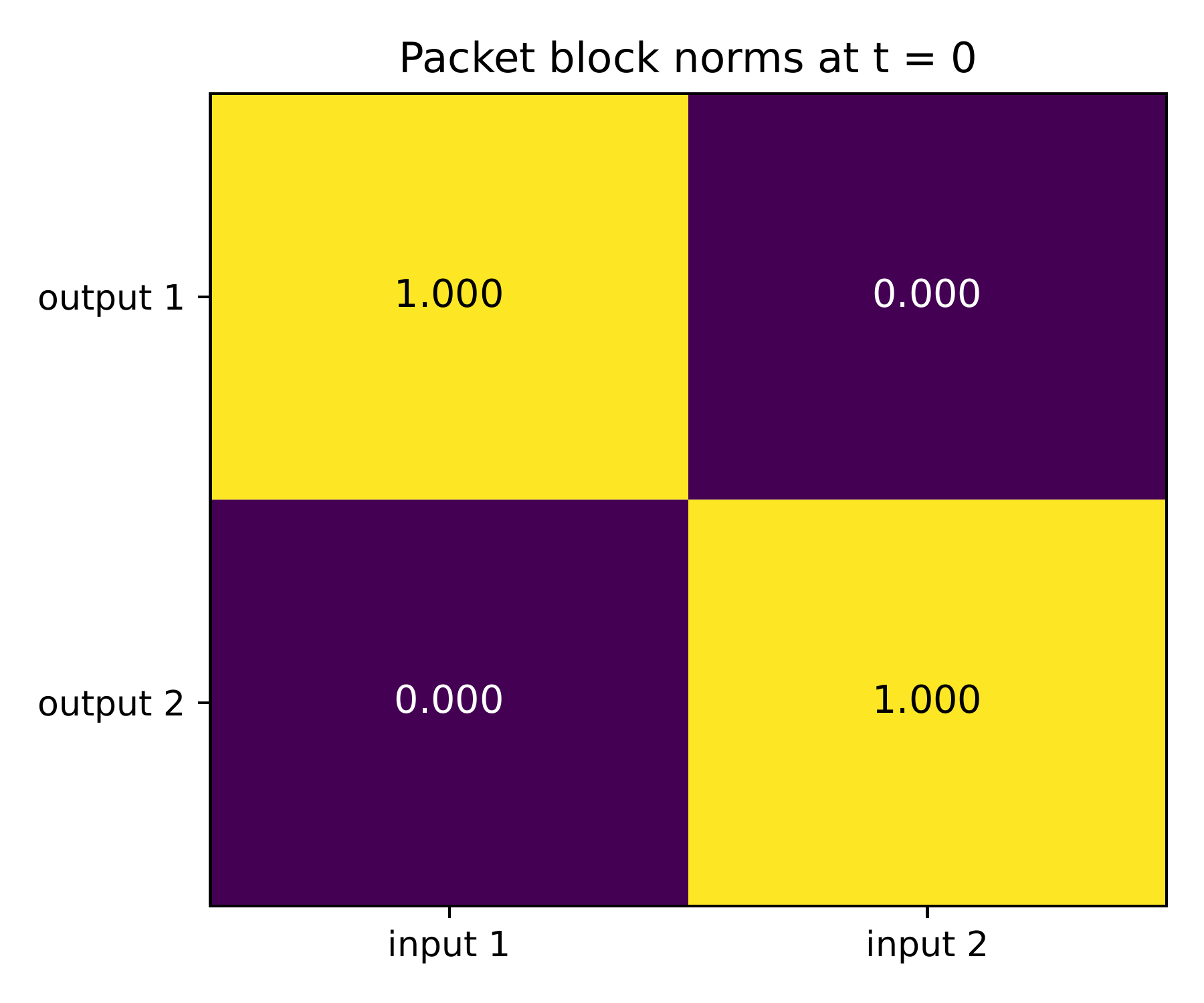
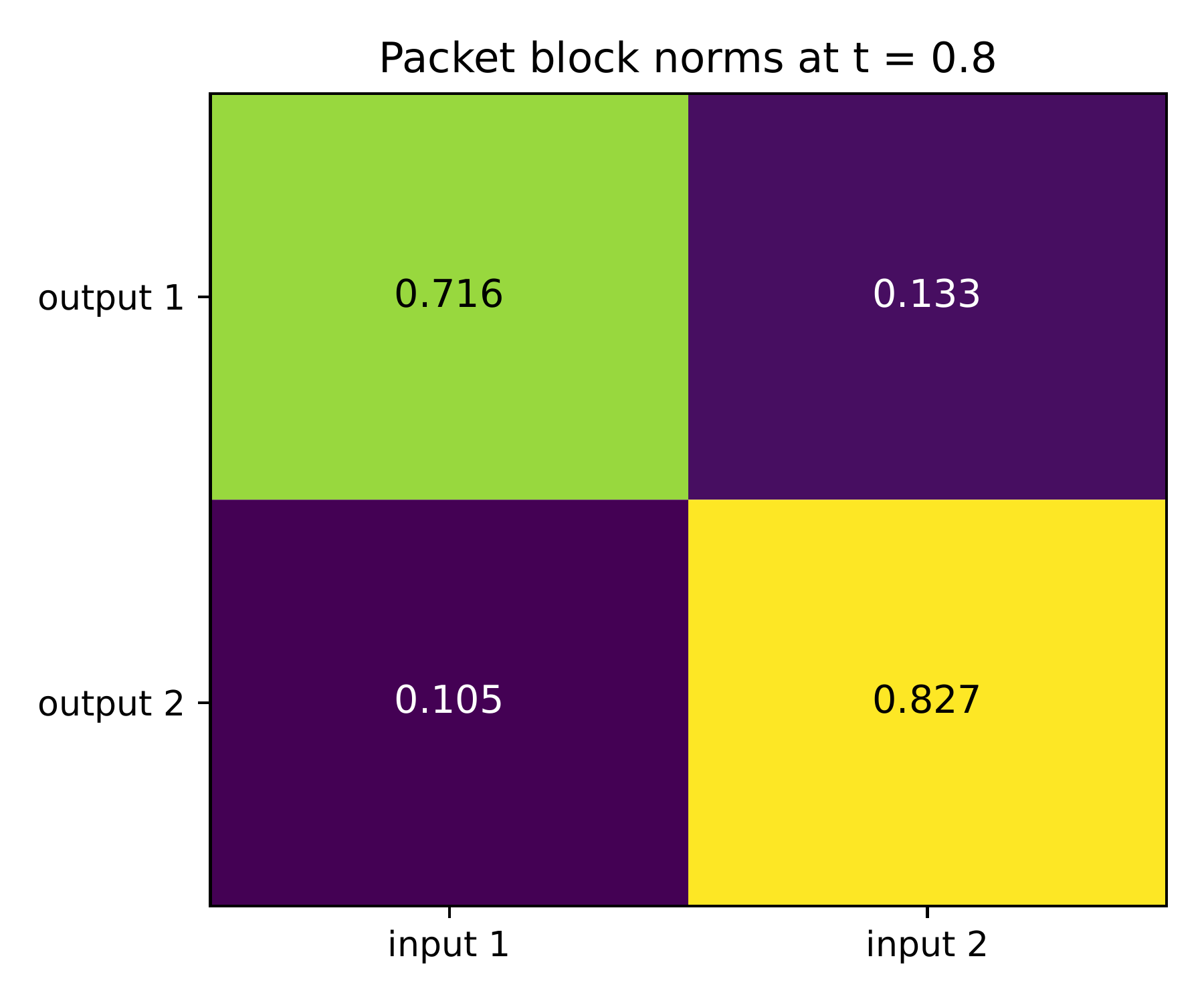
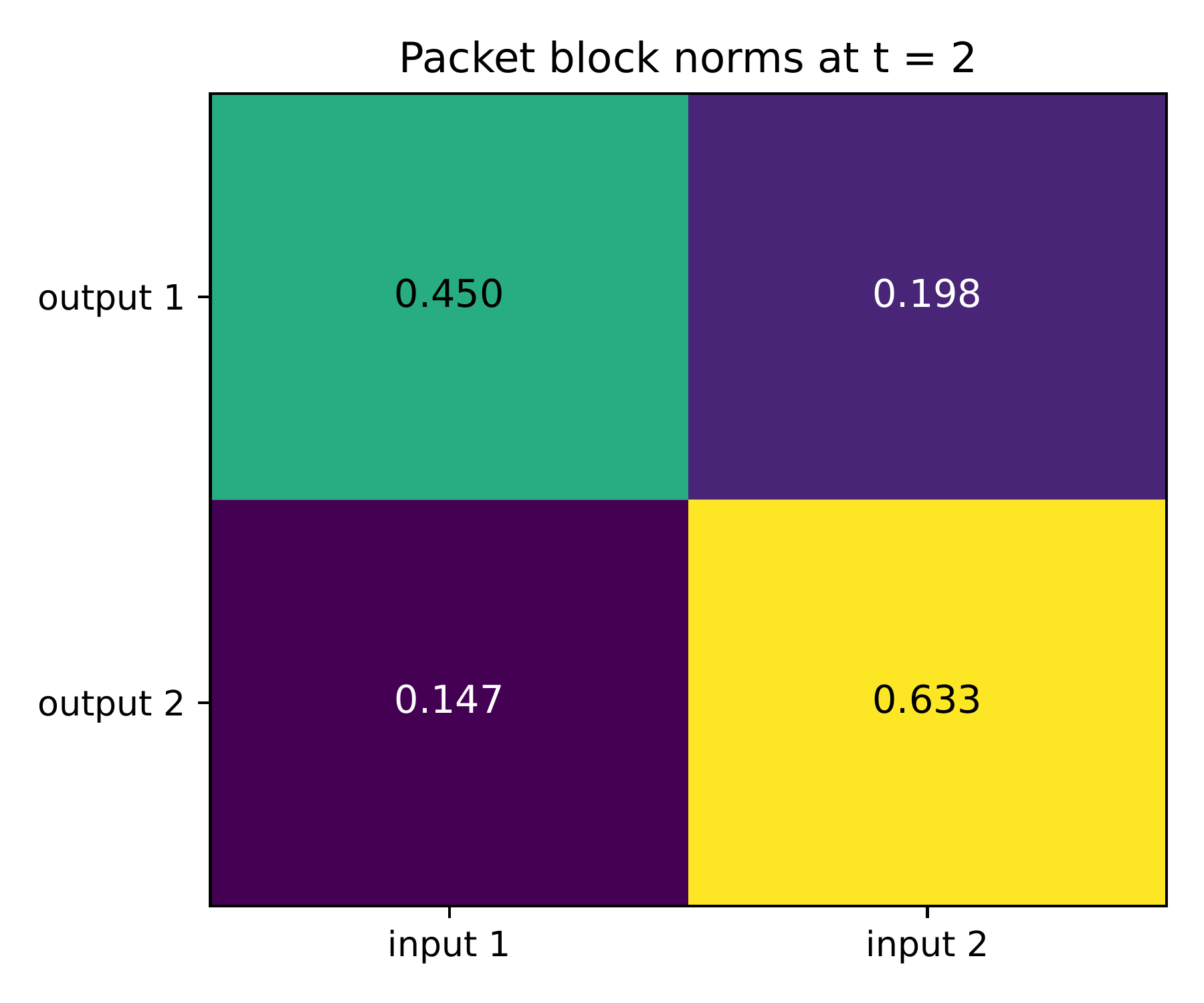
If \(A\in\mathcal B(X)\) and \(T(t)={\mathrm e}^{tA}\), write
Permalink · Source line 2061 · Claim record · Lean coverage · Code · Worked examples
Theorem E2.3: Semigroup and packet convolution
For every bounded operator \(A\), the family \(T(t)={\mathrm e}^{tA}\) is a uniformly continuous group and
For every \(\alpha,\beta\in I\),
Read proof · Read statement and proof side by side · Permalink · Source line 2072 · Claim record · Lean coverage · Code · Worked examples
Proof of Theorem E2.3
The exponential series converges in operator norm. Since every power of \(A\) commutes with every other power, the Cauchy product gives the group law. Inserting \(I_X=\sum_\gamma P_\gamma\) between the two factors gives the block formula.
Back to statement · Read statement and proof side by side · Permalink · Source line 2086 · Claim record · Lean coverage · Code · Worked examples
Proposition E2.4: Block differential system
The packet blocks are differentiable in operator norm and satisfy
Their initial values are
Read proof · Read statement and proof side by side · Permalink · Source line 2090 · Claim record · Lean coverage · Code · Worked examples
Proof of Proposition E2.4
Differentiate \(T(t)\) in operator norm and insert the packet resolution between \(A\) and \(T(t)\), then between \(T(t)\) and \(A\).
Back to statement · Read statement and proof side by side · Permalink · Source line 2107 · Claim record · Lean coverage · Code · Worked examples
Theorem E2.5: Laplace resolvent and packet transform
Let \(A\in\mathcal B(X)\), let \(T(t)={\mathrm e}^{tA}\), and let
Then the Bochner integral converges in operator norm and
For every pair of packets,
Read proof · Read statement and proof side by side · Permalink · Source line 2111 · Claim record · Lean coverage · Code · Worked examples
Proof of Theorem E2.5
The estimate \({\left\lVert T(t)\right\rVert}\leq{\mathrm e}^{t{\left\lVert A\right\rVert}}\) gives absolute convergence of the operator valued integral. Let
Since \(T'(t)=AT(t)=T(t)A\), integration by parts gives
The same calculation on the other side gives \( R(z)(zI-A)=I \). Multiplication by \(P_\beta\) and \(P_\alpha\) may be passed under the norm convergent integral, which gives the packet formula.
Back to statement · Read statement and proof side by side · Permalink · Source line 2131 · Claim record · Lean coverage · Code · Worked examples
Corollary E2.6: Resolvent expansion over packet paths
With \(A=D+N\) as in the directed path decomposition, let
If
then
After multiplication by \(P_\beta\) and \(P_\alpha\), the term of order \(m\) is a sum over directed packet paths of length \(m\) from \(\alpha\) to \(\beta\).
Read proof · Read statement and proof side by side · Permalink · Source line 2153 · Claim record · Lean coverage · Code · Worked examples
Proof of Corollary E2.6
Factor
and expand the second inverse by its norm convergent Neumann series. The diagonal resolvent preserves each packet and every factor \(N\) changes the packet along an active transfer edge.
Back to statement · Read statement and proof side by side · Permalink · Source line 2172 · Claim record · Lean coverage · Code · Worked examples
Theorem E2.7: Reducing packet criterion
The following conditions are equivalent.
\(AP_\alpha=P_\alpha A\) for every \(\alpha\).
\(A_{\beta\alpha}=0\) whenever \(\beta\neq\alpha\).
\(T_{\beta\alpha}(t)=0\) whenever \(\beta\neq\alpha\) and \(t\in{\mathbb R}\).
Every packet space \(P_\alpha X\) is invariant under \(T(t)\) for every \(t\).
When these conditions hold,
Read proof · Read statement and proof side by side · Permalink · Source line 2180 · Claim record · Lean coverage · Code · Worked examples
Proof of Theorem E2.7
The first two conditions are equivalent because the packet resolution gives
A block diagonal generator has block diagonal powers, so the second condition implies the third. Differentiating the off diagonal blocks at zero proves the converse. The equivalence with invariance follows from the definition of the blocks. The final identity follows by restricting the exponential series.
Back to statement · Read statement and proof side by side · Permalink · Source line 2196 · Claim record · Lean coverage · Code · Worked examples
E2.1 Directed path expansion
On this page · Permalink · Source line 2223
Set
The operator \(D\) preserves every packet and \(N\) contains only transfers between distinct packets.
Theorem E2.8: Dyson expansion over packet paths
For \(t\geq0\),
The series converges absolutely in operator norm. After multiplication by \(P_\beta\) and \(P_\alpha\), the term of order \(m\) is a sum over directed packet paths of length \(m\) from \(\alpha\) to \(\beta\).
Read proof · Visual guide: Acyclic paths stop after finitely many transfers · Read statement and proof side by side · Permalink · Source line 2233 · Claim record · Lean coverage · Code · Worked examples
Proof of Theorem E2.8
Write the variation of constants identity
Iterating the identity gives the displayed series. The norm of the term of order \(m\) is at most
The majorant is summable. Inserting the packet resolution around every factor \(N\) leaves only products whose consecutive packet labels are joined by nonzero transfer blocks.
Back to statement · Read statement and proof side by side · Permalink · Source line 2251 · Claim record · Lean coverage · Code · Worked examples
Corollary E2.9: Termination on an acyclic transfer graph
Suppose the directed graph with an edge \(\alpha\to\beta\) whenever \(P_\beta NP_\alpha\neq0\) is acyclic. If its longest directed path has length \(q\), then every Dyson term of order greater than \(q\) vanishes.
Read proof · Visual guide: Acyclic paths stop after finitely many transfers · Read statement and proof side by side · Permalink · Source line 2267 · Claim record · Lean coverage · Code · Worked examples
Proof of Corollary E2.9
Every nonzero term of order \(m\) contains a directed transfer path of length \(m\). An acyclic graph has no path longer than \(q\).
Back to statement · Read statement and proof side by side · Permalink · Source line 2271 · Claim record · Lean coverage · Code · Worked examples