13 Exact elimination of latent packets
On this page · Visual guide: Three ways to reduce a model · Permalink · Source line 1479
The central idea
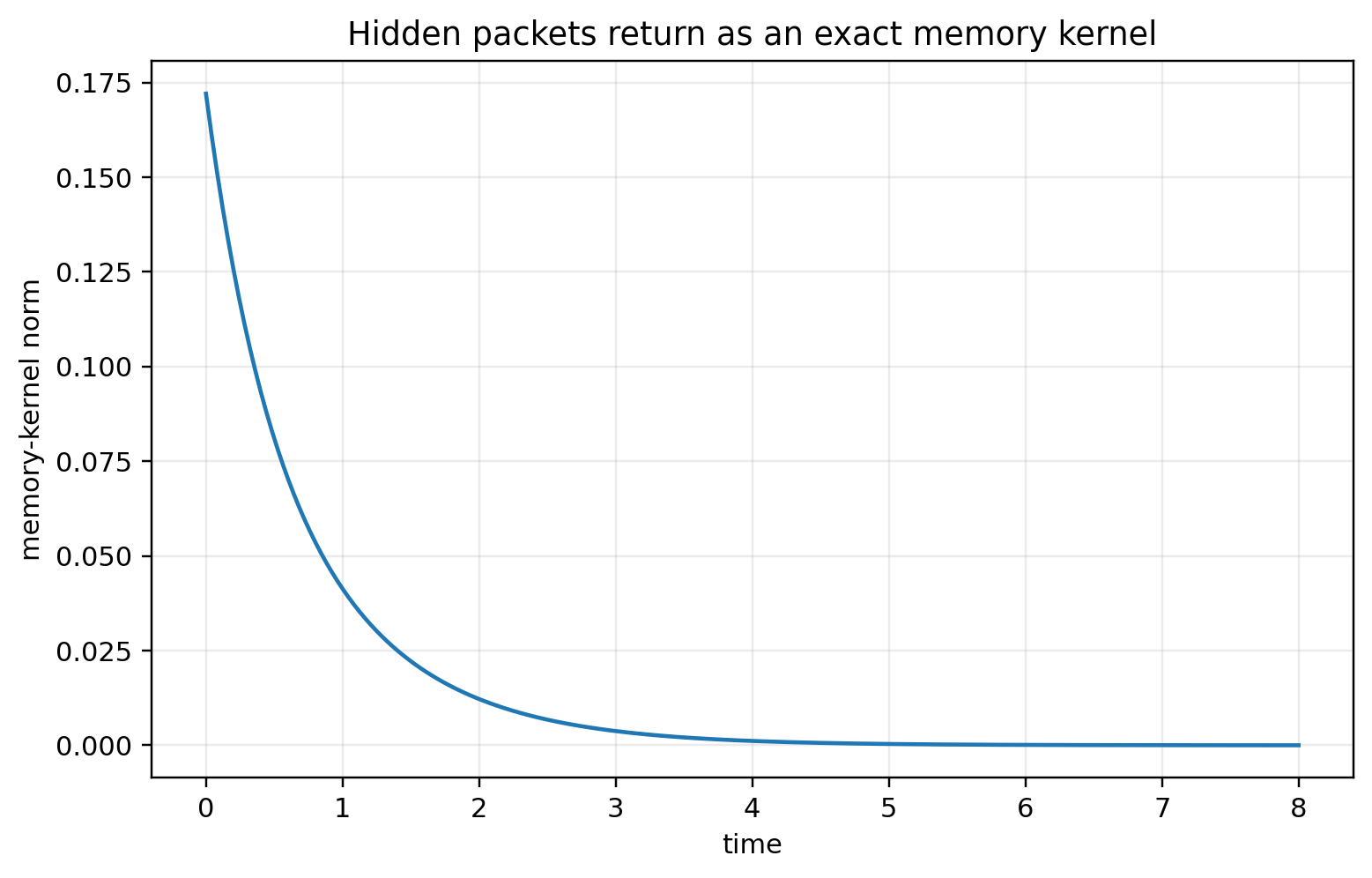
Elimination removes hidden coordinates from the displayed state, but their future influence survives. The resolvent stores that influence as a self energy. The time description stores it as a memory kernel. Both descriptions refer to the same declared block system.
Let \(X=P X\oplus Q X\) and write
Theorem 13.1: Schur–Feshbach projected resolvent
Assume both \(zI-A\) and \(zI-A_{QQ}\) are invertible. Define
Then
Read proof · Visual guide: Elimination makes a frequency-dependent term · Read statement and proof side by side · Permalink · Source line 1494 · Claim record · Lean coverage · Code · Worked examples
Proof of Theorem 13.1
Solve the hidden block equation
for \(x_Q\) and substitute it into the retained equation. The resulting retained coefficient is \(F_P(z)\). Invertibility of the full operator and of the hidden block implies invertibility of this Schur complement. Setting \(y_Q=0\) gives the stated identity as an operator on \({\operatorname{Ran}} P\). Equivalently, this is the block inverse formula.
Back to statement · Read statement and proof side by side · Permalink · Source line 1510 · Claim record · Lean coverage · Code · Worked examples
The self-energy
contains the exact effect of the eliminated packets. A bare truncation \(A_{PP}\) discards this term and is generally not exact.
13.1 Time-domain memory
On this page · Permalink · Source line 1524
For the homogeneous system \(\dot x=Ax\), variation of constants gives
Substitution yields
where
Theorem 13.2: Memory/self-energy correspondence
For finite complex block matrices, assume \(\operatorname{Re}z>\operatorname{Re}\lambda\) for every \(\lambda\in\sigma(A_{QQ})\). Then the following improper integral is absolutely convergent and
Read proof · Visual guide: Hidden state returns as memory · Visual guide: A repeated pole remembers a Jordan chain · Read statement and proof side by side · Permalink · Source line 1544 · Claim record · Lean coverage · Code · Worked examples
Proof of Theorem 13.2
Put \(B=A_{QQ}\) and \(T_z(t)=e^{-zt}e^{tB}=e^{t(B-zI)}\). The generalized-eigenspace decomposition in finite dimensions writes \(T_z\) as a finite sum of constant matrix coefficients times \(t^k e^{(\lambda-z)t}\). This follows by expanding the nilpotent part on each generalized eigenspace; equivalently, apply the decomposition to left multiplication by \(B\) on the matrix algebra and evaluate the exponential at \(I\). The strict spectral inequality makes every such term absolutely integrable on \((0,\infty)\) and forces it to tend to zero. Hence \(T_z\) is Bochner integrable and \(T_z(t)\to0\), including when \(B\) is nonnormal.
Let \(J=\int_0^\infty T_z(t)\,dt\). Integrating both derivative identities \(T_z'=(B-zI)T_z=T_z(B-zI)\) and using \(T_z(0)=I\) gives
Thus \(J=(zI-B)^{-1}\). Continuous left and right multiplication carry the Bochner integral through the two rectangular transfer blocks, yielding the claim.
Back to statement · Read statement and proof side by side · Permalink · Source line 1555 · Claim record · Lean coverage · Code · Worked examples