Paper VIReading edition

Finite-state Feynman--Kac transfer

Reading tools
Reading libraryFind statementsInspect Lean
Switch work

Saved reading

Read side by side

Start reading

Resources & source

Original TeX with line links · Download TeX

The wording and mathematics follow the retained manuscript. This reading format does not add a proof review or extend Lean coverage.

Skip contents and start reading

12 Finite-state Feynman–Kac transfer

Let \(K\) be a column-stochastic matrix, let \(V\) be a potential on the states, and let \(f\) be terminal data. Define

\[ M_V={\operatorname{diag}}(e^{-V})K^T. \]

The backward Feynman–Kac value after \(n\) steps is

\[ u_n=M_V^nf. \]

Theorem 12.1: Discrete Feynman–Kac path formula

For an initial state \(i\),

\[ \boxed{ (u_n)_i = {\mathbb E}_i\left[ \exp\left(-\sum_{r=0}^{n-1}V(X_r)\right)f(X_n) \right]. } \]

Proof of Theorem 12.1

For \(n=1\),

\[ (M_Vf)_i=e^{-V(i)}\sum_jK_{j i}f_j, \]

which is the stated expectation. Iterating and expanding the matrix product sums over every path \((i=i_0,i_1,\ldots,i_n)\) with probability \(\prod_rK_{i_{r+1},i_r}\) and weight \(\prod_re^{-V(i_r)}\).

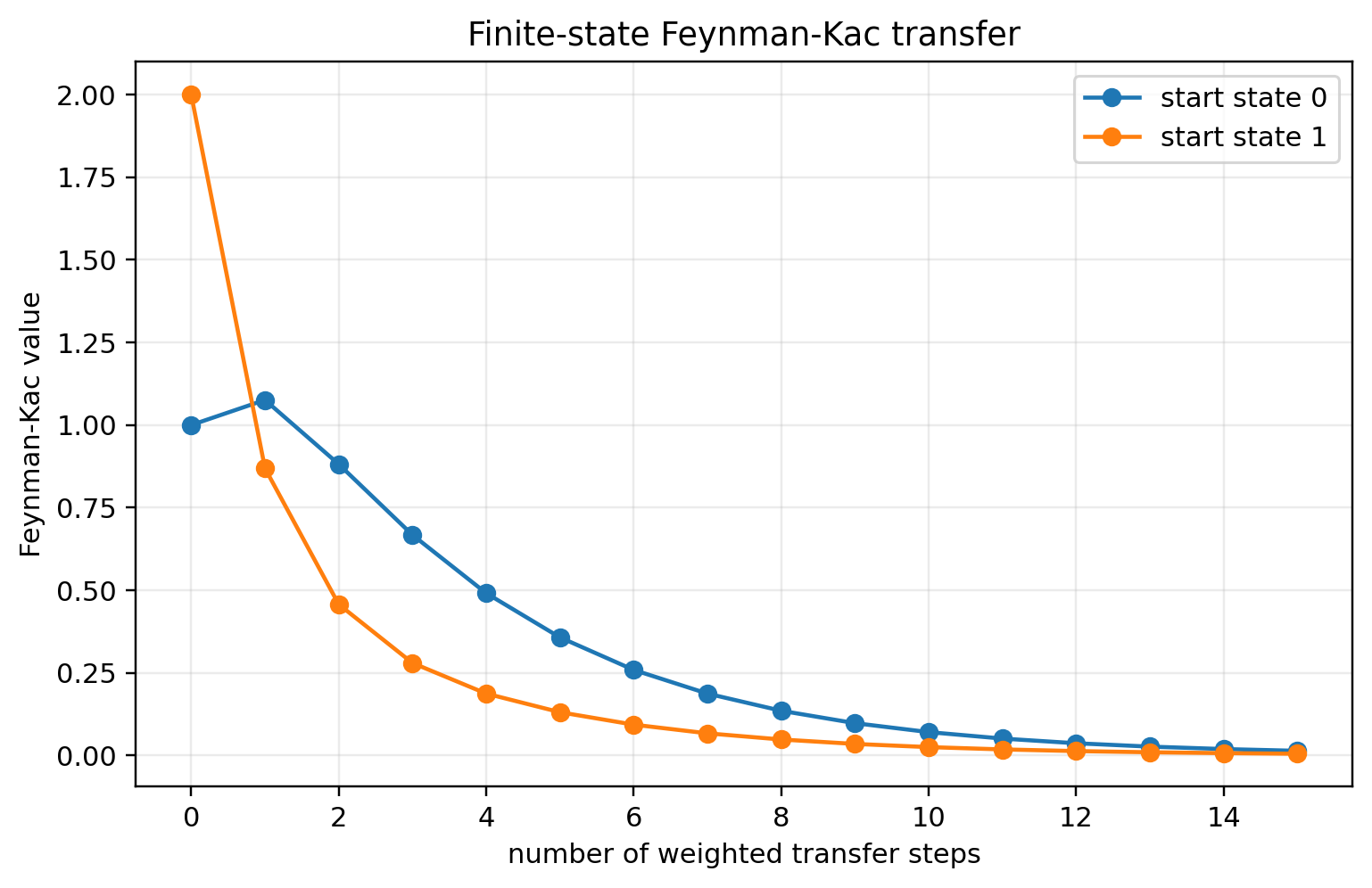
Potential-weighted transfer values computed by the finite Feynman--Kac operator. Exhaustive path enumeration agrees with the matrix formula in the supplied tests.
Potential-weighted transfer values computed by the finite Feynman–Kac operator. Exhaustive path enumeration agrees with the matrix formula in the supplied tests.

View full-size figure (new tab)

Source and conversion record

Source SHA-256: 736e615131f57daf341b6cb0600761d58950450947c85d433206148cca228333

Unsupported prose commands stop the build. The mathematical expression sequence is checked against the source, with manuscript macros expanded for display.

Conversion records

Notation in Paper VI

Look up a symbol without leaving this chapter. Select text before opening help to search for it.

Search this work’s notation.

    Symbols can have different meanings in different passages. Read each result in its own context.

    Open the full notation index