
7 Bayesian conditioning as a normalized nonlinear operator
On this page · Visual guide: A dictionary with orientations · Permalink · Source line 723
Let \(p=(p_i)\) be a probability vector and let \(\lambda=(\lambda_i)\) be a nonnegative likelihood with positive evidence
Define
This map is nonlinear solely because of its scalar reconstruction factor.
Theorem 7.1: Independent-likelihood composition
For nonnegative likelihoods \(\lambda\) and \(\mu\), assume \(Z_\lambda(p)>0\) and \(Z_{\lambda\odot\mu}(p)>0\). Equivalently, both successive updates have positive evidence. Then
Read proof · Visual guide: Evidence changes shape and mass · Visual guide: A nonlinear semigroup of odds · Read statement and proof side by side · Permalink · Source line 739 · Claim record · Lean coverage · Code · Worked examples
Proof of Theorem 7.1
The first normalization appears in both numerator and denominator of the second update and cancels:
Back to statement · Read statement and proof side by side · Permalink · Source line 750 · Claim record · Lean coverage · Code · Worked examples
7.1 Packet evidence and reconstruction
On this page · Permalink · Source line 759
Let the state indices be partitioned into packets \(I_\alpha\). Define
Theorem 7.2: Bayesian packet reconstruction
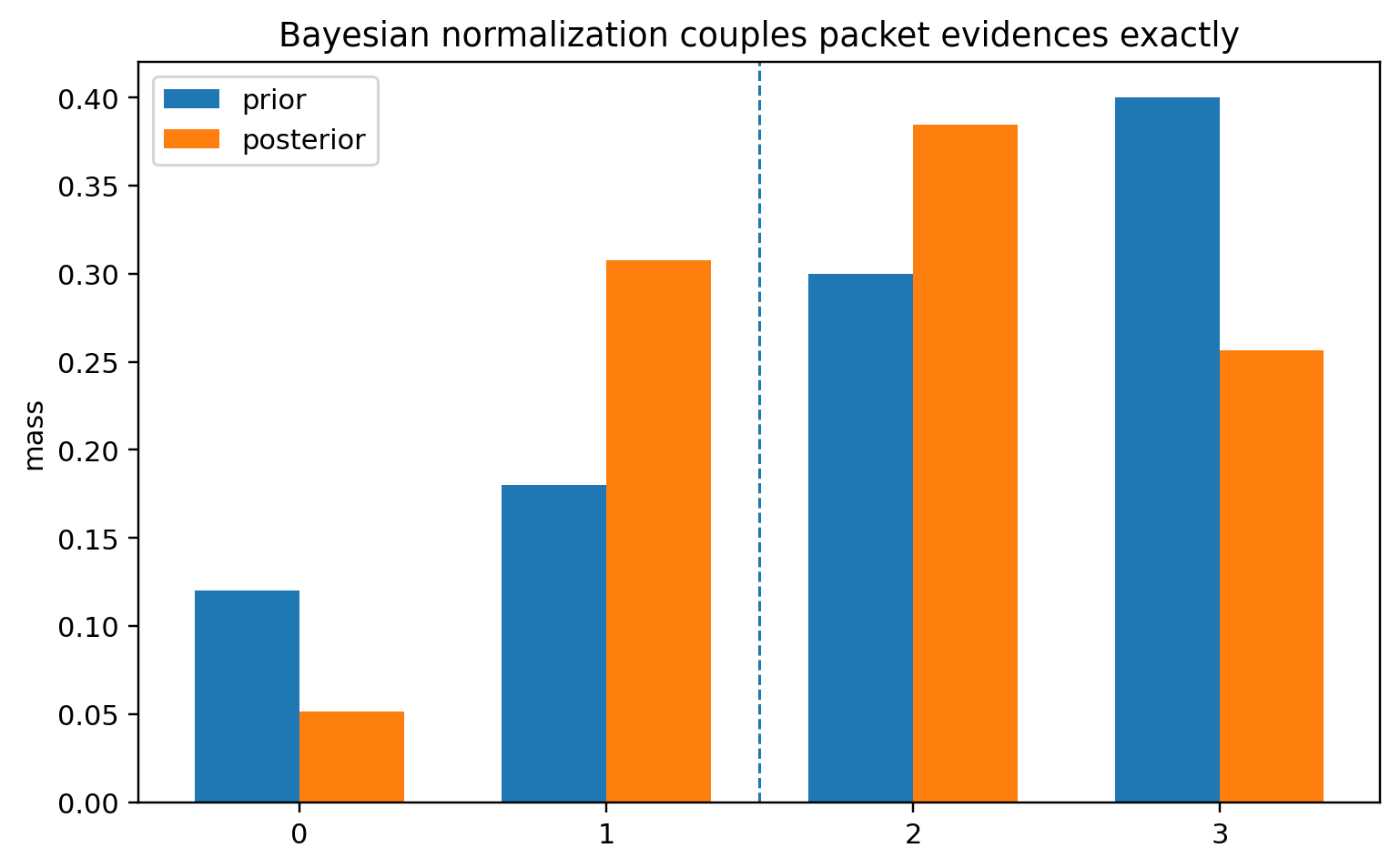
Only packets with positive evidence carry a conditional probability vector. A zero-evidence packet has zero posterior mass and contributes the zero vector. The nonlinear coupling between packets occurs only through the total evidence used to normalize the packet evidences.
Read proof · Visual guide: Evidence changes shape and mass · Read statement and proof side by side · Permalink · Source line 773 · Claim record · Lean coverage · Code · Worked examples
Proof of Theorem 7.2
If \(Z_\alpha=0\), nonnegativity implies \(\lambda_i p_i=0\) for every \(i\in I_\alpha\), so the reconstruction identity holds with both sides zero. For \(Z_\alpha>0\) and \(i\in I_\alpha\),
The packet supports are disjoint, so summing reconstructs the full posterior.
Back to statement · Read statement and proof side by side · Permalink · Source line 784 · Claim record · Lean coverage · Code · Worked examples
Theorem 7.3: Likelihood perturbation bound
Let \(p\) be fixed and let \(\lambda,\mu\ge0\) have positive evidences \(Z_\lambda,Z_\mu\). Then
Read proof · Visual guide: Evidence changes shape and mass · Read statement and proof side by side · Permalink · Source line 803 · Claim record · Lean coverage · Code · Worked examples
Proof of Theorem 7.3
Add and subtract \(\mu\odot p/Z_\lambda\) and use the triangle inequality:
The second term equals \(|Z_\lambda-Z_\mu|/Z_\lambda\) and is bounded by the same weighted \(L^1\) difference divided by \(Z_\lambda\). Interchanging \(\lambda\) and \(\mu\) gives the minimum-evidence form.
Back to statement · Read statement and proof side by side · Permalink · Source line 814 · Claim record · Lean coverage · Code · Worked examples