
2 Packet blocks of a semigroup
On this page · Visual guide: Three ways to reduce a model · Visual guide: A dictionary with orientations · Permalink · Source line 355
The central idea
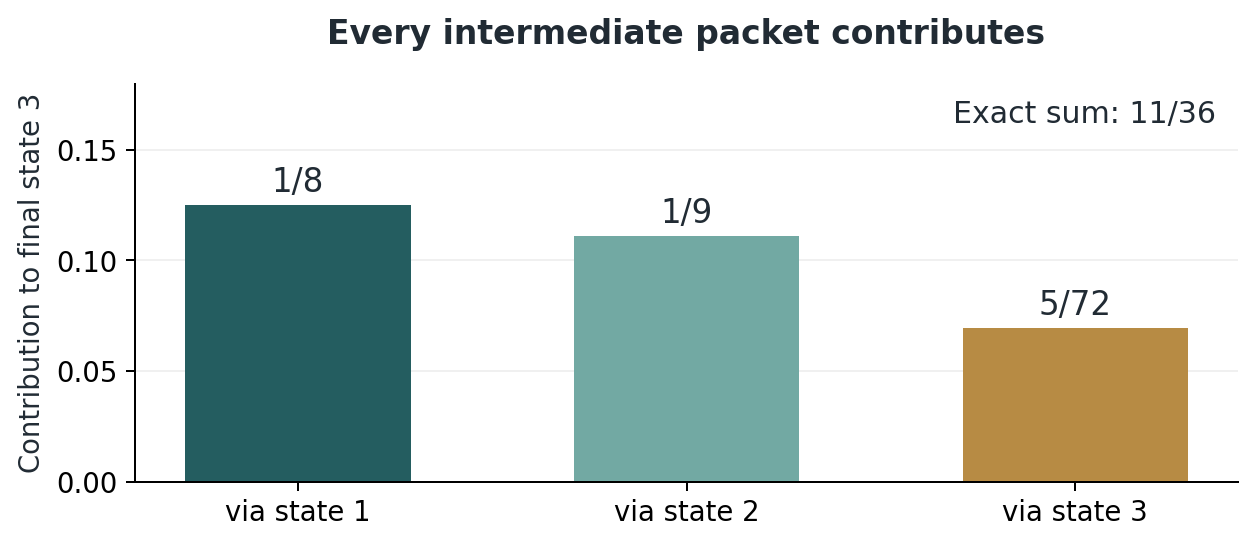
A packet block remembers both the origin and the destination. Composition must sum over every intermediate packet, because an unobserved intermediate coordinate can carry a real contribution. The original formulas below express this bookkeeping exactly.
Let
For any operator \(B\), define
Then
For the semigroup, write
Theorem 2.1: Packet semigroup convolution
For every \(s,t\) and every pair of packets \(\alpha,\beta\),
Thus the semigroup law becomes ordinary matrix multiplication in the packet indices.
Read proof · Visual guide: One evolution, two packet choices · Read statement and proof side by side · Permalink · Source line 386 · Claim record · Lean coverage · Code · Worked examples
Proof of Theorem 2.1
Insert the resolution of the identity between the two semigroup factors:
Back to statement · Read statement and proof side by side · Permalink · Source line 397 · Claim record · Lean coverage · Code · Worked examples
Corollary 2.2: Reducing packets
If \(P_\beta AP_\alpha=0\) for every \(\beta\ne\alpha\), then
for every \(t\). Each packet evolves independently under \(P_\alpha AP_\alpha\).
Read proof · Visual guide: One evolution, two packet choices · Read statement and proof side by side · Permalink · Source line 409 · Claim record · Lean coverage · Code · Worked examples
Proof of Corollary 2.2
The hypothesis makes \(A\) block diagonal. Every power \(A^m\) is block diagonal with respect to the same projectors, and therefore so is the exponential series.
Back to statement · Read statement and proof side by side · Permalink · Source line 418 · Claim record · Lean coverage · Code · Worked examples
Remark 2.3: Path expansion
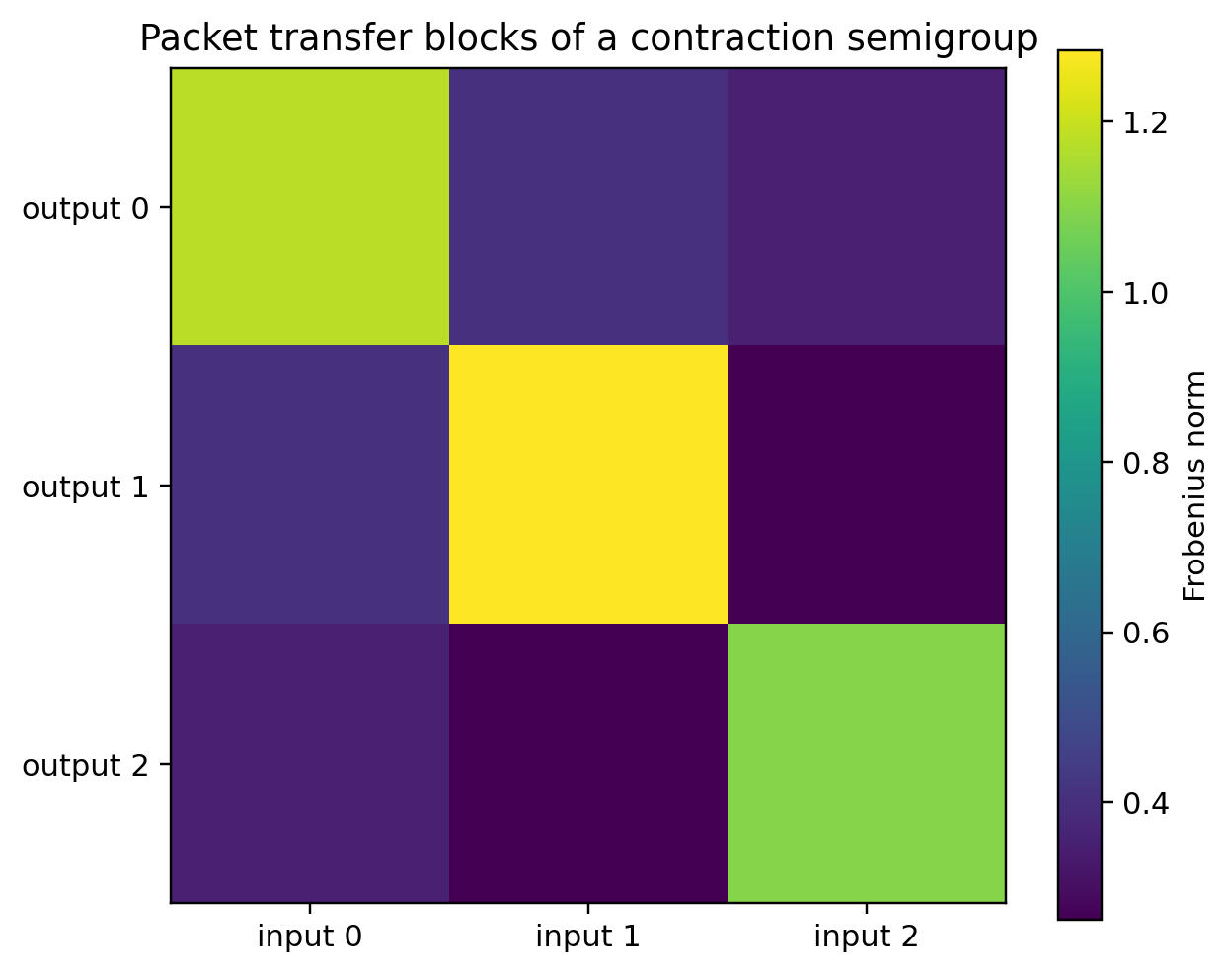
Expanding the exponential and inserting \(I=\sum_\alpha P_\alpha\) between every pair of generators gives
Every coefficient is therefore a sum over packet-transfer paths. The numerical library verifies that truncating this path series converges to the ordinary matrix exponential.