
Amplitudes and probabilities tell different stories
On this page · Permalink · Source line 157
Measurement squares magnitudes; interference depends on coherent amplitude before that step.
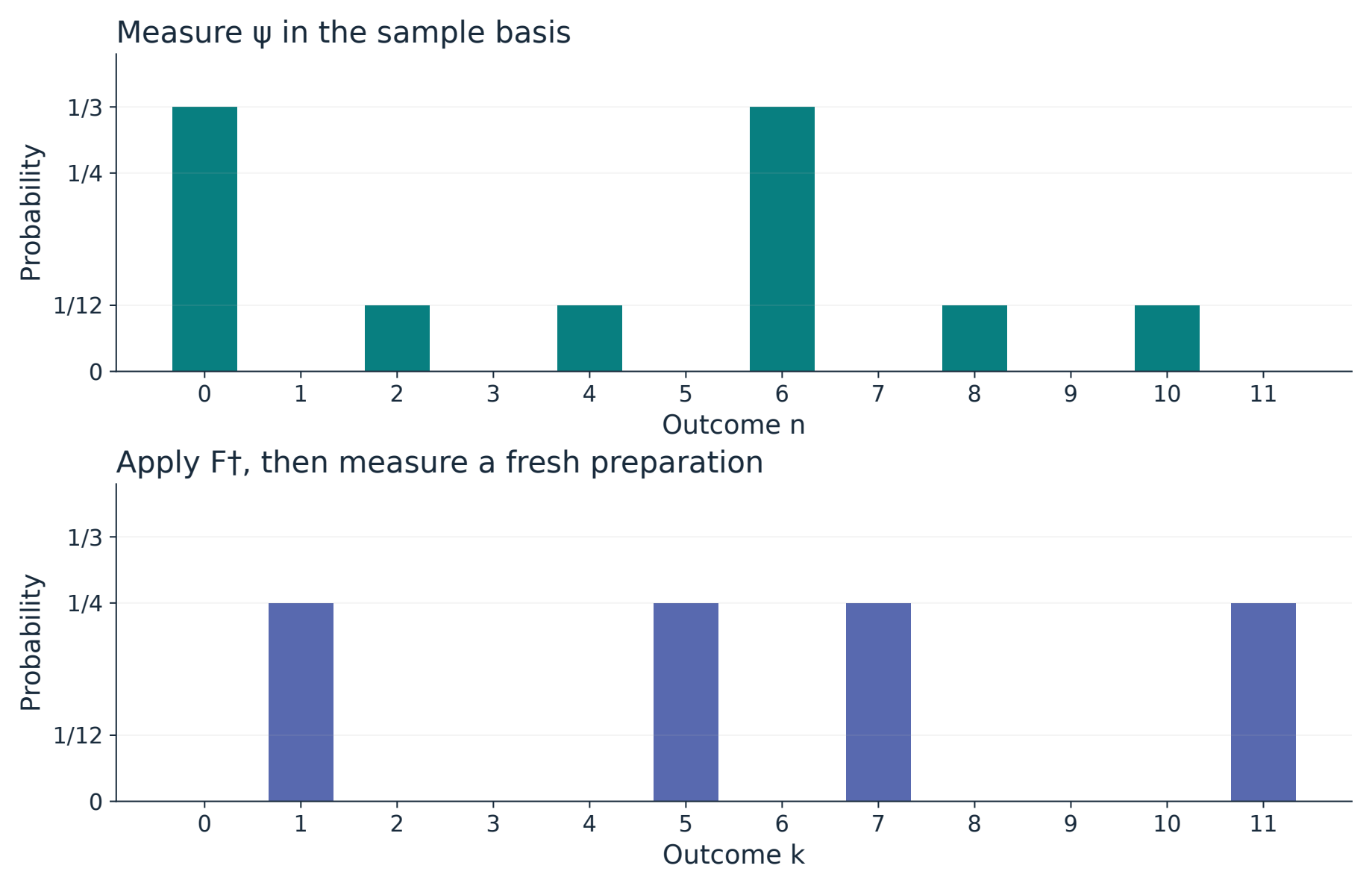
The first procedure gives probabilities \(c_{12}(n)^2/48\). The second gives probability \(1/4\) at each of \(1,5,7,11\) and zero elsewhere. One run returns one outcome. Measuring the sample basis first does not leave the original coherent state available for the second procedure. These distributions are alternative experimental choices, rather than successive readouts of one unchanged state.