
8.2 Catalytic holonomy, excursion geometry, and resource reuse
On this page · Permalink · Source line 214
8.2.1 Subgroup metrics and Schreier loops
On this page · Permalink · Source line 222
Assume first that the restricted and ambient models are groups
For \(h\in H\), the intrinsic and ambient word metrics are
In the group-metric statements, the generating alphabets are symmetric and a generator and its inverse have equal cost. The quotient geometry is the left Schreier graph \(G/H\), with edges \(gH\longmapsto sgH\). For the base-fiber assertion below, assume also \(\mathcal S_H=\mathcal S_G\cap H\). This last condition excludes additional ambient primitives that already lie in \(H\) but have no equally cheap restricted realization.
Theorem 8.10: Holonomy-compression identity
Let every generator have unit cost. For \(h\in H\), \(\ell_G(h)\) is the minimum length of a based loop in \(G/H\) whose lifted word has holonomy \(h\). The intrinsic length \(\ell_H(h)\) is the minimum length among loops that remain in the base fiber.
Proof
An ambient word \(s_k\cdots s_1=h\) projects to the loop
Conversely, a based Schreier loop has product in \(H\). If every prefix lies in \(H\), each edge label is the product of two elements of \(H\) and belongs to \(\mathcal S_G\cap H=\mathcal S_H\). Conversely every restricted word remains in the base fiber. Minimizing the labeled words with endpoint \(h\) gives the two asserted lengths.
Thus
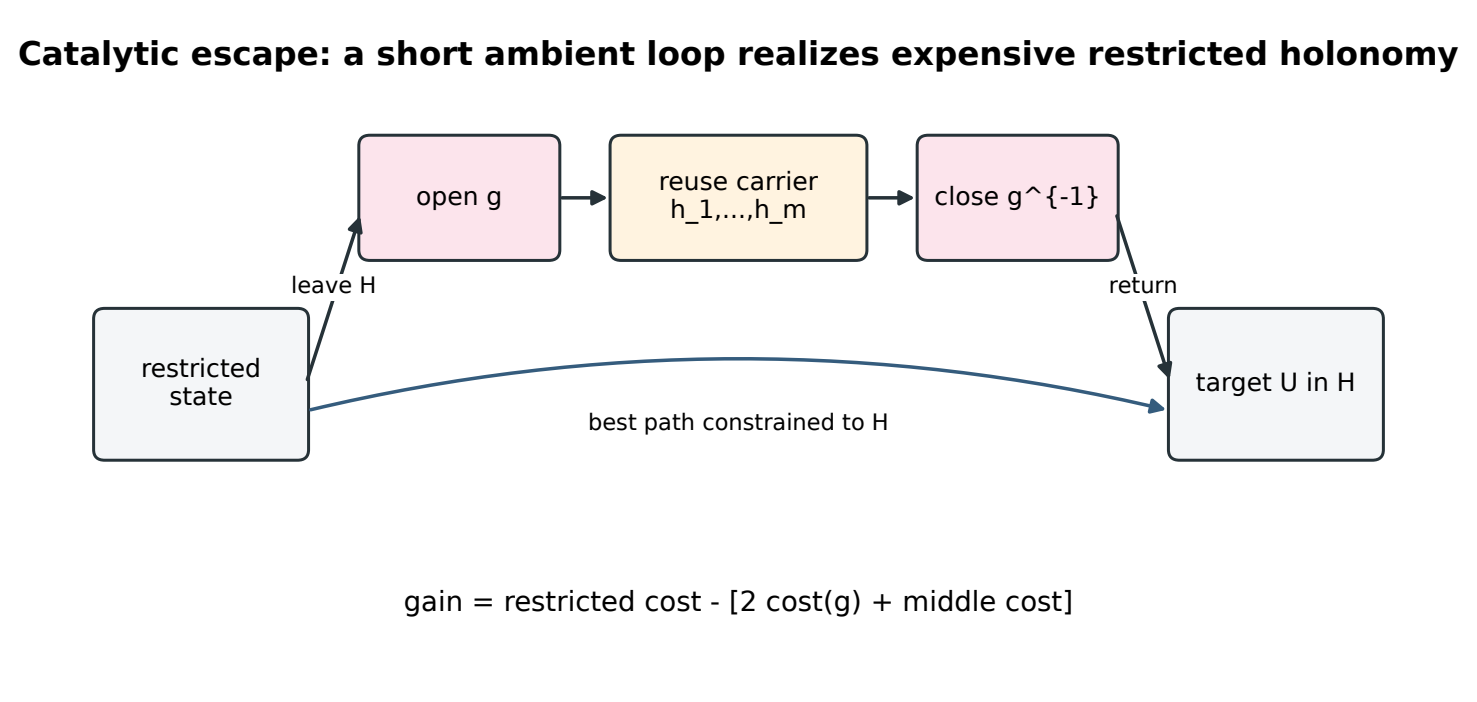
This is the geometric content of a dirty-workspace shortcut.
8.2.2 The basic conjugation inequality
On this page · Permalink · Source line 269
Let \(g\in G\) and \(k\in H\) satisfy \(gkg^{-1}\in H\). Then
Define the intrinsic conjugation stretch
Proposition 8.11: Catalytic stretch criterion
If
then \(gkg^{-1}\) has positive defect.
The opening and closing cost is paid once. Every useful consumer inside the excursion contributes to the stretch.
8.2.3 Many consumers and catalytic excess
On this page · Permalink · Source line 291
Suppose the middle word is
The ambient word
has cost at most
If the restricted images \(gh_ig^{-1}\) require costs \(r_i\) and a lower-bound invariant proves that their obligations cannot be shared, then
A sufficient inequality is
The left side is the gross catalytic benefit. The right side is the restoration cost.
Definition 8.12: Catalytic excess
For a normal form with \(r\) matched excursions and \(C\) useful cross interactions, define
when each consumer contributes one unit and each opening or closing costs one unit.
Positive excess is necessary in the simplest transvection model, but it is not sufficient. An all-cross configuration may admit a mirror word of equal restricted length. Temporal asymmetry or phase holonomy is also required.
8.2.4 Excursion budgets
On this page · Permalink · Source line 324
Counting ambient-only gates is only one measure of how far a circuit leaves its restricted model.
Definition 8.13: Excursion profile
For a circuit path \(X_0,X_1,\ldots,X_L\), an excursion profile may include
the number \(q\) of ambient-only gates,
the maximum Schreier distance \(d(X_tH,H)\),
the rank of a forbidden block,
the bandwidth of a forbidden dependency,
the number of simultaneously open catalytic intervals,
the intersection graph of those intervals,
the maximum algebraic degree created temporarily,
the maximum ancilla dimension or branch count.
The established linear family shows that a rank-one, bandwidth-one excursion using exactly two forbidden gates can save linearly many operations. Thus geometric excursion size need not control computational benefit.
8.2.5 Catalytic interval geometry
On this page · Permalink · Source line 341
Associate to every matched opening and closing operation an interval
The family of intervals can be disjoint, nested, laminar, or crossing.
Principle 8.14: First higher-order frontier
Independent or disjoint intervals often reduce to additive copies of a one-catalyst analysis. Crossing intervals are the first place where one dirty resource can alter another and where a multiplicative distortion larger than the clean one-carrier value may occur.
Define the catalytic width
One may then study
where the ambient circuit has width at most \(w\). The unitriangular snapshot family gives \(D_n^{(1)}=\Omega(n)\) in its corresponding interval model.
8.2.6 Four recurrent catalytic mechanisms
On this page · Permalink · Source line 369
8.2.6.1 Basis-change catalysis
On this page · Permalink · Source line 370
An ambient gate \(g\) changes the frame in which several restricted operations are cheap:
Hadamard and Fourier transforms are the basic quantum examples. The frame is restored at the end.
8.2.6.2 Commutator catalysis
On this page · Permalink · Source line 377
An ambient commutator creates a new direction:
For continuous controls,
The desired effective generator may lie in the restricted algebra even though the path does not.
8.2.6.3 Degree catalysis
On this page · Permalink · Source line 390
A Toffoli, CCZ, or non-Gaussian gate can create higher algebraic degree or higher moments temporarily. If the nonlinear object is reused and canceled, the final target may remain affine, diagonal, or Gaussian.
8.2.6.4 Branch and workspace catalysis
On this page · Permalink · Source line 393
Ancillas, measurements, reset, teleportation, and classical feedforward enlarge the realization category. The resource is a temporary branch, subsystem, or borrowed state rather than a group element.
8.2.7 When defects are impossible
On this page · Permalink · Source line 396
A useful positive theorem is a criterion guaranteeing geodesic convexity.
Proposition 8.15: One-Lipschitz retraction criterion
Suppose there is a group homomorphism \(\pi:G\to H\) with \(\pi|_H=\operatorname{id}_H\) such that every ambient generator \(s\in\mathcal S_G\) satisfies
Then
for every \(h\in H\), hence the two metrics agree on \(H\).
Proof
For an ambient word \(h=s_L\cdots s_1\), multiplicativity gives \(h=\pi(h)=\pi(s_L)\cdots\pi(s_1)\). Subadditivity and the generator bounds give \(\ell_H(h)\le\sum_j c(s_j)\). Taking the infimum over ambient words proves the claim.
The unitriangular counterexample proves that no such generator-wise one-Lipschitz retraction exists for the lower transvection model inside the all-transvection model.
8.2.8 Weighted restoration and phase transitions
On this page · Permalink · Source line 415
Let every restricted gate cost one and every ambient-only gate cost \(\lambda\). For a catalyst used by \(v\) consumers with unit benefit, the displayed construction has net gain at least
The critical weight is therefore target and mechanism dependent.
Definition 8.16: Critical catalyst penalty
For a target family \(U_n\), define
Determining \(\lambda_c\) exactly is a refined synthesis problem. It can be more physically meaningful than unweighted gate count.
8.2.9 Restoration is the source of nontriviality
On this page · Permalink · Source line 432
If the ambient resource need not be restored, the opening cost can dominate the comparison and many examples become trivial. Catalytic escape is strongest when the following all hold:
the final target lies entirely in the restricted class,
every auxiliary subsystem or violated constraint is restored,
the ambient-only resource is used more than once,
the restricted lower bound charges the same repeated obligations separately,
the gain survives a realistic weighted cost.
Conjectural frontier
In many finite gate hierarchies, minimal defects should admit a bounded-width catalytic normal form. Proving or refuting this would turn an unrestricted synthesis search into a search over a finite family of excursion motifs.