Quantum and CircuitsReading edition

A degree-one dual certificate for two-input AND

Reading tools
Reading libraryFind statementsInspect Lean
Switch work

Saved reading

Read side by side

Start reading

Resources & source

Original TeX with line links · Download TeX

The wording and mathematics follow the retained manuscript. This reading format does not add a proof review or extend Lean coverage.

Skip contents and start reading

A degree-one dual certificate for two-input AND

Let \(f(a,b)=ab\), with unique positive point \((1,1)\). For degree at most one, the evaluation vector is \(v_1(a,b)=(1,a,b)\). The three negative points already span the positive vector.
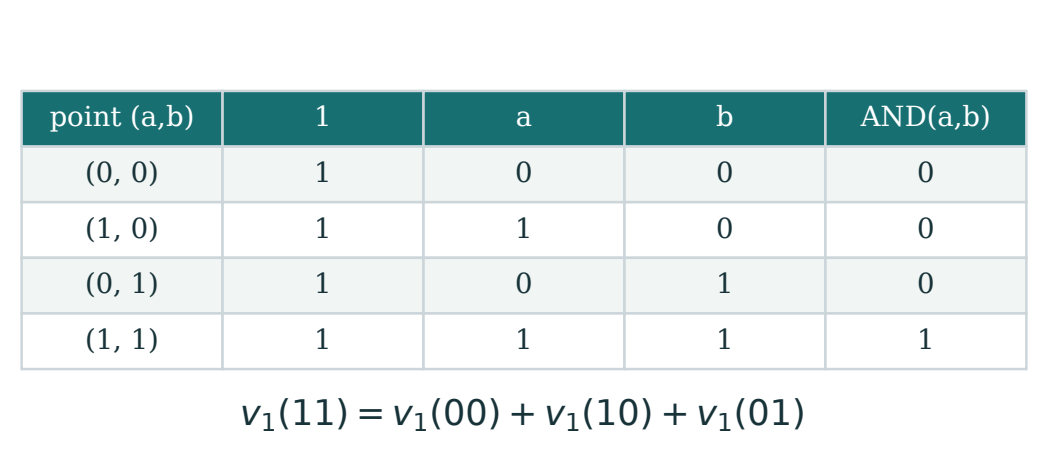
The first three rows are negative inputs. Their XOR equals the last evaluation row.

View full-size figure (new tab)

Any affine polynomial is a coefficient covector \(c=(c_0,c_a,c_b)\). Safety means that it pairs to zero with each negative row. The displayed dependence therefore forces its value at \((1,1)\) to be zero. No safe affine packet detects the positive point.

The degree-two polynomial \(ab\) does detect it, so \(\beta_{11}(f)=\beta(f)=2\). Since \(\beta^*\le n=2\) and \(\beta^*\ge\beta\), \(\beta^*=2\). The complete bound gives \(T\ge1\), attained by one direct Toffoli to the target.

The constant coordinate also checks parity: this dependence uses three negative rows, an odd number. Without the constant coordinate, that parity conclusion would not follow.

Exact finite dependence plus written duality. Lean proves the corresponding AND2 degree and beta exclusions by four-corner parity, without formalizing the general evaluation-span dual.

Source and conversion record

Source SHA-256: 488075fae27e7db2e4bcee68c08f93b659a12536c807e5e419d6e8e166317763

Unsupported prose commands stop the build. The mathematical expression sequence is checked against the source, with manuscript macros expanded for display.

Conversion records

Notation in Quantum and Circuits

Look up a symbol without leaving this chapter. Select text before opening help to search for it.

Search this work’s notation.

    Symbols can have different meanings in different passages. Read each result in its own context.

    Open the full notation index