
9.6 Projective, matroidal, and spectral structure
On this page · Permalink · Source line 1745
9.6.1 The flagged Pasch packet
On this page · Permalink · Source line 1747
Over \({\mathbb F}_2\), write
The canonical ambient word uses the six nonzero vectors
inside \({\operatorname{span}}(x,p,q)\cong{\mathbb F}_2^3\). The only missing nonzero vector is \(x+q\).
In \(\operatorname{PG}(2,2)\), three distinct points form a line exactly when their vector representatives sum to zero. The six points support the four lines
Every point lies on exactly two of these lines. This is the Pasch configuration, equivalently the Fano plane with one point and its three incident lines removed from the full incidence structure.
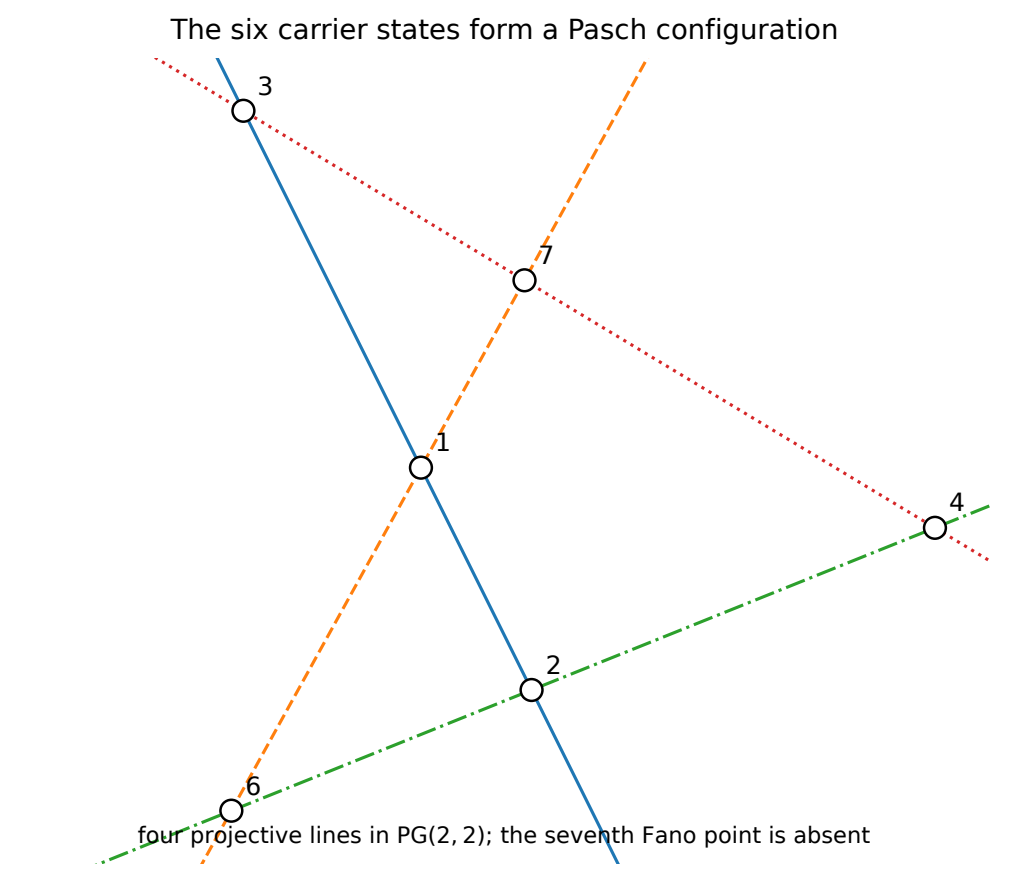
The configuration is flagged because the rows have fixed roles. Points \(x\) and \(q\) are stationary sources, \(p\) is the carrier, and the remaining points occur as carrier states. Forgetting those roles loses the circuit ordering information.
9.6.2 The regular matroid \(M(K_4)\)
On this page · Permalink · Source line 1789
The six carrier states admit a field-independent representation. In the ordered basis \((x,p,q)\), place them as the columns of
corresponding respectively to
Proposition 9.29: Regular-matroid core
Every square minor of \(B\) belongs to \(\{0,\pm1\}\), so \(B\) is totally unimodular. Hence the column-dependence matroid is the same over every field. Under the edge labeling
it is the graphic matroid \(M(K_4)\).
Proof
A direct calculation of all square minors of \(B\) gives only \(0\), \(1\), and \(-1\). Thus every subdeterminant has characteristic-independent vanishing, and a column set is independent over one field exactly when it is independent over every field. The four minimal dependent triples are
Under the displayed edge labeling, these are precisely the four triangular cycles of \(K_4\). They determine the rank-three cycle matroid \(M(K_4)\), which is regular because it has a totally unimodular representation; see, for example, [37].
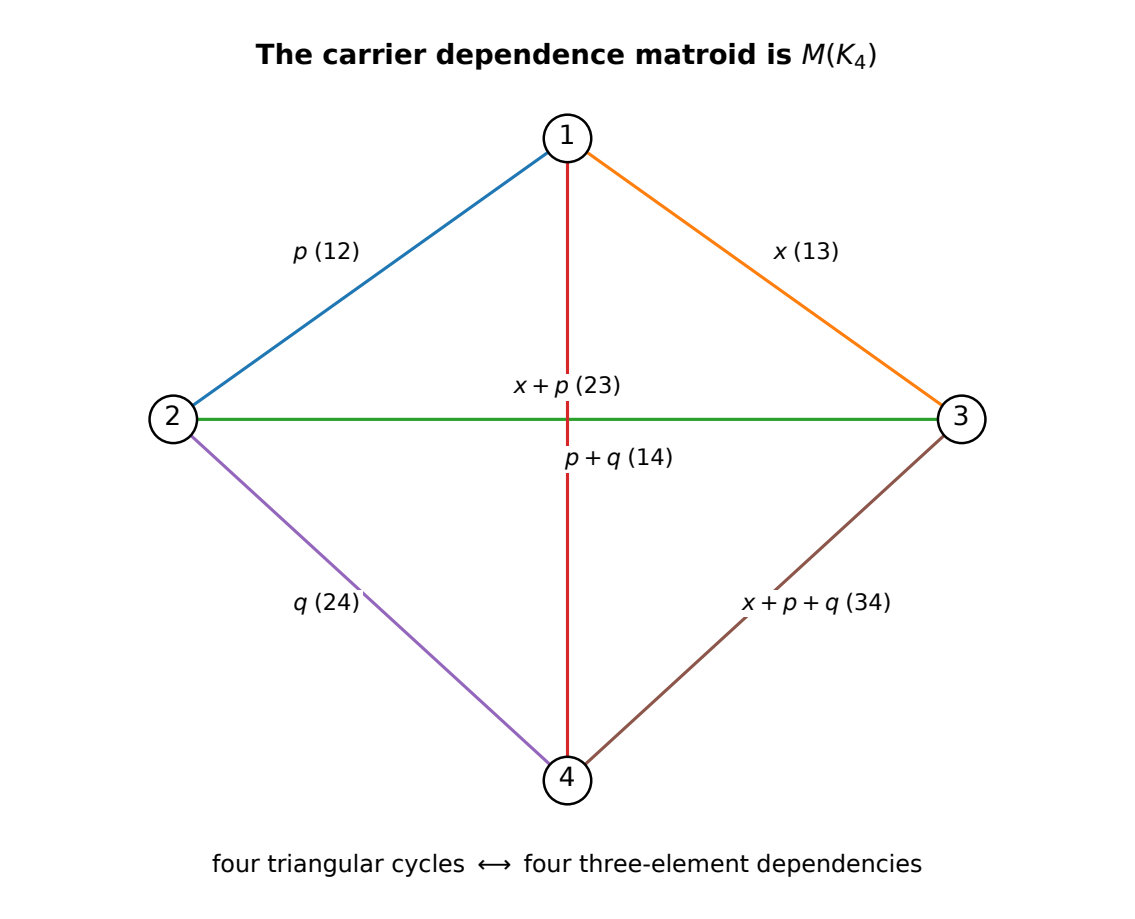
The field-independent circuit theorem is stronger than matroid representability alone, because it also depends on the ordering and the designated carrier role. Nevertheless, Proposition 9.29 explains why the local dependence pattern survives unchanged in every characteristic.
9.6.3 Distance as first arrival
On this page · Permalink · Source line 1845
Let \(G\) be a finite group and \(S=S^{-1}\) a symmetric generating set. On \(\ell^2(G)\), let \(\lambda\) be the left regular representation,
and define
For \(g\in G\), define the endpoint Green series
Proposition 9.30: First-arrival identity
The coefficient of \(z^k\) in \(\mathcal G_{S,g}(z)\) is the number of length-\(k\) words in \(S\) with product \(g\). Hence
Proof
Formally,
The matrix coefficient \(\langle\delta_g,A_S^k\delta_e\rangle\) counts \(k\)-step walks from \(e\) to \(g\), which are exactly length-\(k\) words with product \(g\). The first nonzero coefficient occurs at the word distance.
If
is the spectral resolution, then
Thus eigenvalues alone do not determine first arrival. The endpoint matrix coefficients of the spectral projectors are essential.
For the canonical target \(C\), exact word counts begin
The metric defect is the valuation drop
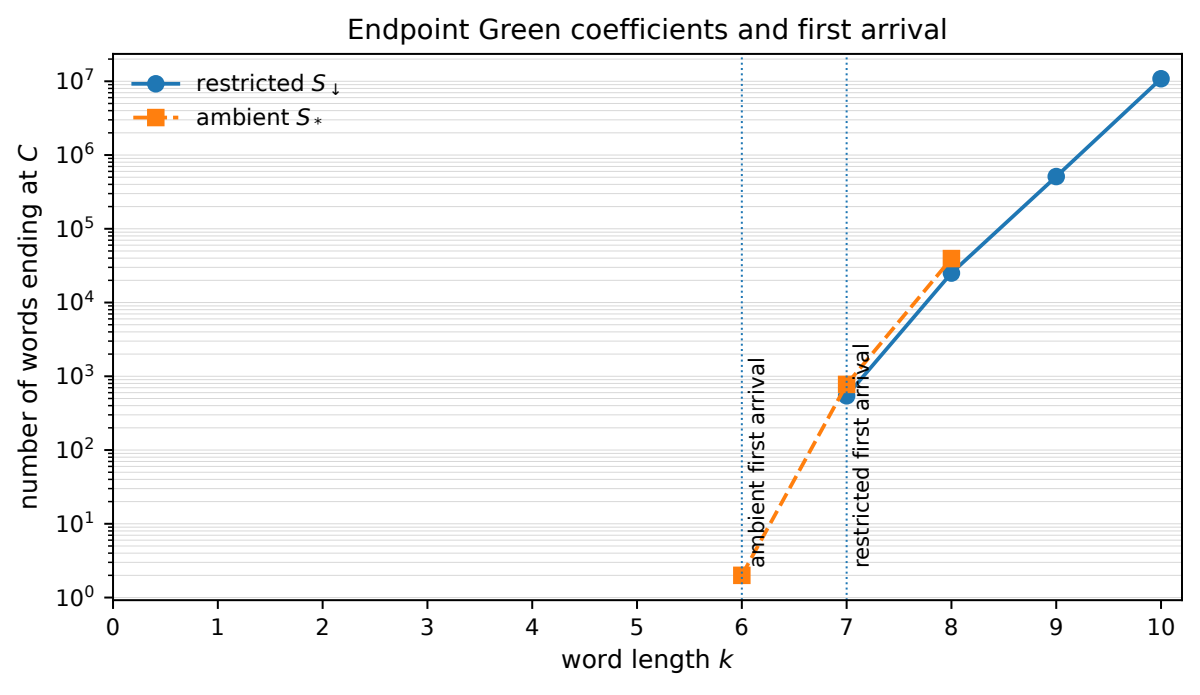
Across the twenty defects, the truncated endpoint data split into five Green-signature classes, each of multiplicity four. The signatures are listed in Table 9.3.
| restricted coefficients | ambient coefficients | ||||||
|---|---|---|---|---|---|---|---|
| packet | \([z^7]\) | \([z^8]\) | \([z^9]\) | \([z^{10}]\) | \([z^6]\) | \([z^7]\) | \([z^8]\) |
| 1 | 326 | 15430 | 316118 | 7576819 | 4 | 570 | 23318 |
| 2 | 326 | 15536 | 321870 | 7727183 | 4 | 570 | 23318 |
| 3 | 543 | 25080 | 510703 | 10824940 | 2 | 776 | 39454 |
| 4 | 543 | 25639 | 511524 | 10984988 | 2 | 776 | 39454 |
| 5 | 543 | 26091 | 511819 | 11121486 | 2 | 776 | 39454 |