
Exact symmetry families
On this page · Permalink · Source line 710
4.1 Fixed charge and exact-number circuits
On this page · Permalink · Source line 711
4.1.1 Excitation-number packets
On this page · Permalink · Source line 716
For \(n\) qubits, define
Its eigenvalues are \(k=0,1,\ldots,n\). The projector onto Hamming weight \(k\) is
and
The decomposition
recovers the full dimension through
4.1.2 Number-preserving gates
On this page · Permalink · Source line 746
Single-qubit \(R_Z\) gates commute with \(\widehat N\). A two-qubit exchange rotation acts in the ordered basis \({\lvert 00\rangle},{\lvert 01\rangle},{\lvert 10\rangle},{\lvert 11\rangle}\) as
It rotates \({\lvert 01\rangle}\) and \({\lvert 10\rangle}\) while fixing \({\lvert 00\rangle}\) and \({\lvert 11\rangle}\), so it preserves exact Hamming weight.
Corollary 4.1: Fixed-charge polynomial simulation
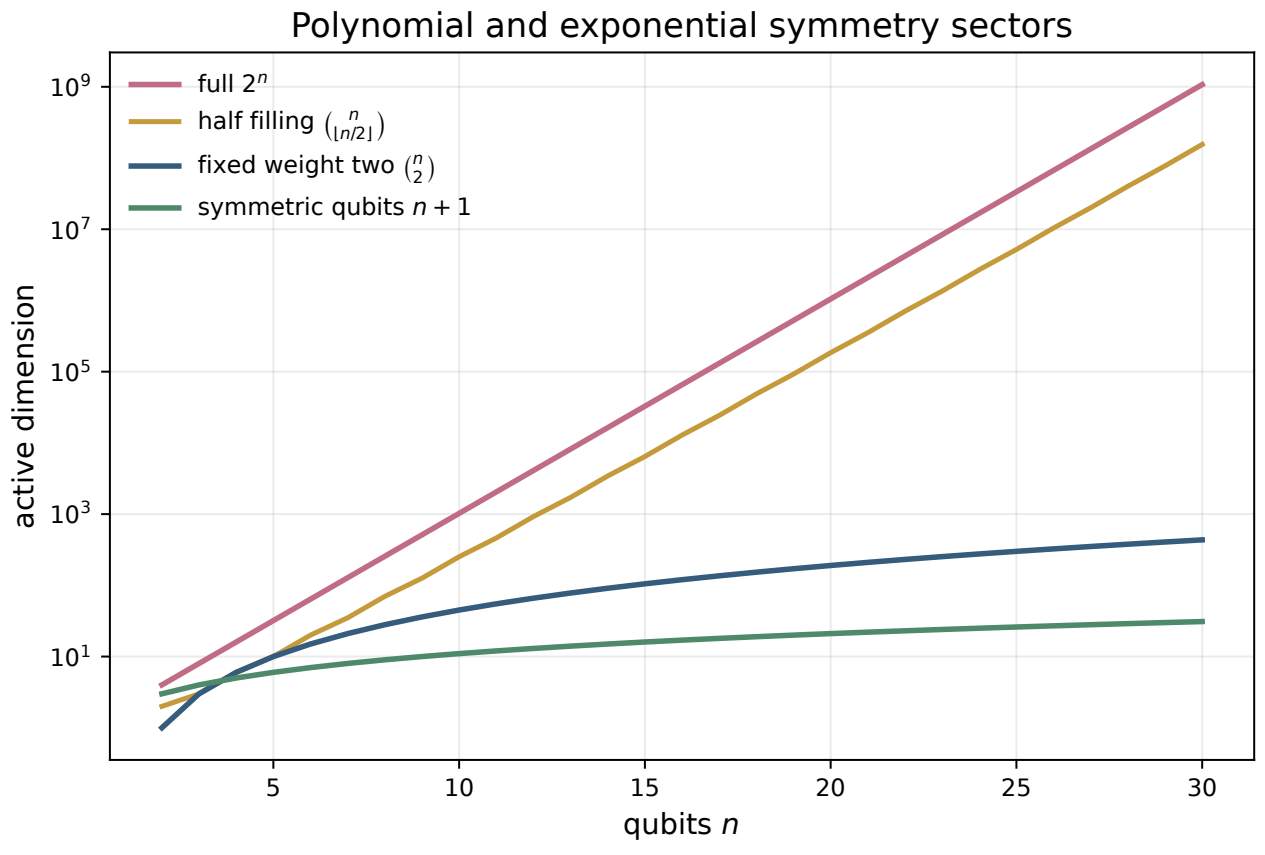
For every fixed \(k\), a polynomial-time uniform family of number-preserving circuits initialized in \({\mathcal H}_{n,k}\) and measured by an efficiently computable observable is classically simulable in polynomial time, provided the initial weight-\(k\) coordinates can be computed efficiently and each restricted local gate is efficiently applied in that basis.
Proof
For fixed \(k\),
The weight-\(k\) basis is efficiently indexed by \(k\)-element subsets. A local number-preserving gate changes only basis states containing the affected occupation pattern. Apply Theorem 3.7.
4.1.3 Sparse update structure
On this page · Permalink · Source line 773
A one-qubit diagonal phase changes one amplitude at a time. An exchange gate on modes \(p,q\) couples a basis state only to the state obtained by moving one excitation between those modes. Thus every column of the restricted gate has at most two nonzero entries. For fixed \(k\), the total update cost is polynomial in \(n\).
4.1.4 Uniformity and input encoding
On this page · Permalink · Source line 776
The fixed-charge corollary assumes \(k\) is a fixed constant independent of \(n\). It also applies when \(k=O(1)\) is supplied by the circuit family. If \(k\) is written in binary and allowed to scale as \(n/2\), the sector can become exponential. The theorem is about the dimension and update cost of the actual active sector, not the name of the symmetry.
4.1.5 Observables
On this page · Permalink · Source line 785
A diagonal observable depending on occupations is immediate. Few-body number-preserving observables are sparse in the subset basis. More global observables may require additional structure. The measurement hypothesis in Theorem 3.7 cannot be omitted: a compactly evolved state does not help if the requested output itself hides exponential work.