3.5 Approximate symmetry and leakage certificates
On this page · Permalink · Source line 317
3.5.1 Hamiltonian leakage
On this page · Permalink · Source line 321
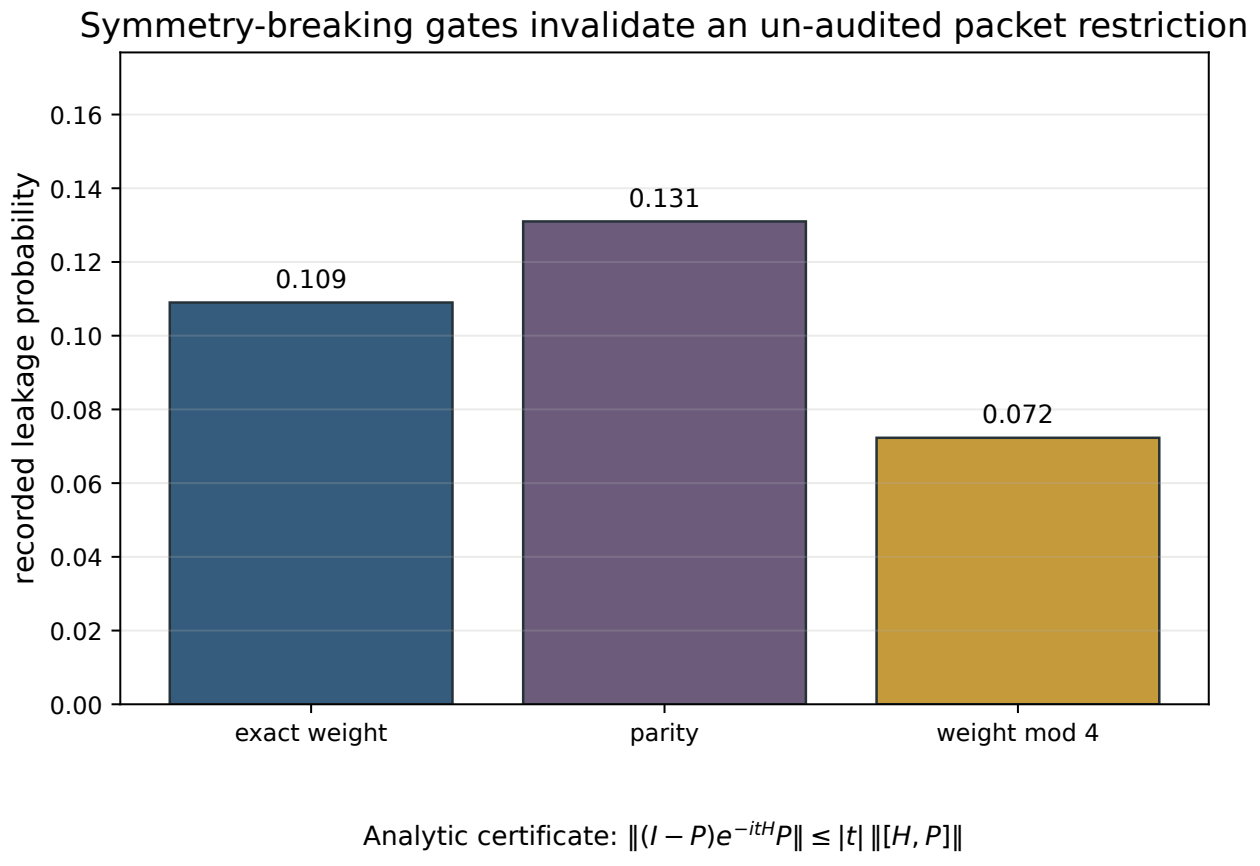
Exact conservation is not the only useful regime. Let \(P\) be an orthogonal projector and let
for a bounded self-adjoint Hamiltonian \(H\). The leakage operator from the packet is
Theorem 3.9: Commutator leakage bound
For every real \(t\),
Proof
Define
Then \(F(0)=e^{-itH}P\) and \(F(t)=Pe^{-itH}P\). Differentiation gives
Therefore
The unitary factors and projectors have norm at most one, so the integral is bounded by \(|t|\|[H,P]\|\).
3.5.2 Circuit leakage
On this page · Permalink · Source line 358
For a gate \(G_j\), define
Let \(V_j=PG_jP\). A telescoping expansion gives
Taking norms yields the following.
Proposition 3.10: Sum-of-leakages bound
For an initial state in \(P{\mathcal H}\),
This is conservative because leakage contributions may interfere destructively. Its value is that it is composable and can be checked gate by gate.
3.5.3 Decision-problem consequence
On this page · Permalink · Source line 386
If the packet representation is polynomial, the restricted updates are efficient, and
then the approximate packet simulator reproduces the final acceptance probability to inverse-polynomial accuracy. After ordinary promise-gap amplification, this suffices for a deterministic polynomial-time decision algorithm.
3.5.4 Adaptive packet enlargement
On this page · Permalink · Source line 393
A practical simulator need not fix one packet forever. It can maintain an active set \(A_t\) of packets, estimate transfers \(P_\alpha G_tP_\beta\), and add a packet when its predicted mass exceeds a tolerance. The proof obligation becomes a global accounting identity:
The key research problem is to retain polynomial active size while certifying the tail.