
9.7 Interval-tree certificates and connected higher-dimensional families
On this page · Permalink · Source line 1938
From this point through the rank and tensor arguments, the coefficient domain is a field \({\mathbb F}\). The six-row atom is the first defect, but it is not an isolated low-dimensional accident. This section gives a field-independent family of connected targets in every dimension at least seven. The lower bound is certified by a multiscale rank potential adapted to the ordered flag.
9.7.1 Interval-tree rank potential
On this page · Permalink · Source line 1942
Definition 9.31: Interval tree
An interval tree on the ordered coordinates \(0,1,\ldots,n-1\) is a rooted binary tree whose leaves occur in that order and whose every node is a contiguous interval. If an internal node \(v\) splits its interval into consecutive left and right children \(L_v\) and \(R_v\), define
Lemma 9.32: One-cut locality
Let \(X\in{\operatorname{U}}_n({\mathbb F})\) and let \(X'\) be obtained from \(X\) by one lower-directed transvection. Then
Proof
Suppose the gate is \(s\to t\) with \(s<t\). Let \(v_0\) be the lowest node of \(T\) whose two children separate \(s\) and \(t\). The order of the leaves forces \(s\in L_{v_0}\) and \(t\in R_{v_0}\). At this one node, a single row of the cross block \(X[R_{v_0},L_{v_0}]\) changes, so its rank changes by at most one.
At every ancestor of \(v_0\), the two rows lie in the same child. If that child is the right child, the gate is an internal row operation on the relevant cross block and preserves rank; if it is the left child, the cross block is unchanged. At a descendant containing \(t\) but not \(s\), every column of the descendant interval lies strictly to the right of \(s\). Since \(X\) remains lower triangular, row \(s\) vanishes on those columns, so the descendant block is unchanged. All other descendants are also unchanged. Hence only the term at \(v_0\) can vary.
Corollary 9.33: Interval-tree lower bound
For every \(A\in{\operatorname{U}}_n({\mathbb F})\) and every interval tree \(T\),
Proof
The identity has potential zero. Apply Lemma 9.32 along any lower-directed word from the identity to \(A\).
Definition 9.34: Tree-tight target
A lower-unitriangular target \(A\) is tree tight if some interval tree \(T\) satisfies
Tree tightness is stronger than possessing a rank lower bound. It says that one ordered hierarchy accounts for the entire restricted word length. The family below is tree tight by construction.
9.7.2 The snapshot family
On this page · Permalink · Source line 1988
Fix integers
and choose distinct phases
Order the coordinates as
For \(0\le s\le u\), put
Define
by
and
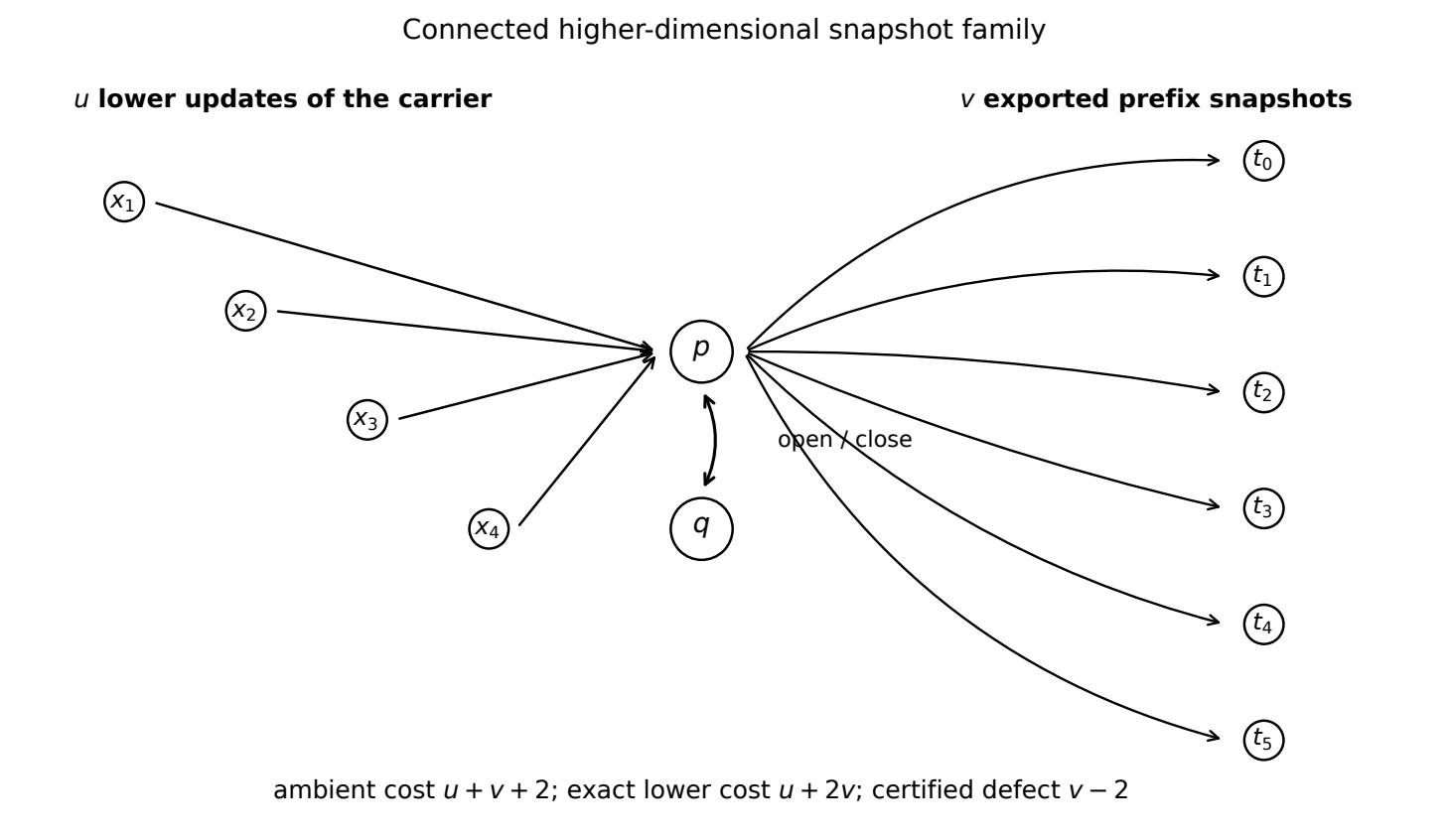
The output rows record selected intermediate versions of the carrier \(p\).
Proof of Theorem 9.5
For the ambient construction, first apply
Sweep through the updates
Whenever phase \(s_j\) is reached, apply
Finally apply \(q\to p\) with coefficient \(-1\). At phase \(s\), the carrier is \(e_q+w_s\), so every output has the required value, and the final gate removes \(e_q\) from row \(p\). The word has length
Thus
For a lower word, perform the same \(u\) updates without opening the catalyst. At each selected phase, use the two gates
This gives length \(u+2v\).
It remains to prove optimality in the lower model. At the root, split
The nonzero rows of the root cross block are \(w_{s_1},\ldots,w_{s_v}\). Distinct prefix vectors are linearly independent: in a linear relation, inspect successively a coordinate occurring in \(w_{s_j}\) but in none of the earlier prefixes, starting from the largest phase. Hence the root contributes \(v\).
Inside the left child, use the comb that splits off \(x_1\), then \(x_2\), and so on while retaining \(p\) in the remaining interval. Every one of the \(u\) cuts has rank one because the final row \(p\) contains every \(x_i\). Inside the right child, repeatedly split off the last output while retaining \(q\) in the left interval. Each of the \(v\) cuts has rank one because every output contains \(q\). Therefore
The interval-tree lower bound matches the displayed lower circuit.
Remark 9.35: Support connectivity
For \(u,v\ge1\), the undirected support graph of \(A(u;s_1,\ldots,s_v)-I\) is connected. Row \(p\) joins all update coordinates \(x_i\), while every output joins both \(p\) and \(q\). The separation below therefore does not arise from a direct sum of independent six-row gadgets.
9.7.3 Exact higher binary examples
On this page · Permalink · Source line 2084
The interval tree gives the exact restricted distance in all dimensions. For the first three higher targets, a separate bidirectional search also proves that the displayed ambient construction is optimal.
Theorem 9.36: Exact binary cases in dimensions seven through nine
Over \({\mathbb F}_2\), let
Then
and
Proof
The restricted values follow from Theorem 9.5. The ambient words have lengths \(7\), \(8\), and \(9\). To exclude shorter words, the supplement computes exact ambient balls and checks that the two relevant balls do not intersect. The certificate sizes are
| \(n\) | tested split | left ball | right ball |
|---|---|---|---|
| \(7\) | \(3+3\) | \(23276\) | \(23276\) |
| \(8\) | \(3+4\) | \(52277\) | \(1174097\) |
| \(9\) | \(4+4\) | \(2994949\) | \(2994949\) |
Every intersection is empty. Since the generating sets are symmetric, an empty radius-\(r\) versus radius-\(s\) intersection rules out every word of length at most \(r+s\).
These are exact higher-dimensional examples, not merely padded copies of \(C\).
9.7.4 A connected defect in every dimension
On this page · Permalink · Source line 2128
Proof of Corollary 9.6
For \(n\ge7\), put
and take the phases
The inequality \(v_n\le u_n+1\) holds, so the snapshot target is defined. By Theorem 9.5,
while
Hence
Connectivity follows from the preceding remark.
| \(n\) | \(u\) | \(v\) | \({\ell_{\downarrow}}\) | ambient upper bound / certified gap |
|---|---|---|---|---|
| \(7\) | \(2\) | \(3\) | \(8\) | \(7\;/\;1\) |
| \(8\) | \(3\) | \(3\) | \(9\) | \(8\;/\;1\) |
| \(9\) | \(3\) | \(4\) | \(11\) | \(9\;/\;2\) |
| \(10\) | \(4\) | \(4\) | \(12\) | \(10\;/\;2\) |
| \(11\) | \(4\) | \(5\) | \(14\) | \(11\;/\;3\) |
| \(12\) | \(5\) | \(5\) | \(15\) | \(12\;/\;3\) |
| \(13\) | \(5\) | \(6\) | \(17\) | \(13\;/\;4\) |
| \(15\) | \(6\) | \(7\) | \(20\) | \(15\;/\;5\) |
| \(17\) | \(7\) | \(8\) | \(23\) | \(17\;/\;6\) |
| \(19\) | \(8\) | \(9\) | \(26\) | \(19\;/\;7\) |
| \(21\) | \(9\) | \(10\) | \(29\) | \(21\;/\;8\) |
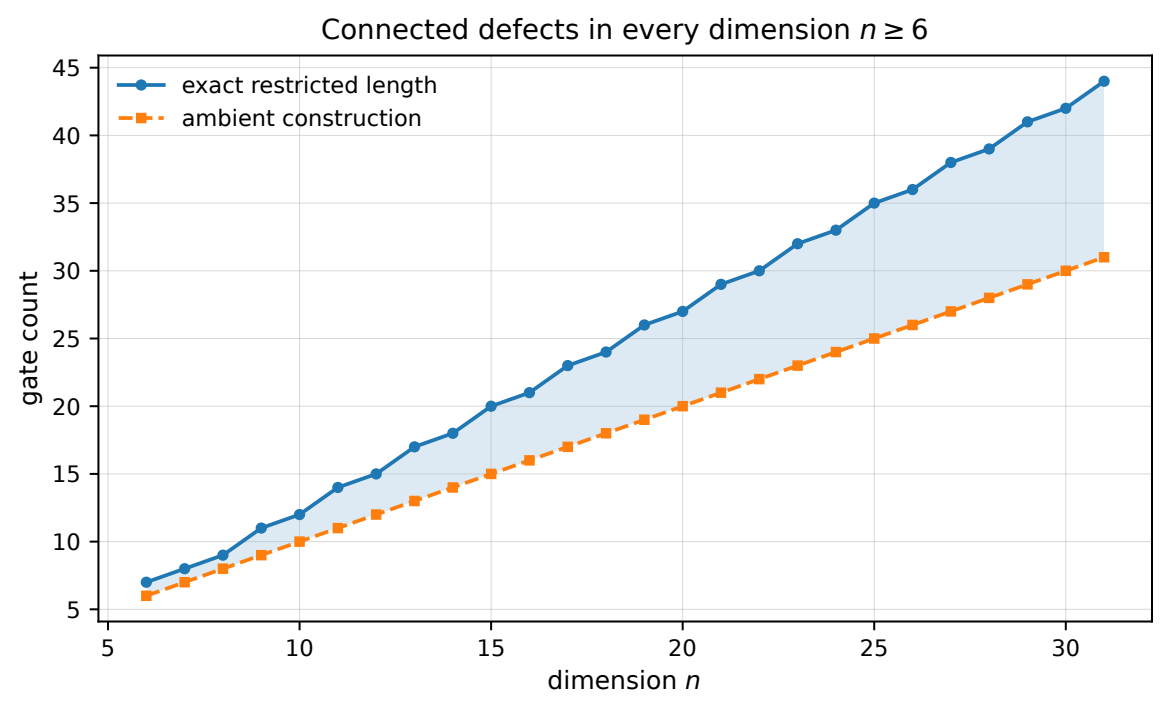
The ratio also increases beyond the block-sum value \(7/6\).
Corollary 9.37: Asymptotic multiplicative distortion
For every field,
Proof
Along the optimized connected family,
which tends to \(3/2\).