
9.9 Algebraic rarity of catalytic defects
On this page · Permalink · Source line 2393
The preceding sections construct highly structured targets with large defects. This section proves the complementary statement that catalytic defects are nongeneric at every fixed dimension. Fix a field \(K\). Algebraic dimensions and closures are taken after base change to an algebraic closure of \(K\). Put
9.9.1 Transvection product loci
On this page · Permalink · Source line 2402
For a direction skeleton
define the polynomial word map
The coefficients are allowed to vanish, so a word of length at most \(L\) can be padded to length \(L\). Let
be the ambient reachability locus, and define \(\mathcal R^\downarrow_{n,\le L}\) analogously using only lower directions.
Equivalently, put
Then \({\ell_{*}}(A)\) and \({\ell_{\downarrow}}(A)\) are the corresponding transvection product lengths: the least \(L\) for which \(A\in X_*^L\) or \(A\in X_\downarrow^L\).
Proposition 9.45: Dimension of bounded-length loci
For every \(L\ge0\), the sets \(\mathcal R^*_{n,\le L}\) and \(\mathcal R^\downarrow_{n,\le L}\) are constructible and
Proof
There are finitely many direction skeletons of length \(L\). For each skeleton, \(\Phi_\sigma\) is a morphism from an \(L\)-dimensional affine space. Chevalley's theorem makes its image constructible, and the closure of the image has dimension at most \(L\) [30]. Finite unions preserve constructibility and the maximum dimension bound. Intersecting with the closed subvariety \({\operatorname{U}}_n\) cannot increase dimension.
The argument is an instance of a general parameter-counting principle.
Proposition 9.46: Dimension per gate
Let \(G\) be an algebraic group, let \(V\subseteq G\) be an irreducible subvariety of dimension \(D\), and let \(X\subseteq G\) be a finite union of locally closed subvarieties, each of dimension at most \(r\), with the identity in \(X\). Write
Then
In particular, if \(rL<D\), a Zariski-generic point of \(V\) has \(X\)-product length greater than \(L\).
Proof
Every irreducible component of the Cartesian power \(X^{\times L}\) has dimension at most \(rL\). Multiplication \(G^L\to G\) is a morphism, so the closure of the image of each component has dimension at most \(rL\). There are finitely many components, and intersecting the resulting finite union with \(V\) cannot increase dimension. Since the identity belongs to \(X\), products of length at most \(L\) are already contained in \(X^{(L)}\).
For transvections, the discrete choice of direction contributes finitely many components and each component carries one scalar parameter. Thus \(r=1\). Every element of \({\operatorname{U}}_n(K)\) has lower length at most \(N\): process the strict lower entries in any root order compatible with elimination. The dimension-per-gate bound shows that this worst-case value is generic.
Theorem 9.47: Generic rigidity
Let \(K\) be an infinite field. There is a nonempty Zariski-open subvariety \(\Omega_n\subseteq{\operatorname{U}}_n\), defined over \(K\), such that \(\Omega_n(K)\) is nonempty and
The same statement holds with exact product length replaced by border product length.
Proof
After base change to an algebraic closure \(\overline K\), Proposition 9.45 gives
Because the word maps are defined over \(K\), this proper closed set descends to a proper closed subset of \({\operatorname{U}}_n\) over \(K\). Its complement is a nonempty Zariski-open set \(\Omega_n\). Since \(K\) is infinite and \({\operatorname{U}}_n\cong{\mathbb A}^N\), the set \(\Omega_n(K)\) is nonempty and Zariski dense. For any \(A\in\Omega_n(K)\), one has \({\ell_{*}}(A)\ge N\). The inequalities
force equality. Replacing each image by its Zariski closure gives the border-length statement by the same argument.
9.9.2 Defect codimension
On this page · Permalink · Source line 2497
For an algebraically closed field \(K\) and \(d\ge1\), define
Theorem 9.48: Defect–codimension bound
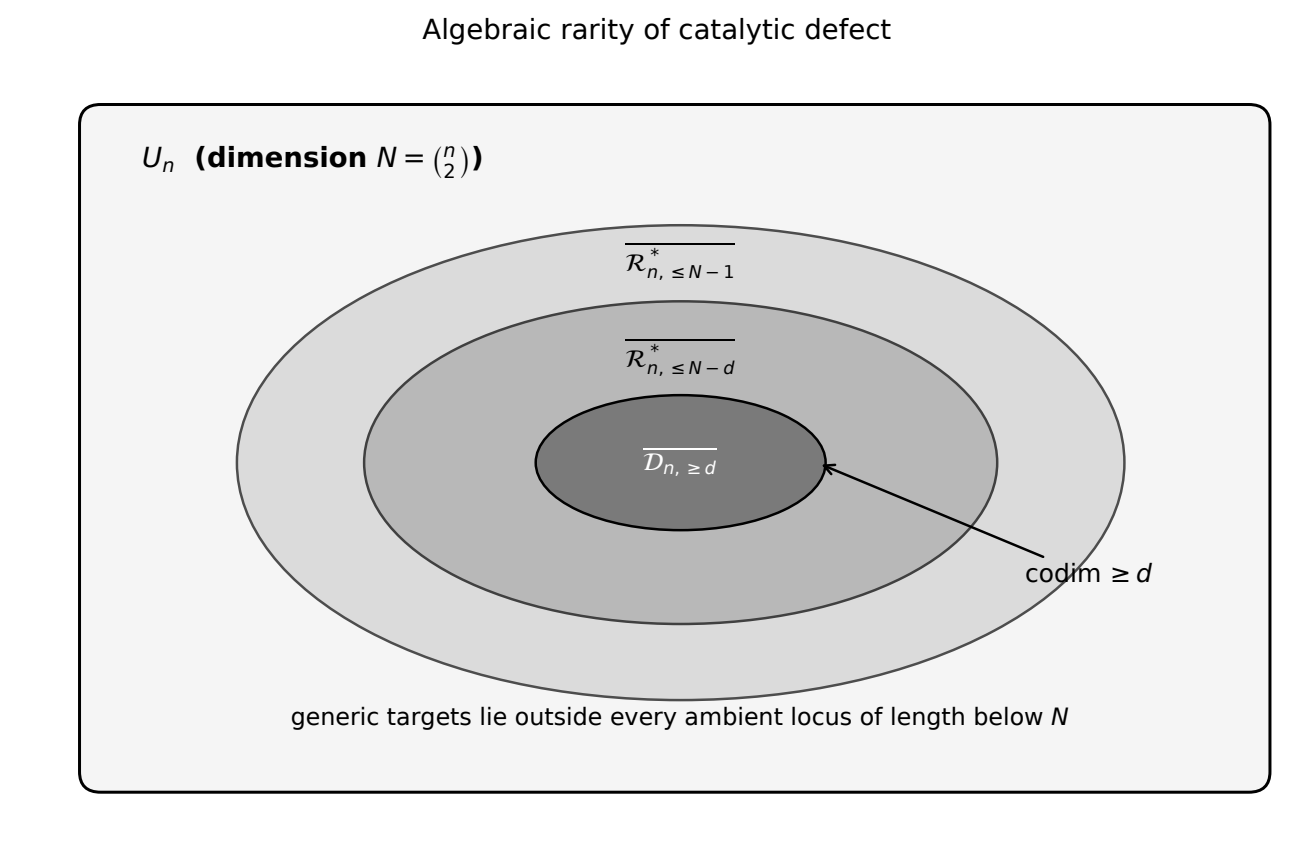
Let \(K\) be algebraically closed. For every \(1\le d\le N\),
Equivalently,
More finely, on the stratum where \({\ell_{\downarrow}}(A)=L\) and \({\Delta}(A)\ge d\), the closure has dimension at most \(L-d\).
Proof
If \({\Delta}(A)\ge d\), then
Thus \(\mathcal D_{n,\ge d}\subseteq\mathcal R^*_{n,\le N-d}\), and Proposition 9.45 gives the first assertion. On the intrinsic-length-\(L\) stratum one instead has \({\ell_{*}}(A)\le L-d\), proving the refinement.
9.9.3 Finite-field sparsity
On this page · Permalink · Source line 2537
The dimension argument has an elementary counting counterpart. Allowing zero coefficients, a padded word of length \(L\) is specified by \(L\) choices among \(M\) directed positions and \(L\) coefficients in \({\mathbb F}_q\). Consequently
Corollary 9.49: Finite-field defect density
For \(1\le d\le N\),
In particular, for fixed \(n\),
as \(q\to\infty\).
Proof
The defect condition implies ambient length at most \(N-d\), so the number of such targets is at most \((Mq)^{N-d}\). Divide by
The expectation bound follows from
The same counting argument also gives
whenever the right side is positive. Thus maximal ambient and intrinsic length is not only Zariski generic over infinite fields but asymptotically typical over growing finite fields at fixed dimension.
9.9.4 Border catalysis
On this page · Permalink · Source line 2579
For an algebraic generating set \(X\), define the border product length
This is analogous to the passage from tensor rank to border rank [35]. The generic value is still \(N\) by Theorem 9.47, but exact and border defects can differ on exceptional strata. It is presently open whether the canonical atom \(C\) belongs to the closure of the six-factor lower transvection locus. A negative answer would show that its one-gate defect is stable under algebraic degeneration; a positive answer would exhibit a rank-versus-border-rank phenomenon inside reversible linear synthesis.
Remark 9.50: Rare but amplifiable
The codimension theorem and the tensor construction point in opposite directions without contradiction. At each fixed \(n\), a defect of size \(d\) lies on a codimension-at-least-\(d\) subset. Carefully selected points on these thin strata can nevertheless be tensorized into families with \(\Omega(n\log n)\) additive defect. Catalytic compression is therefore algebraically rare but asymptotically amplifiable.