
9.3 The universal six-row atom
On this page · Permalink · Source line 1307
Let \(R\) be a nonzero commutative ring with identity, and let
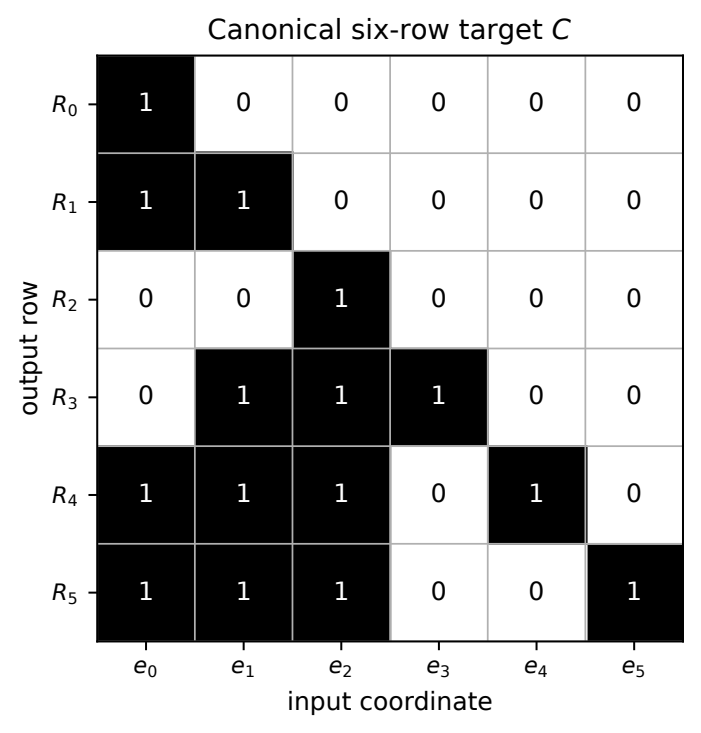
The target \(C\) of Equation (9.1) has rows
9.3.1 A six-gate ambient word
On this page · Permalink · Source line 1334
Proposition 9.17
For every nonzero commutative ring \(R\) with identity,
Proof
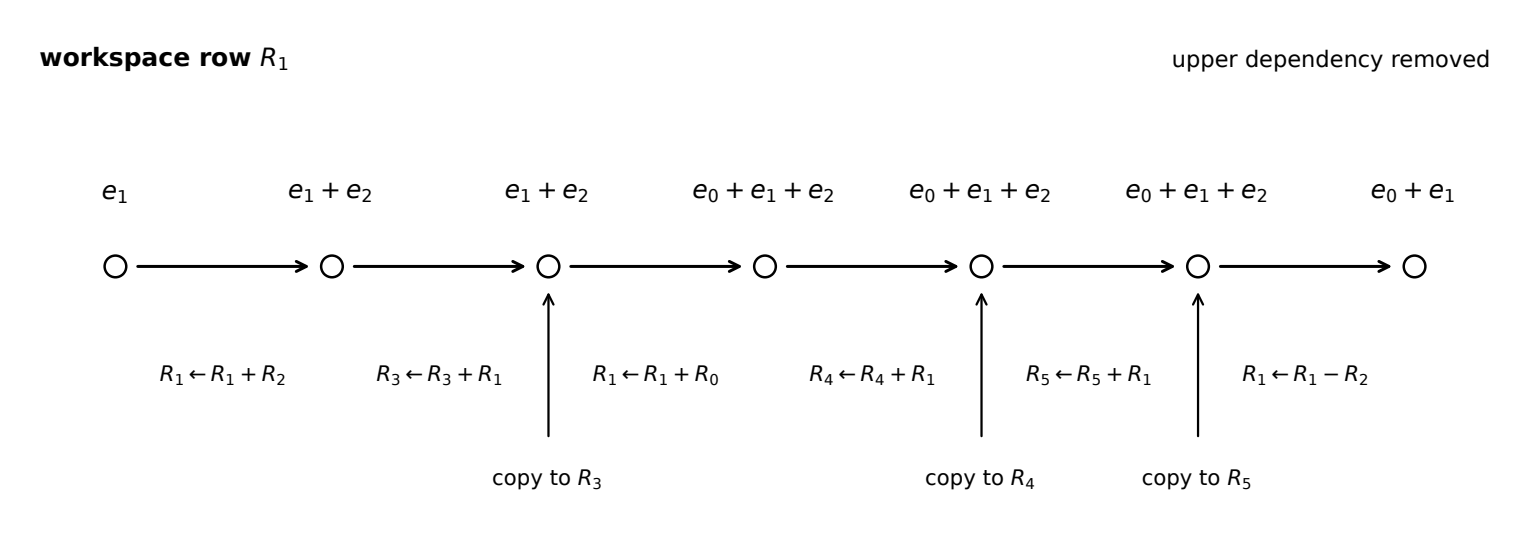
Apply the following six gates:
After Equation (9.2), row \(1\) contains \(v\). Gate Equation (9.3) copies \(v\) to row \(3\). Gate Equation (9.4) changes the carrier to \(w\), which is copied to rows \(4\) and \(5\) by Equation (9.5) and Equation (9.6). Gate Equation (9.7) removes the temporary \(e_2\) component, leaving \(e_1+e_0\). Every row now agrees with \(C\).
9.3.2 A seven-gate lower word
On this page · Permalink · Source line 1363
Proposition 9.18
For every nonzero commutative ring \(R\) with identity,
Proof
The lower-directed word
produces \(C\). After the first two gates, row \(2\) contains \(w\). Rows \(4\) and \(5\) copy that state. The two gates on row \(3\) cancel the unwanted \(e_0\) and leave \(v\). The final gate restores row \(2\).
9.3.3 Restricted lower bound
On this page · Permalink · Source line 1386
Proposition 9.19
For every nonzero commutative ring \(R\) with identity,
Proof
Rows \(1,3,4,5\) differ from their initial values, so they must each be targeted. Assume for contradiction that a lower-directed word of length at most six produces \(C\).
First suppose row \(2\) is never targeted. Row \(0\) remains \(e_0\), row \(2\) remains \(e_2\), and every state ever assumed by row \(1\) lies in \({\operatorname{span}}(e_0,e_1)\) because the only possible source below row \(1\) is row \(0\). Every output row retains coefficient \(1\) on its own pivot coordinate in a lower-directed circuit, so no output row can lie in \(W\). Hence no available source row is a unit multiple of either
By Lemma 9.16, each of rows \(3,4,5\) must be targeted at least twice. Together with the required targeting of row \(1\), this gives at least seven gates.
Now suppose row \(2\) is targeted. Since its final value is \(e_2\), Lemma 9.15 forces at least two targetings of row \(2\). A six-gate word must therefore target row \(2\) exactly twice and each of rows \(1,3,4,5\) exactly once. Each output row \(3,4,5\) must receive its complete addition in its unique targeting. Row \(0\) cannot supply \(v\) or \(w\), and row \(1\) never contains an \(e_2\) component. Therefore row \(2\) must supply all three outputs, up to unit scaling. But two targetings of row \(2\) expose at most one noninitial intermediate state before row \(2\) returns to \(e_2\), while the outputs require both distinct states \(v\) and \(w\). This is impossible.
9.3.4 Ambient lower bound
On this page · Permalink · Source line 1409
Proposition 9.20
For every nonzero commutative ring \(R\) with identity,
Proof
Assume that an ambient word of length at most five produces \(C\). Rows \(1,3,4,5\) must each be targeted. Rows \(0\) and \(2\) are unchanged. If either were targeted, it would require at least two targetings, giving at least six gates in total. Thus rows \(0\) and \(2\) are never targeted. If all four changed rows are targeted once, each has only its initial and final state. No such source is a unit multiple of \(v=e_1+e_2\) or \(w=e_0+e_1+e_2\), so the output rows cannot be completed. In the only remaining case, exactly one of rows \(1,3,4,5\) is targeted twice and the other three are targeted once.
Project the rows to the quotient module \(R^6/W\). Rows \(0,1,2\) have zero image, while rows \(3,4,5\) begin and end at the three distinct quotient basis vectors of the free quotient module. An output row targeted exactly once must therefore use a source lying in \(W\), by Lemma 9.16.
Suppose first that row \(1\) is the twice-targeted row. The three output rows are each targeted once. Rows \(0\) and \(2\) supply only scalar multiples of \(e_0\) and \(e_2\). Row \(1\) begins at \(e_1\), has one intermediate state, and ends at \(e_1+e_0\). Thus at most one of the two required unit-multiple classes of \(v\) and \(w\) can appear as an available source. The three outputs require both, a contradiction.
Suppose instead that an output row, say row \(r\in\{3,4,5\}\), is targeted twice. The other two outputs and row \(1\) are targeted once. We claim that row \(r\) cannot lie in \(W\) between its two targetings. To cancel its unique quotient pivot \(e_r\) at the first targeting, the source would already have to contain an \(e_r\) component. Before row \(r\) is first targeted, the only way another row can acquire such a component is to be targeted using row \(r\) as source. That other row is targeted only once and would then retain an unwanted \(e_r\) component in its final value. Therefore row \(r\) never becomes a \(W\)-valued carrier. The only \(W\)-valued source states are rows \(0\) and \(2\) and the two states of singly targeted row \(1\), namely its initial and final states. None supplies both \(v\) and \(w\). The two singly targeted outputs cannot be completed, again a contradiction.
Proof of Theorem 9.1
Combine Proposition 9.17, Proposition 9.18, Proposition 9.19, and Proposition 9.20.
Remark 9.21
The proof uses only unimodular rows, unit coordinates, and pivot support. It does not use division or a characteristic assumption. In characteristic two the closing subtraction equals addition.
Corollary 9.22: Failure of geodesic convexity
For every field \({\mathbb F}\) and every \(n\ge6\), the lower-unitriangular frame subgraph is not geodesically convex in the transvection Cayley graph of \({\operatorname{E}}_n({\mathbb F})={\operatorname{SL}}_n({\mathbb F})\).
Proof
Embed \(C\) as \(C\oplus I_{n-6}\). A six-gate ambient word acts on the first six rows. In a lower-directed circuit, rows with index at least six cannot be used as sources for targets among the first six rows, so the restricted lower bound of seven persists.
For the remainder of the paper, unless explicitly stated otherwise, the coefficient domain is a field \({\mathbb F}\).