
States, measurements, and open dynamics
On this page · Permalink · Source line 1587
5.1 Density operators: populations and coherences
On this page · Permalink · Source line 1588
5.1.1 Two packet indices
On this page · Permalink · Source line 1593
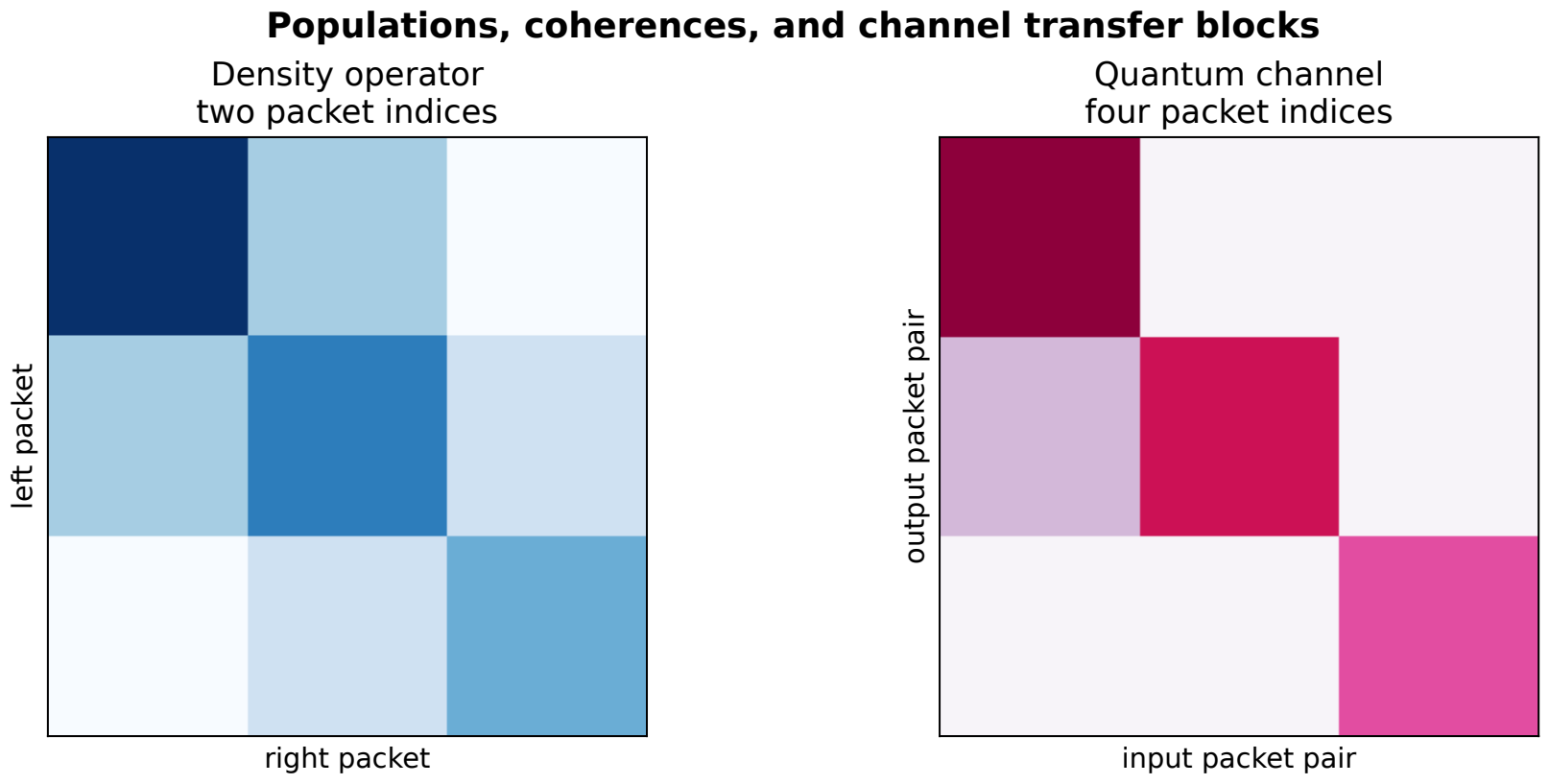
A pure state uses one packet label. A density operator uses two:
The diagonal block \(P_\alpha\rho P_\alpha\) is population inside packet \(\alpha\). The off-diagonal block \(P_\alpha\rho P_\beta\) is coherence between packets \(\alpha\) and \(\beta\).
Discarding off-diagonal blocks is not merely a change of coordinates. It is a physical operation such as dephasing. An exact simulator must preserve all coherence blocks relevant to the final observable.
5.1.2 Hilbert–Schmidt decomposition
On this page · Permalink · Source line 1605
Orthogonality of the left-right operator packets gives
This identity supplies an exact coherence-energy ledger. It can be used to decide which blocks are large, to audit dephasing, or to bound truncation errors in approximate packet simulations.
5.1.3 Symmetry-preserving unitary dynamics
On this page · Permalink · Source line 1615
If \(U\) commutes with every packet projector, then
The left and right packet labels are preserved. Populations and coherences evolve independently by their declared labels.
5.1.4 Observable sparsity
On this page · Permalink · Source line 1624
For an observable \(M\),
Only operator packets coupled by \(M\) contribute. A measurement that is diagonal in the symmetry labels depends only on populations. A phase-sensitive measurement can require off-diagonal coherences.
5.1.5 Polynomial operator-space collapse
On this page · Permalink · Source line 1640
If only polynomially many density blocks are reachable and every block has a polynomial representation, then mixed-state evolution can also be simulated in polynomial time. The representation size is not the square of the full Hilbert dimension. It is the total cost of the active left-right blocks.
Derived theorem or corollary
For a polynomial active set \(A_n\) of packet labels, a density-matrix simulator has at most \(|A_n|^2\) label pairs. Polynomial-time simulation follows when each active coherence block has a polynomial classical representation and channel updates remain sparse and efficient.