Quantum and CircuitsReading edition

A real three-dimensional view of one amplitude

Reading tools
Reading libraryFind statementsInspect Lean
Switch work

Saved reading

Read side by side

Start reading

Resources & source

Original TeX with line links · Download TeX

The wording and mathematics follow the retained manuscript. This reading format does not add a proof review or extend Lean coverage.

Skip contents and start reading

A real three-dimensional view of one amplitude

The plot follows an actual complex amplitude as the relative phase advances. At sample \(n=6\), the phase-family amplitude is

\[ \chi_\theta(6)=\frac{e^{i\theta}}{\sqrt3}. \]
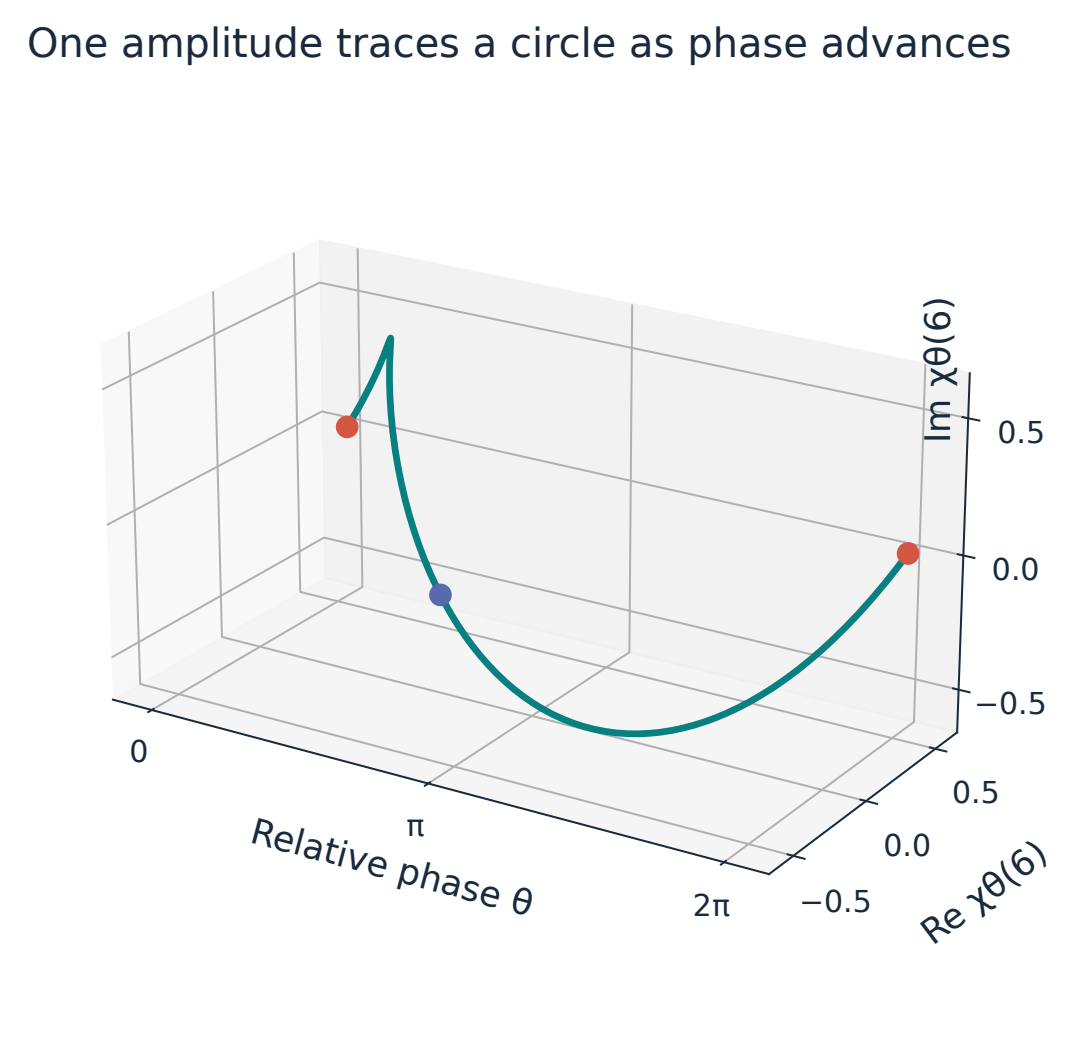
Coordinates are ( theta , operatorname Re chi theta (6), operatorname Im chi theta (6)). In the real-imaginary plane the amplitude traces a radius-1/ sqrt 3 circle. Advancing the phase coordinate produces the three-dimensional trajectory.
Coordinates are \((\theta,\operatorname{Re}\chi_\theta(6),\operatorname{Im}\chi_\theta(6))\). In the real-imaginary plane the amplitude traces a radius-\(1/\sqrt3\) circle. Advancing the phase coordinate produces the three-dimensional trajectory.

View full-size figure (new tab)

Its magnitude is constant, so the sample-six probability stays \(1/3\) throughout. Nevertheless, interference changes the probability of the selected subspace according to the preceding page. The geometry separates phase change from magnitude change.

Source and conversion record

Source SHA-256: 503ea76e373dccd7b89832d850c0849d8c457e16f0edcaf7b8e28ea38fc6f6a3

Unsupported prose commands stop the build. The mathematical expression sequence is checked against the source, with manuscript macros expanded for display.

Conversion records

Notation in Quantum and Circuits

Look up a symbol without leaving this chapter. Select text before opening help to search for it.

Search this work’s notation.

    Symbols can have different meanings in different passages. Read each result in its own context.

    Open the full notation index