
4.3 Coarse packets and the honest limitation
On this page · Permalink · Source line 854
4.3.1 Parity
On this page · Permalink · Source line 857
The even- and odd-parity packets each have dimension
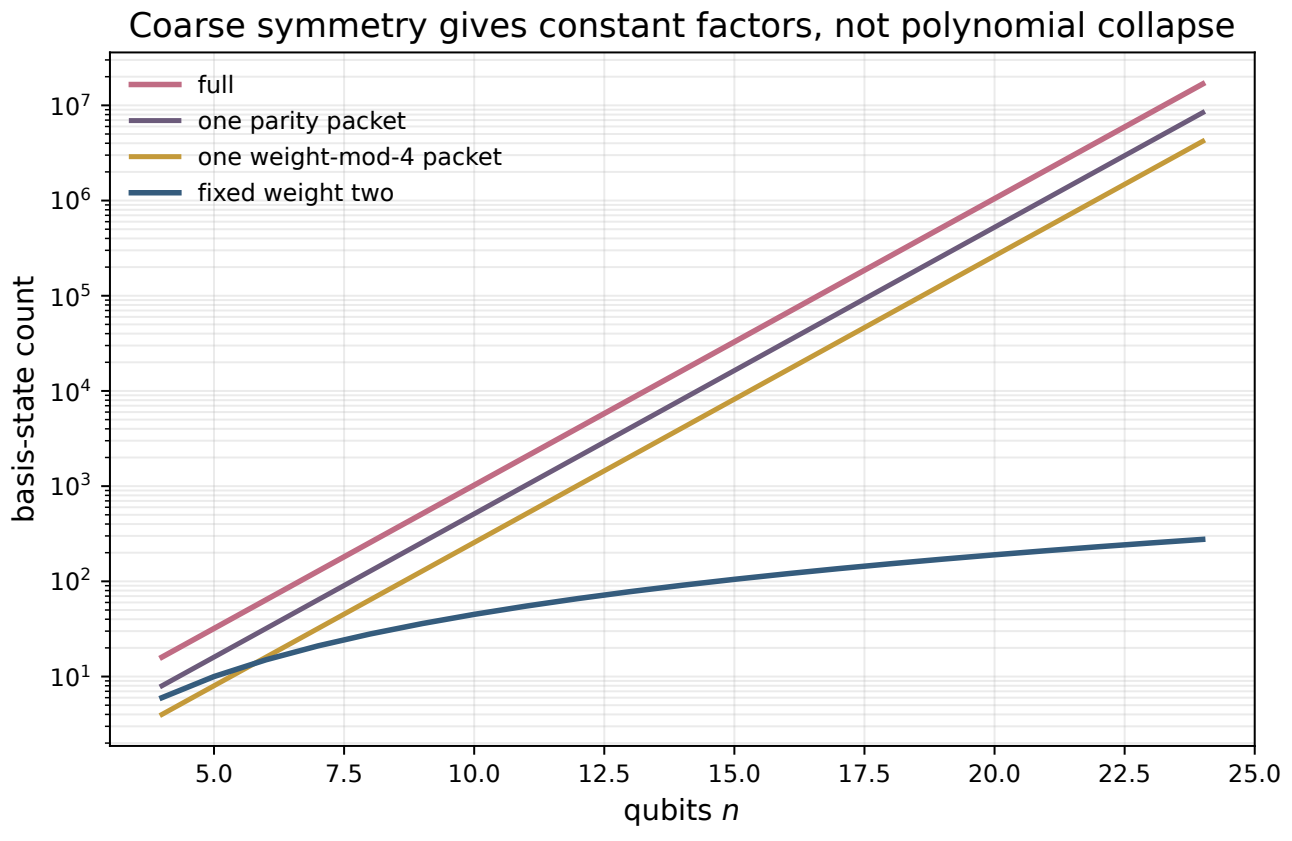
Parity removes half the state vector. This can produce a useful constant factor, but it does not change exponential scaling.
A pair-creation rotation mixes \({\lvert 00\rangle}\) and \({\lvert 11\rangle}\) and therefore changes excitation number by two while preserving parity. The packet is exact for a parity-preserving circuit, but its internal dimension remains exponential.
4.3.2 Weight modulo four
On this page · Permalink · Source line 866
A four-qubit rotation between \({\lvert 0000\rangle}\) and \({\lvert 1111\rangle}\) changes excitation number by four. It can mix exact-weight sectors while preserving weight modulo four. A single residue packet contains asymptotically one quarter of all basis states. Again, the reduction is a constant factor.
4.3.3 Half filling
On this page · Permalink · Source line 869
At half filling,
The packet is smaller by a polynomial factor, but it remains exponential. At \(n=20\), the half-filled packet contains \(184{,}756\) amplitudes. The archived repeated-application gain is approximately \(7.396\), while the one-shot gain is \(0.6529\), meaning the packet path was slower in that single-run test after compilation overhead.
Recorded computation
The half-filled benchmark demonstrates a necessary distinction: dimension reduction can be exact and useful without yielding polynomial complexity or a one-shot speedup.
4.3.4 Entanglement inside a packet
On this page · Permalink · Source line 888
A small number of symmetry labels does not imply low entanglement. The half-filled packet can support volume-law entanglement. Tensor-network bond dimension and packet dimension are independent resources. A robust simulator should therefore track both
where \(\chi_{\rm internal}\) measures the cost of representing the state inside the packet.
4.3.5 The no-label shortcut
On this page · Permalink · Source line 895
A stabilizer syndrome is only a label. A momentum quantum number is only a label. A total charge residue is only a label. The internal multiplicity space may still contain exponentially many degrees of freedom. The packet-simulation theorem becomes polynomial only when the complete active representation, not merely the label set, has polynomial classical cost.