
8.4 Matroidal state geometry, quiver factorizations, and root-system catalysis
On this page · Permalink · Source line 735
8.4.1 Intermediate states as a representable matroid
On this page · Permalink · Source line 743
A linear circuit visits vectors that satisfy exact dependence relations. If \(\mathcal V\) is the set of all row states appearing during a computation, then \(\mathcal V\) determines a representable matroid. A transvection
creates a three-point projective line
The ambient circuit chooses a tour through this projective configuration. A flag-preserving circuit must lift the same dependencies through prescribed pivot positions.
Definition 8.25: Flagged matroid tour
Let \(M\) be a representable matroid with designated initial basis, target basis, and consumer states. A flagged tour is a sequence of basis exchanges or transvections in which the \(i\)th carrier remains inside a specified filtration layer. An ambient tour drops this constraint.
The six-row atom realizes the graphic regular matroid \(M(K_4)\). Its ambient state tour is shorter than every compatible flag lift. Regularity explains why the same dependence pattern survives every field and, through integer matrices, every nonzero commutative coefficient ring in the stated model.
8.4.2 Matroidal classification problem
On this page · Permalink · Source line 759
The first general classification problem is:
Which regular matroids admit designated carrier and consumer roles for which an ambient tour is shorter than every flag-compatible tour?
Natural subclasses are graphic, cographic, and network matrices. Potential invariants include branch width, circuit size, excluded minors, and the number of consumer incidences supported by one projective line.
Conjectural frontier
Minimal field-universal catalytic atoms should be governed by regular matroids, while characteristic-dependent atoms should arise from representable matroids with excluded-characteristic minors.
This conjecture is a programmatic guide. The core paper establishes only the \(M(K_4)\) instance.
8.4.3 Dynamic rank-one factorization
On this page · Permalink · Source line 771
Consider a height-two block shear
A restricted circuit may change source and output bases while transmitting rank-one terms. Let \(P_r\in U_s\) be the source basis before the \(r\)th transmission and let \(Q_{>r}\in U_t\) be the future output basis. A cross gate contributes
to the final block. Hence
with closed basis paths
Definition 8.26: Dynamic rank-one cost
The dynamic rank-one cost of \(C\) is the minimum of
over such timed decompositions.
Ordinary rank retains only the number of transmissions after arbitrary bases are given for free. Circuit complexity charges the closed paths needed to expose and restore those bases.
8.4.4 Quiver gate models
On this page · Permalink · Source line 810
Let \(Q=(Q_0,Q_1)\) be a quiver. Associate a vector space \(V_v\) to every vertex. Internal gates change bases inside \(V_v\), while edge gates transmit low-rank maps along arrows. A target is a representation of the path algebra or an automorphism of a filtered quiver module.
This generalization includes:
block-triangular linear circuits,
network coding with reversible local state,
layered dataflow architectures,
incidence-algebra transformations,
tensor networks with reusable bond states.
A catalytic excursion can temporarily activate a forbidden arrow or enlarge a vertex space. The restored target still lies in the original quiver representation class.
Research template
A quiver threshold theorem should specify a forbidden-arrow motif, an exact ambient word, a projection-based restricted lower bound, and an amplification operation under quiver substitution. The unitriangular snapshot family is the linearly ordered one-dimensional-vertex case.
8.4.5 Pattern groups and architecture constraints
On this page · Permalink · Source line 828
For a poset \(P\), define the pattern group
When the allowed positions are transitively closed, \(U_P\) is a group. Compare the intrinsic metric generated by \(P\)-allowed transvections with the metric induced by all transvections.
The first threshold now depends on the forbidden-edge geometry of \(P\). One may ask whether a six-role catalytic motif embeds as a generator-preserving retract. If it does, the larger architecture inherits a defect.
Proposition 8.27: Retraction inheritance
Suppose a smaller nested pair \(H\le G\) embeds into \(H'\le G'\) by homomorphisms preserving the inclusion, the ambient embedding does not increase gate cost, and there is a homomorphic retraction \(\pi:H'\to H\) onto the embedded copy. Require \(\ell_H(\pi(s))\le c(s)\) for every restricted generator \(s\) of \(H'\). Then every defect in \(H\le G\) gives a defect at least as large in \(H'\le G'\).
The proof projects a restricted word in the larger system and embeds the shorter ambient word from the smaller system.
8.4.6 Root subgroups and Chevalley relations
On this page · Permalink · Source line 844
Let \(G\) be a split reductive group [24], [31] with root system \(\Phi\). Let \(\Psi\subseteq\Phi\) be a closed set of allowed roots and let \(U_\Psi\) be generated by the root groups \(x_\beta(t)\) for \(\beta\in\Psi\). Define
and let \(\ell_\Phi\) permit all roots.
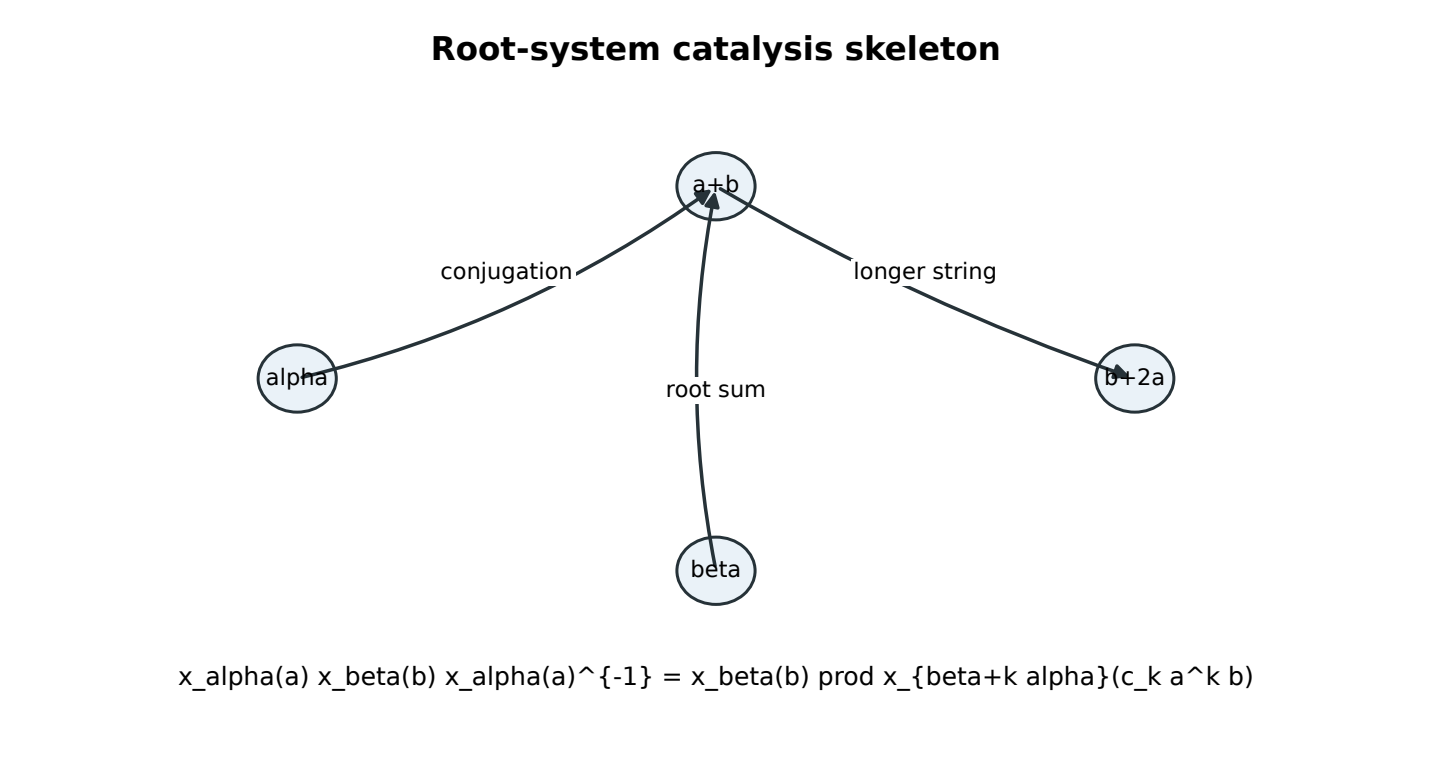
The Chevalley conjugation formula has the schematic form
A forbidden root \(\alpha\) can therefore create several allowed root effects before being removed.
8.4.7 Type \(A\) and beyond
On this page · Permalink · Source line 869
Row transvections are root-group elements of type \(A\). The established unitriangular atom occurs in \(A_5\). In nonsimply laced systems, root strings can have length greater than two. This raises the possibility that one ambient root can create multiple restricted effects per consumer.
Conjecture 8.28: Long-root catalytic gain
There exist gate alphabets in types \(B\), \(C\), or \(G_2\) for which a clean one-catalyst multiplicative distortion exceeds the type-\(A\) snapshot limit of \(3/2\).
No lower-bound certificate is presently supplied. The conjecture identifies a concrete reason to test nonsimply laced root systems rather than merely repeating type \(A\) computations.
8.4.8 Symplectic root systems and Clifford logic
On this page · Permalink · Source line 877
The binary Clifford group modulo phases acts through \({\operatorname{Sp}}(2n,2)\). A parabolic subgroup stabilizing a Lagrangian is the symplectic analogue of a Borel or flag-preserving circuit class. Hadamard gates leave this parabolic, while \(S\), \({\operatorname{CZ}}\), and \({\operatorname{CX}}\) preserve it. The exact Clifford censuses in Section 10.2 are therefore a first root-system extension of the linear theory.
8.4.9 Categorical realization defects
On this page · Permalink · Source line 880
The group framework does not cover measurement, feedforward, postselection, or entangled design objects. Let
be monoidal categories with costed generators. A target morphism can have a finite metric defect or an infinite existence defect.
The categorical viewpoint supports:
unitary versus measurement-assisted circuits,
product-state versus entangled realizations,
clean versus borrowed ancilla categories,
symmetry-preserving versus symmetry-breaking channels,
exact versus approximate completion.
The common invariant is still the cost of a restored target. What changes is the geometry of the path and the meaning of holonomy.
8.4.10 A general research dichotomy
On this page · Permalink · Source line 899
The broad program separates into two tasks.
Construction: exhibit an ambient excursion whose repeated consumers produce a cheaper target.
Certification: prove that the restricted category cannot share the same obligations as efficiently.
Conjugation identities often solve the first task. The second is the difficult part and requires model-specific invariants such as interval-tree rank, symplectic flag length, algebraic degree, phase-polynomial rank, covariance constraints, or branch complexity.