
4.2 The exact weight-two benchmark
On this page · Permalink · Source line 788
4.2.1 Purpose and status
On this page · Permalink · Source line 792
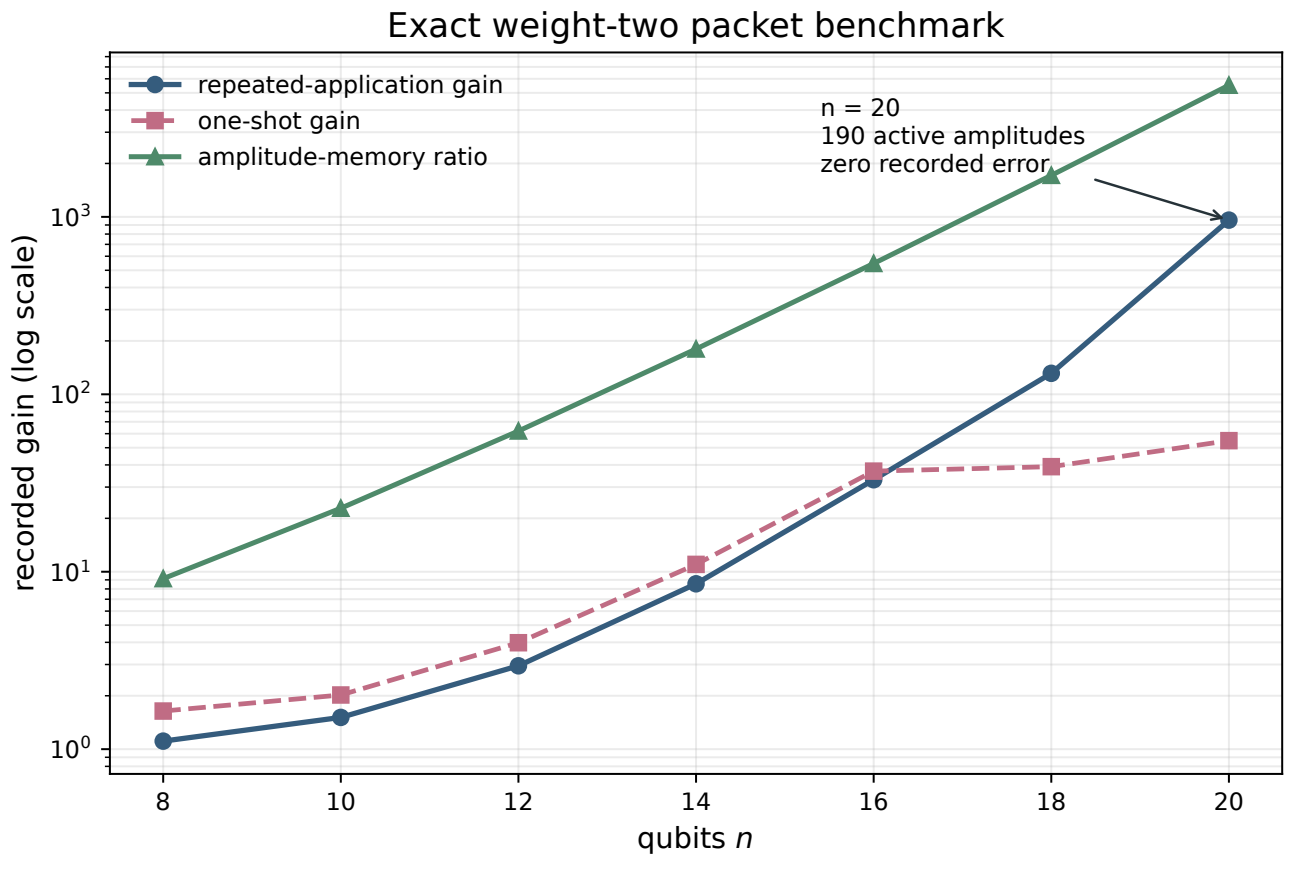
The benchmark record compares a full state-vector simulator with a simulator restricted to the exact weight-two packet. Both use the same local gate arithmetic. The benchmark is not a hardware claim and not a universal performance model. It shows that the exact dimension reduction can translate into large memory and repeated-application gains in an ordinary implementation.
Recorded computation
At \(n=20\), the full state has \(1{,}048{,}576\) amplitudes and the exact weight-two packet has \(190\). The archived repeated-application gain is \(958.8\), the one-shot gain is \(54.8\), and the amplitude-memory ratio is \(5518.8\). The recorded relative reconstruction error is zero at the displayed precision.
4.2.2 Recorded table
On this page · Permalink · Source line 799
| \(n\) | full dim. | packet dim. | apply gain | one-shot gain | memory gain | rel. error |
|---|---|---|---|---|---|---|
| 8 | 256 | 28 | 1.11 | 1.64 | 9.14 | 0 |
| 10 | 1,024 | 45 | 1.51 | 2.02 | 22.8 | 0 |
| 12 | 4,096 | 66 | 2.95 | 3.98 | 62.1 | 0 |
| 14 | 16,384 | 91 | 8.55 | 11.0 | 180.0 | 0 |
| 16 | 65,536 | 120 | 33.0 | 36.9 | 546.1 | 0 |
| 18 | 262,144 | 153 | 131.3 | 39.1 | 1,713.4 | 0 |
| 20 | 1,048,576 | 190 | 958.8 | 54.8 | 5,518.8 | 0 |
4.2.3 What is machine independent
On this page · Permalink · Source line 820
The dimension identity
is independent of implementation. It predicts an exponential memory advantage for fixed \(k=2\). The measured runtime ratio need not equal the dimension ratio. Packet indexing, compilation, sparse update kernels, allocation, and cache behavior determine the constant factors.
4.2.4 Repeated application versus one shot
On this page · Permalink · Source line 827
Let \(C_{\rm compile}\) be the cost of constructing the packet basis and restricted gate plans, and let \(C_{\rm apply}\) be one packet application. Reusing the compiled plan \(R\) times costs
If the full path costs \(RC_{\rm full}\), the packet method breaks even when
This is why time evolution, parameter sweeps, variational loops, and repeated likelihood evaluations are natural applications.
4.2.5 Independent reconstruction check
On this page · Permalink · Source line 848
The release code generates a random packet state, embeds it in the full Hilbert space, applies the same \(R_Z\) and exchange gates through both arithmetic paths, and compares the final states. The representative checks at \((n,k)=(6,1),(8,2),(10,2)\) produce errors near machine precision.
Scope.
On this page · Permalink · Source line 851
The recorded benchmark supports exactness and implementation value for a symmetry-preserving subclass. It does not show that generic quantum circuits admit comparable reductions.