
10.5 Gaussian, matchgate, and fermionic catalytic models
On this page · Permalink · Source line 4082
10.5.1 Two Gaussian settings
On this page · Permalink · Source line 4090
Quantum Gaussianity occurs [45] in two closely related but algebraically different settings.
For \(n\) bosonic modes, a Gaussian unitary acts on quadratures
by an affine symplectic transformation
For \(n\) fermionic modes, a fermionic Gaussian unitary acts on \(2n\) Majorana operators by
Nearest-neighbor matchgates give a circuit presentation of a fermionic Gaussian subgroup on qubits.
In both cases one can choose a restricted subgroup preserving a flag, mode ordering, particle number, or bipartition, and compare it with a larger Gaussian or non-Gaussian gate set.
10.5.2 An inherited symplectic shear theorem
On this page · Permalink · Source line 4112
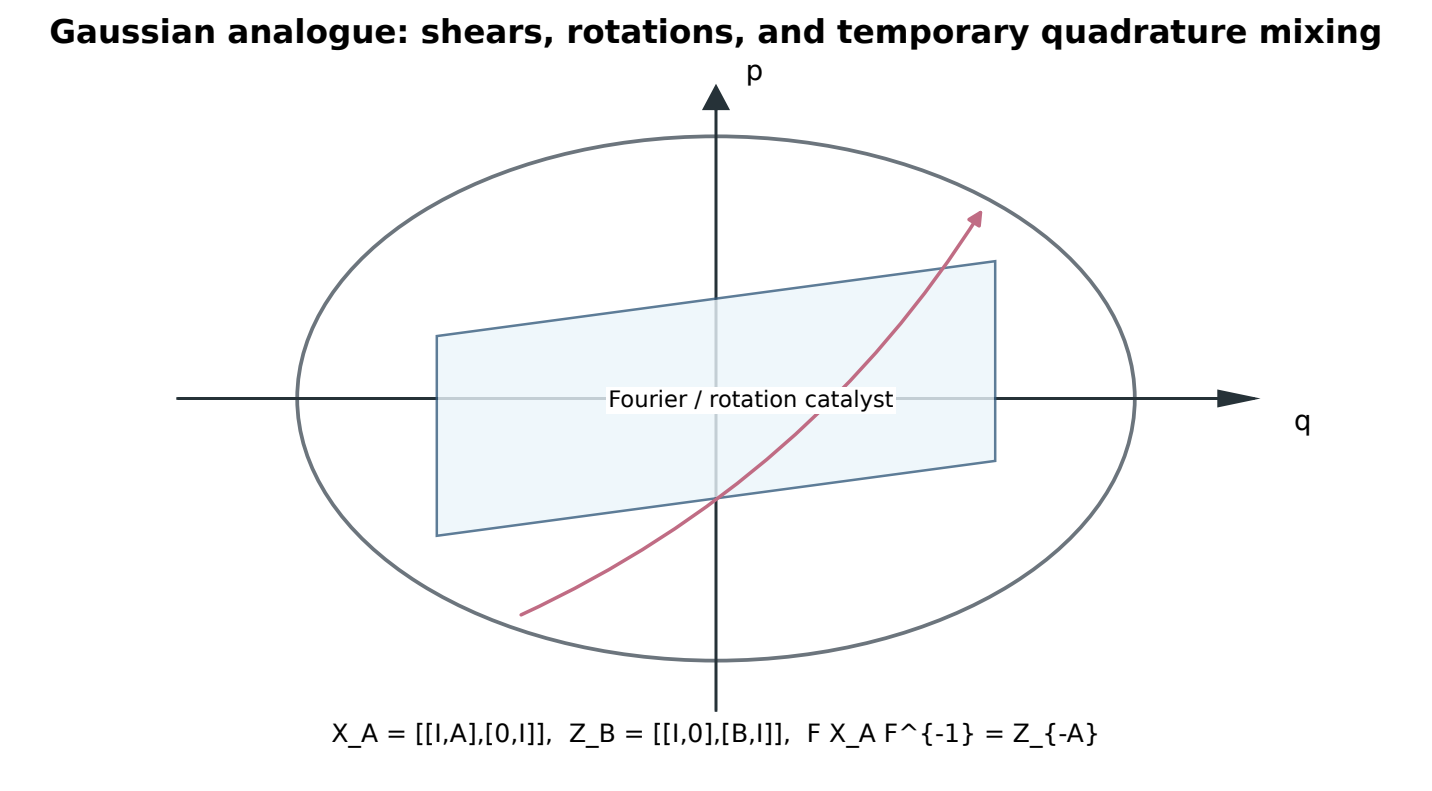
Every invertible linear transformation \(A\in{\operatorname{GL}}(n,R)\) has a canonical symplectic embedding
Indeed, with
one checks
Thus every row-transvection identity in the established linear theory induces an exact identity between symplectic shear circuits.
Proved statement
Under a Gaussian gate alphabet in which each embedded elementary transvection \(\iota(I+aE_{ij})\) is one primitive and direction is the only restriction, the universal six-row catalytic atom embeds into a twelve-quadrature Gaussian atom with restricted length seven and ambient length six.
This is a formal inheritance statement for the declared shear alphabet. It does not assert optimality after arbitrary beam splitters, squeezers, Fourier transforms, or local Gaussian gates are admitted at unit cost.
10.5.3 Bosonic gate hierarchies
On this page · Permalink · Source line 4145
Natural nested models include
Typical primitive resources are:
SUM or controlled displacement gates,
beam splitters,
single-mode and two-mode squeezers,
Fourier transforms,
cubic phase gates,
photon counting or non-Gaussian state injection.
Each inclusion supports a different defect. A target Gaussian transformation might be shortened by leaving a triangular decomposition but remaining Gaussian. A more radical question asks whether temporary non-Gaussianity can shorten a final Gaussian target.
10.5.4 Bloch–Messiah versus catalytic synthesis
On this page · Permalink · Source line 4167
A bosonic Gaussian unitary admits a Bloch–Messiah decomposition
where \(K_1,K_2\) are passive symplectic transformations and \(D\) is a diagonal squeezing layer. This normal form optimizes conceptual structure, not necessarily a weighted gate count on a specific architecture.
Catalytic synthesis asks whether a short excursion into a basis where many shear or squeezing obligations align can reduce total cost. The opening and closing passive layers play the role of the catalyst.
Research template
A Gaussian catalytic theorem requires:
a declared primitive library and cost vector;
a target subgroup, such as triangular, number conserving, or local;
an explicit sandwich \(KHK^{-1}\) returning to the target subgroup;
a lower bound based on symplectic rank, singular values, graph cuts, or mode support;
treatment of approximation error when continuous parameters are synthesized numerically.
10.5.5 Fermionic Gaussian and matchgate circuits
On this page · Permalink · Source line 4187
Let \(c_j,c_j^\dagger\) be fermionic creation and annihilation operators. Quadratic Hamiltonians generate Gaussian unitaries, and their action is determined by an orthogonal transformation on Majoranas. Number-conserving Gaussian operations correspond to a unitary action on modes, while general Gaussian operations allow particle-hole mixing.
This yields the hierarchy
A temporary Bogoliubov transformation can violate number conservation while preserving parity. The target may nevertheless return to the number-conserving subgroup.
Definition 10.13: Bogoliubov catalytic defect
For a number-conserving Gaussian target \(U\), compare the minimum cost using number-conserving primitives with the minimum cost using general Gaussian primitives, requiring the endpoint to conserve number exactly.
10.5.6 Matchgates and geometry
On this page · Permalink · Source line 4204
Nearest-neighbor matchgate circuits [16], [10] have strong classical simulation properties. Their geometry changes when SWAP, fermionic SWAP, long-range connectivity, or a single non-matchgate resource is added. Candidate restricted/ambient pairs include:
nearest-neighbor matchgates versus all-to-all matchgates;
number-conserving matchgates versus general matchgates;
matchgates versus parity-preserving two-qubit gates;
Gaussian circuits versus Gaussian circuits with one reusable non-Gaussian ancilla.
A compiler application is immediate: a temporary mode permutation or particle-hole rotation may allow a batch of otherwise expensive interactions to share one routing or basis-change layer.
10.5.7 Covariance-matrix lower bounds
On this page · Permalink · Source line 4215
For a Gaussian state, the covariance matrix \(\Gamma\) transforms as
in the bosonic case and
in the fermionic case. Possible restricted lower bounds include:
rank change of off-diagonal covariance blocks,
symplectic singular-value obligations,
growth of mode support,
graph bandwidth and cut rank,
number of nontrivial canonical angles between invariant subspaces.
One elementary gate changes only a controlled portion of these data. A useful invariant must also charge preparation of a carrier that makes progress on many cuts simultaneously.
10.5.8 Temporary non-Gaussianity
On this page · Permalink · Source line 4234
Suppose a non-Gaussian primitive \(g\) is introduced and later removed:
If \(g h_i g^{-1}\) generates several useful Gaussian effects, the excursion may be catalytic. However, many standard non-Gaussianity monotones vanish only on states rather than unitaries, and cancellation at the endpoint complicates direct lower bounds.
Candidate monotones and certificates include:
degree in the Weyl characteristic function,
Wigner negativity generated during the path,
operator Schmidt rank across mode cuts,
polynomial degree of Heisenberg-evolved quadratures,
stabilizer rank for encoded finite-dimensional subspaces.
10.5.9 Exact and numerical search
On this page · Permalink · Source line 4251
Finite exact enumeration is available for binary symplectic or orthogonal quotients, but continuous Gaussian groups require a different strategy.
Fix a symbolic gate skeleton and solve polynomial equations for parameters.
Use interval arithmetic to certify nonexistence below a length.
Exploit canonical decompositions to quotient local or passive layers.
For discrete-angle Gaussian libraries, use exact algebraic-number arithmetic.
Store both an upper-bound circuit and a dual or algebraic certificate.
10.5.10 Architecture and routing
On this page · Permalink · Source line 4261
On a line or grid, Gaussian and matchgate circuits may be dominated by routing. Let \(G_{\mathrm{conn}}\) be the hardware graph. A mode permutation \(\pi\) can be treated as a catalyst if it is opened, many interactions are executed in the reordered frame, and \(\pi^{-1}\) restores the logical labeling. The benefit is
This is the same amortization law as the linear snapshot family, now applied to mode geometry.
Conjectural frontier
There exist number-conserving or nearest-neighbor Gaussian targets whose minimum weighted cost is reduced by a restored Bogoliubov, mode-permutation, or non-Gaussian excursion. The first exact threshold depends on the primitive library and is not determined here.
10.5.11 Research deliverables
On this page · Permalink · Source line 4274
A complete Gaussian extension should produce:
a finite or semialgebraic model with exact endpoint equality;
at least one nontrivial lower-bound invariant;
a minimal catalytic atom;
a weighted hardware interpretation;
a tensor or repeated-mode amplification theorem;
code using exact arithmetic or certified intervals.